email Youtube

Home
Galleries
Blog
Workshops & Calendar
Store
Resources
About
Contact

Archive for the ‘Janome’ Category

Janome’s new Skyline S7 Sewing Machine

Monday, October 26th, 2015

Janome never ceases to amaze me with the quality of its machines.  The Janome Skyline S7 is a more modestly priced machine than what I have used for the past decade, but it has features straight from the top of the line 15000 (click on the link to open a new tab to Janome’s page with all the features).   If your budget or preferences don’t run to expensive machines, this machine may have all the versatility and dependability that you need with the right sticker price.  I am, quite bluntly, surprised and pleased at the wide array of features and outstanding performance of the S7.

Here’s the nice photo of the S7 from Janome’s site (NOTE:  photos are mostly clickable to view larger):
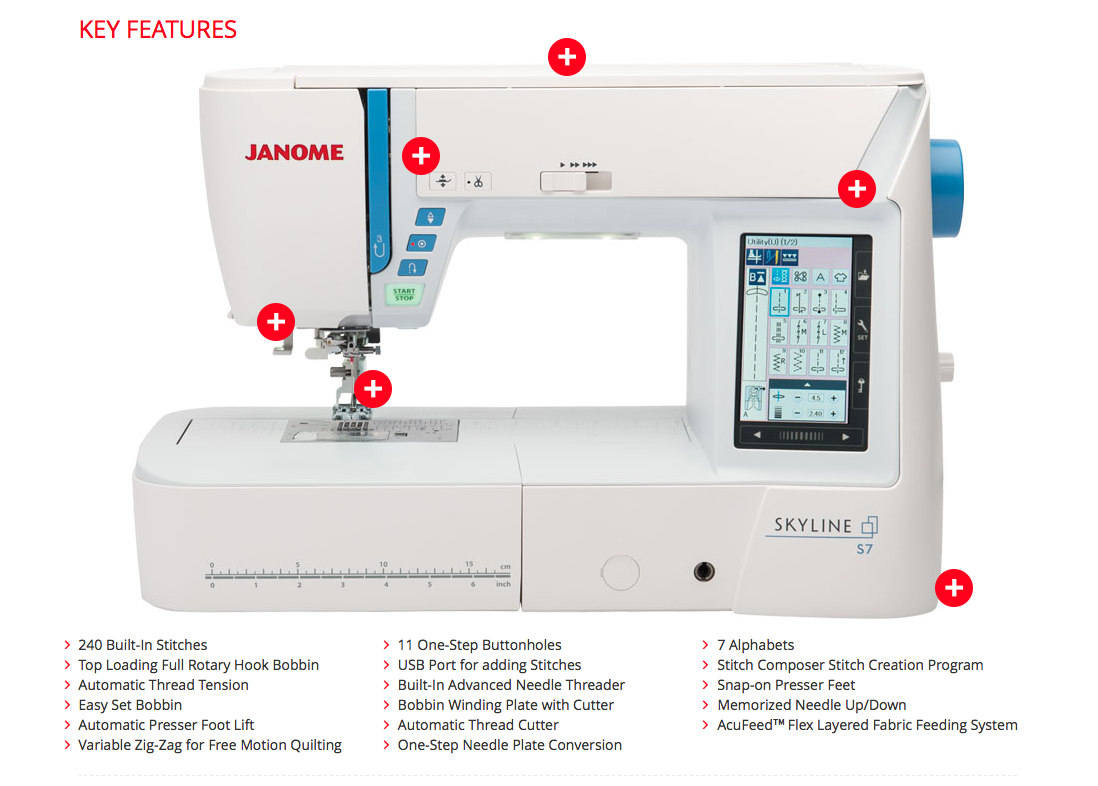
A screen capture from the Janome America website. To link to the site, go here.

A screen capture from the Janome America website. To link to the site, go S7 and scroll down.

Also from the Janome site, the included parts. Pretty much everything you need for routine sewing.

Also from the Janome site, the included parts. Pretty much everything you need for routine sewing.

And much less fancy shot of the S7 in my studio:
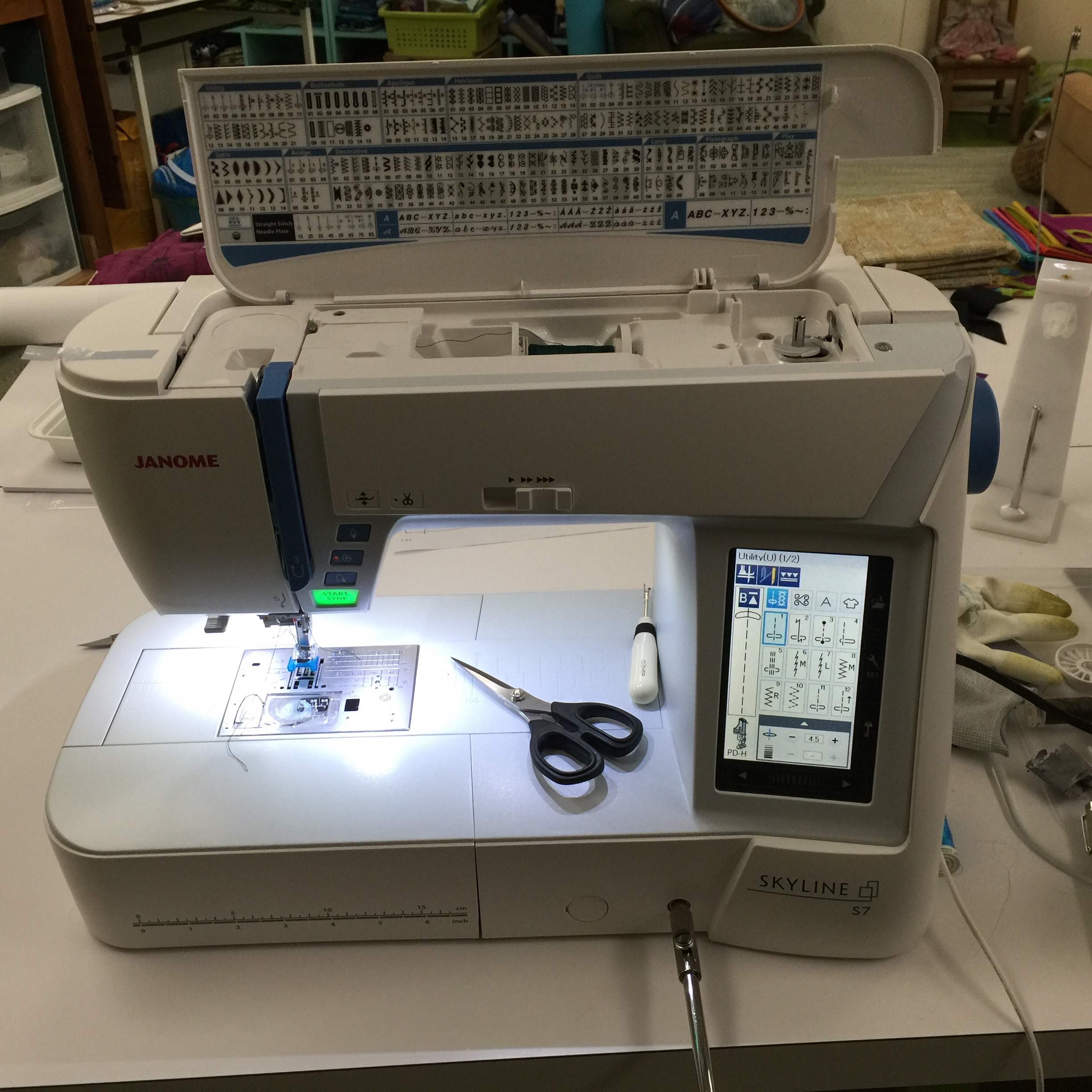
The Janome Skyline S7 in my studio.

The Janome Skyline S7 in my studio.  Notice the wonderful knee-lift in place!

I prepared a variety of projects to work on during my brief loan period for the Skyline S7, which Janome introduced/debuted at Janome Institute late this August and is now arriving at Janome dealers.   I had piecing for quilting, mending and repairs, sewing a new top, free-motion quilting, and decorative stitching.  The machine handled every task like a champ.  Here’s a teaser…keep reading to find out more about this block:
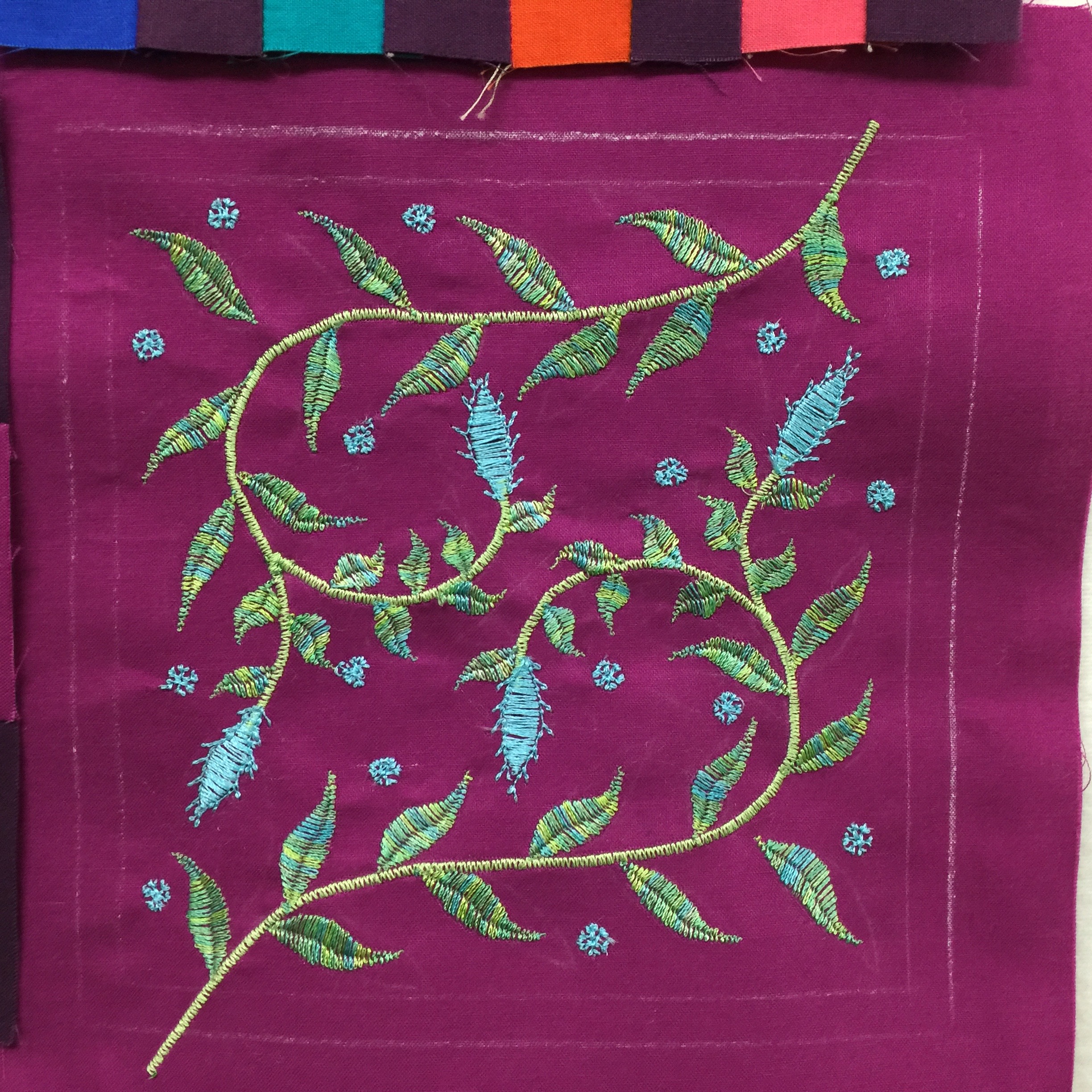
IMG_6042

For free instructions on how to use the built-in stitches to create this block, see below. This block will work with Janome’s ongoing 100 blocks in 50 days project; read more about the 100-Blocks Janome 100 Blocks.

Now…back to the regular review (I just wanted to tuck the pretty block up top!)
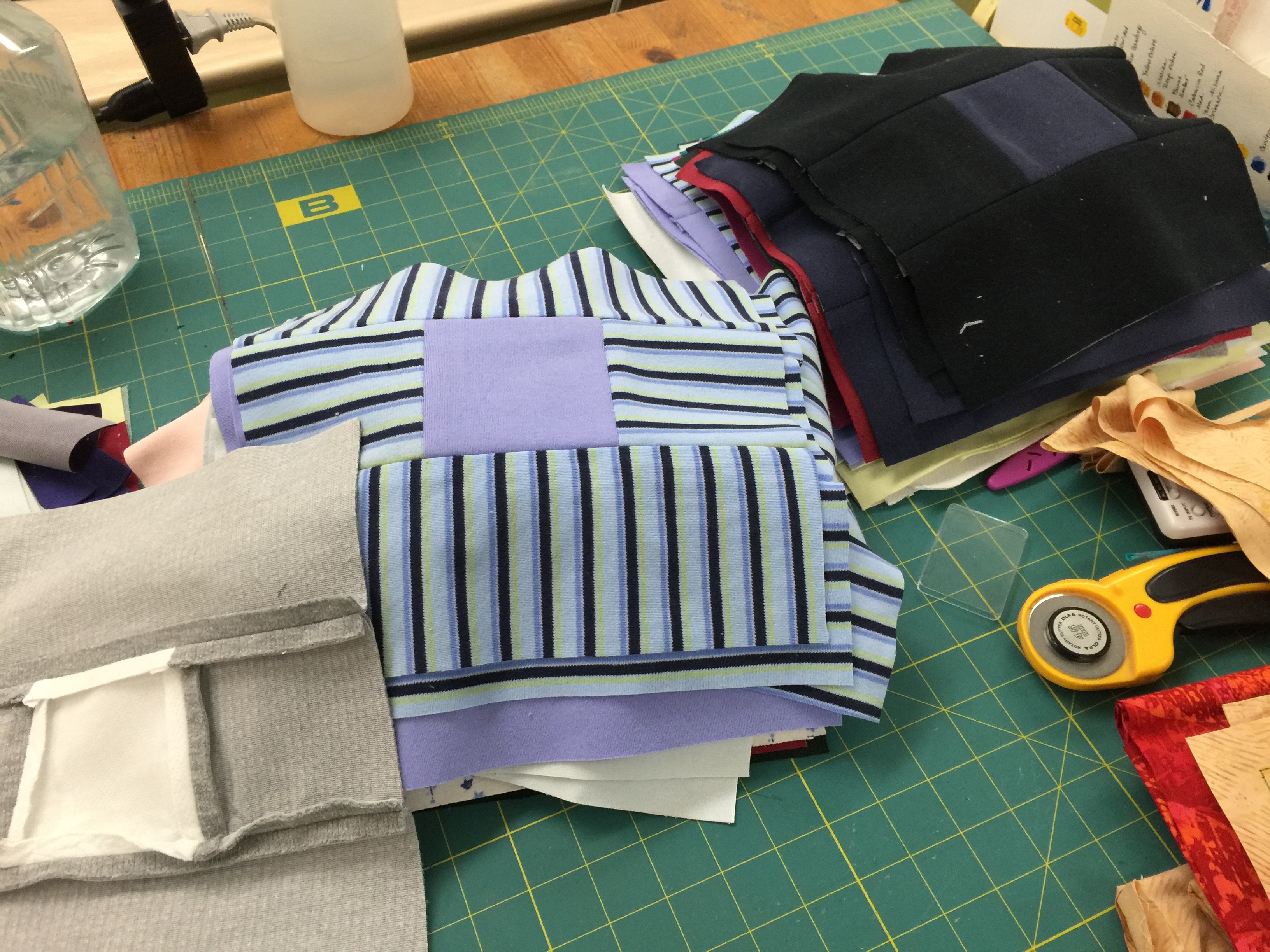
I've been piecing some blocks (who me?): made of turtleneck shirts. Eek! I had to stabilize all of them with interfacing (gray one in lower left corner). As expected, the machine breezed through without nary a burp.

I’ve been piecing some blocks (who me?): made of turtleneck shirts. Eek! I had to stabilize all of them with interfacing (gray one in lower left corner). As expected, the machine breezed through without nary a burp.  Because of the thickness of the fabric, I did find using a leader/ender so the stretchy fabric didn’t get pushed into the opening was a good thing.  Of course, I could have (and should have) used the straight stitch plate instead!

I had a tunic top cut out to make on this machine (see blogpost here or just scroll down two posts–and take a look at the review of the Janome15000 App while on your way).  I like a nice, clean finish.  So I used French seams (center vertical), overcast (using one of the utility stitches), and a bias edge as you can see in the next photo.
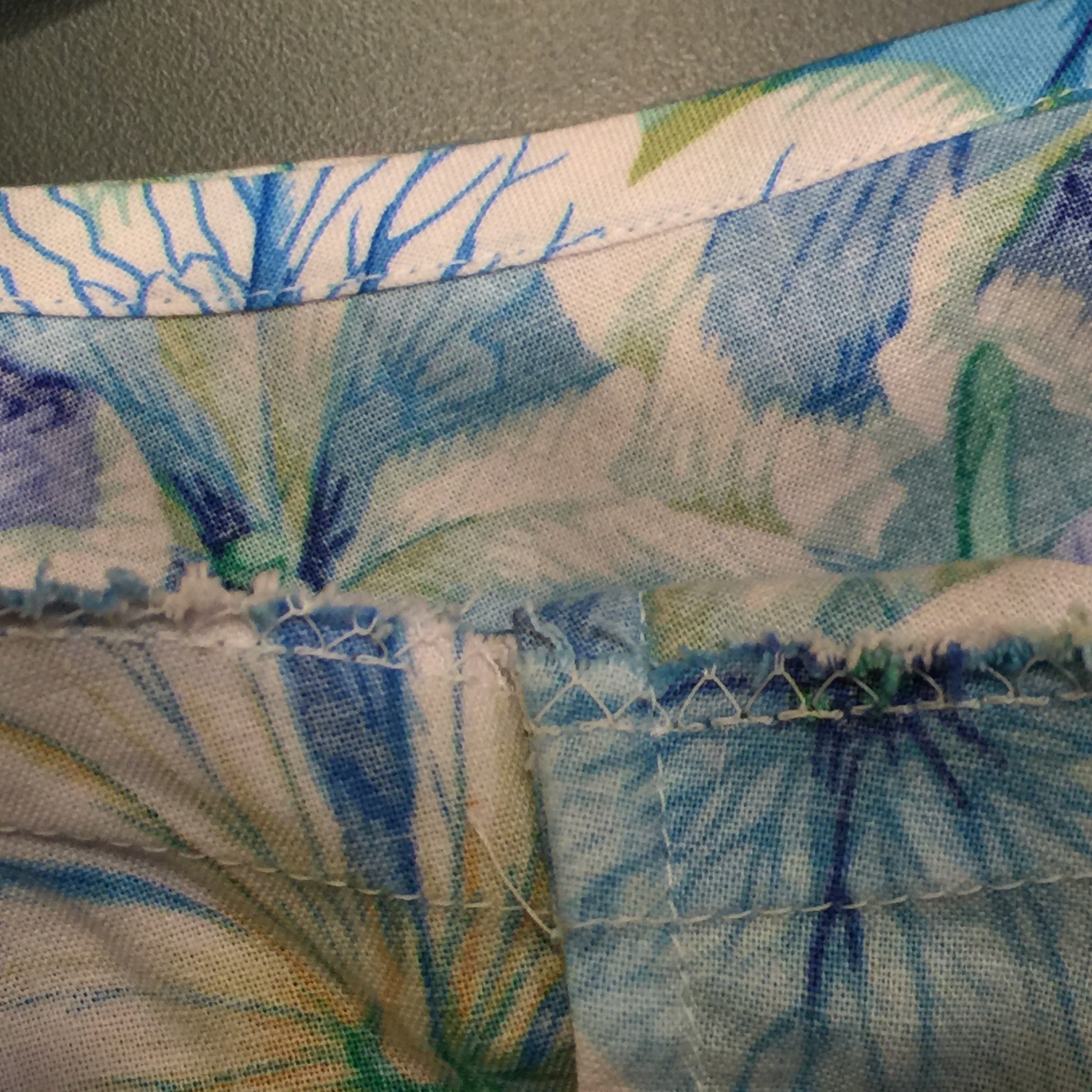
Seam finishes in my tunic: bias facing, on the top, overcast edge at the armscye (set in sleeve seam) and French seam (enclosed raw edges) on the side seam.

Seam finishes in my tunic: bias facing, on the top, overcast edge at the armscye (set in sleeve seam) and French seam (enclosed raw edges) on the side seam.

I did a quick free-motion quilting practice using the open toe foot skimming foot.  The default setting with my preferred threads, a 40-wt shiny poly in the needle and a 60-wt fine poly in the bobbin, wasn’t quite perfectly balanced for that thread combination, so I adjusted the balance by one notch and it looks excellent.  This is a common adjustment when using threads that are not identical.  Why do I use a thinner thread in the bobbin?  For art quilts, durability for wear and washing isn’t an issue.  And with the density of my stitching, the finer bobbin thread means less thread-build up, not as stiff, and more miles of thread to the bobbin!  ALWAYS test a potential new machine with the fabrics, batting and thread combinations that are your favorites–not whatever the sewing machine store has on hand!
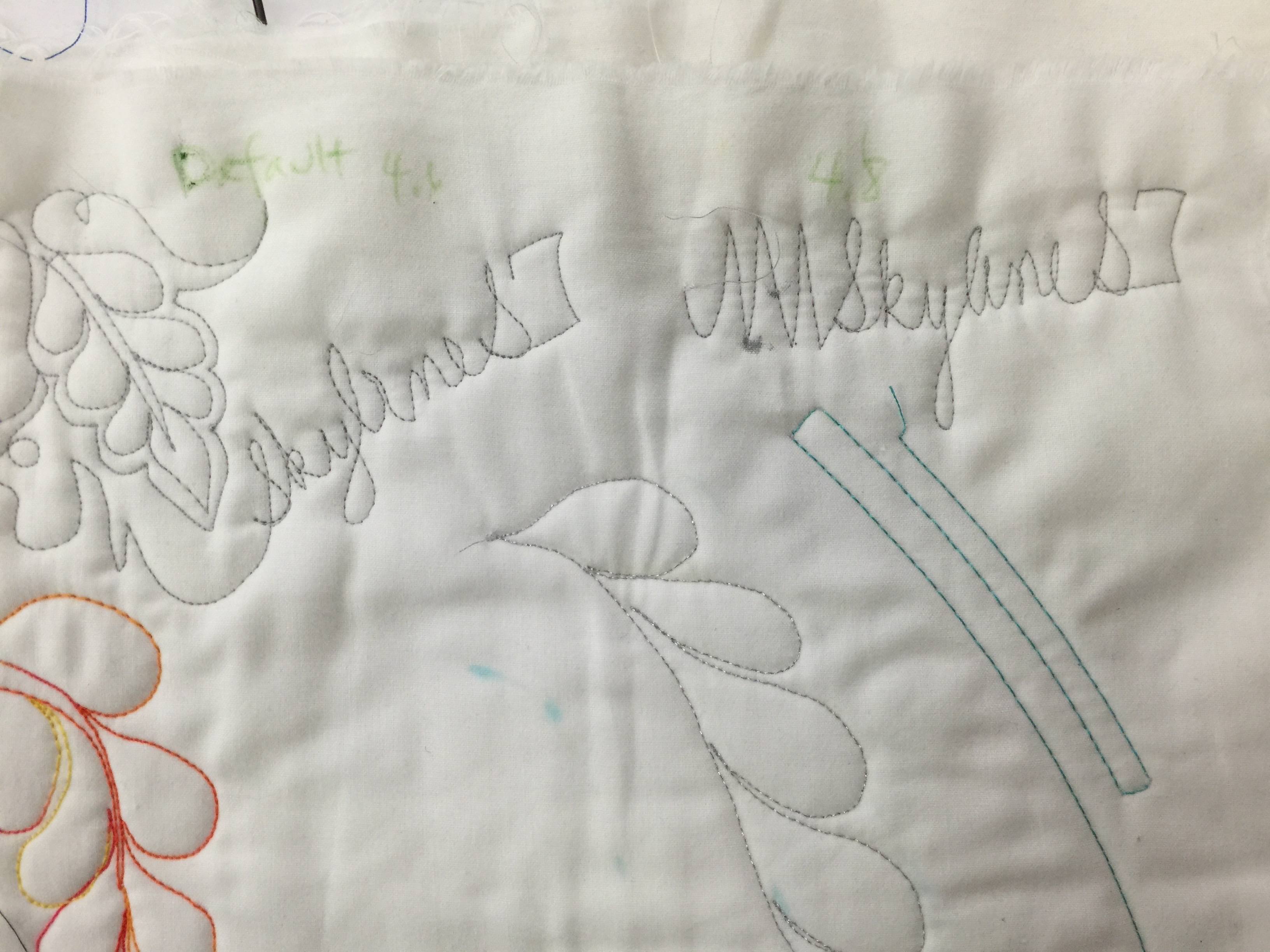
Test free-motion stitching on the S7.

Test free-motion stitching on the S7.  You can see my note that says “Default 4.6” and “4.8.”  After looking at the back having stitched the first feather and name, I decided I wanted to have the balance adjusted slightly.  I always test for stitch balance with two contrasting colors so I can see what is happening.
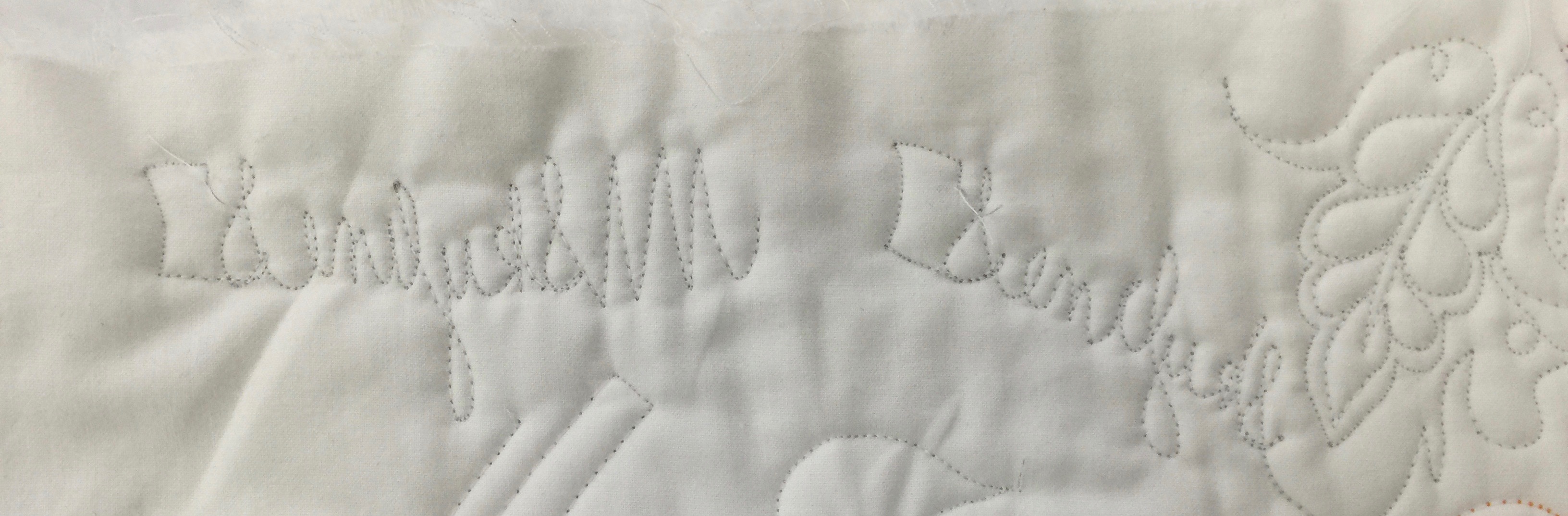
Reverse of FMQ.

Reverse of FMQ.  The stitching on the right is the default setting.  I was seeing a TINY bit too much of the needle thread on the back, so I loosened the top tension one notch.  The second stitch out, on the left in the photo above, is better.  The tiny bit of dark you see is the shadow inside the needle hole.  A bit of moisture/steam or just time will close up those needle holes.  (Click for larger view)

The drawbacks to the S7 were VERY few and minor:  the harp, the space between the needle and the housing on the right, is that of a standard sewing machine.  I’ve been sewing on the machines with a longer harp area for a decade now.   However, I have also quilted a king-sized quilt (carefully) on a machine with a smaller harp than this one.   If you want to quilt king-sized quilts at home you might want to consider a longer harp, otherwise, you’ll be fine with this machine.  Also, the machine does not come with an extension table included.  These are minor quibbles:  this is a great machine for someone doing garment and home dec work, and for someone who is newer to quilting and doesn’t want to spend the bigger bucks for the larger machine.

Note:  one commenter told me “a regular sewing machine has a harp area of 6″-7″ and the S7 has a harp area of 8.25″ That makes it even more of a real winner (I hope you correct this on your S7 evaluation.)”   OK, I don’t have a measuring tape or the time to check this out (plus the machine is back at Janome), but let’s just go with “the harp area is smaller rather than larger.”  You can still quilt on it!  <grin!>

Janome makes a “Quilting Kit” to go with it that includes an extension table and my most-favorite-in-the-world convertible free-motion quilting foot.   The Skyline quilting kit part number is (according my lovely Janome contact) 003863402005, and comes with an extension table, appliqué foot, clear view quilting foot, ditch quilting foot, open toe satin stitch foot and (drum roll please!) the convertible free motion quilting foot set that is my fave!

My final test was the decorative stitches.  I’ve been able to be a part of Janome’s 100 blocks in 50 days project (ongoing now, here).  I liked the Michael Miller Cotton Couture fabric SO MUCH (silky, soft, glorious) that I made extra blocks for myself, and designed this embroidered block to go with mine. Here is the PDF for my Janome Embroidered Block .  Basically, start with a 7 inch block and stabilizer suitable for the weight of your cloth; you want to cut large because stitching can shrink a block a bit.  Basically, cut it big and trim to exact size when done.  Use a satin stitch (a short length zigzag) to create two stems coming in from opposite corners of the block.  Use the Satin Stitch leaf (built in on the S7–similar stitches on other machines) and adjust the stitch length (doubled on some) following the instructions in the manual, width and stitch density (refer to the PDF) to stitch out the leaves using my block as a general guide for placement–you don’t have to be exact.   I outlined the leaves with an overcast stitch from the basic utility stitches menu.  Then use the snowflake stitch, reduced in size, to make the “dots” in the background.  When complete, trim to 6 1/2 inches to match your other “100 Blocks” project.

Notice that I chalk marked a 6 inch square and a 5 1/2 inch square inside it. I needed to know the edges of the finished block, and wanted to leave a bit of clearance around the design so none of the decorative stitching accidentally ended up in the seam allowance.
Notice that I chalk marked a 6 inch square and a 5 1/2 inch square inside it. I needed to know the edges of the finished block, and wanted to leave a bit of clearance around the design so none of the decorative stitching accidentally ended up in the seam allowance.
The Janome 15000 App by Jim and Diane Stutsman of Software Miracles

Saturday, October 24th, 2015

The phrases life-saver, worth it’s weight in gold, a value at twice the price are what first come to mind:   The Janome 15000 app is simply amazing.  I have delayed blogging and reviewing it because I wanted to view ALL the videos first.  I came to realize there is simply so much content packed into this App that it would take eons for me to go through all of the videos, and I should simply go ahead and say:  if you are lucky enough to have the Janome 15000, unless you are an expert like Jim and Diane Stutsman, BUY THIS App!!!!!


IMG_6044

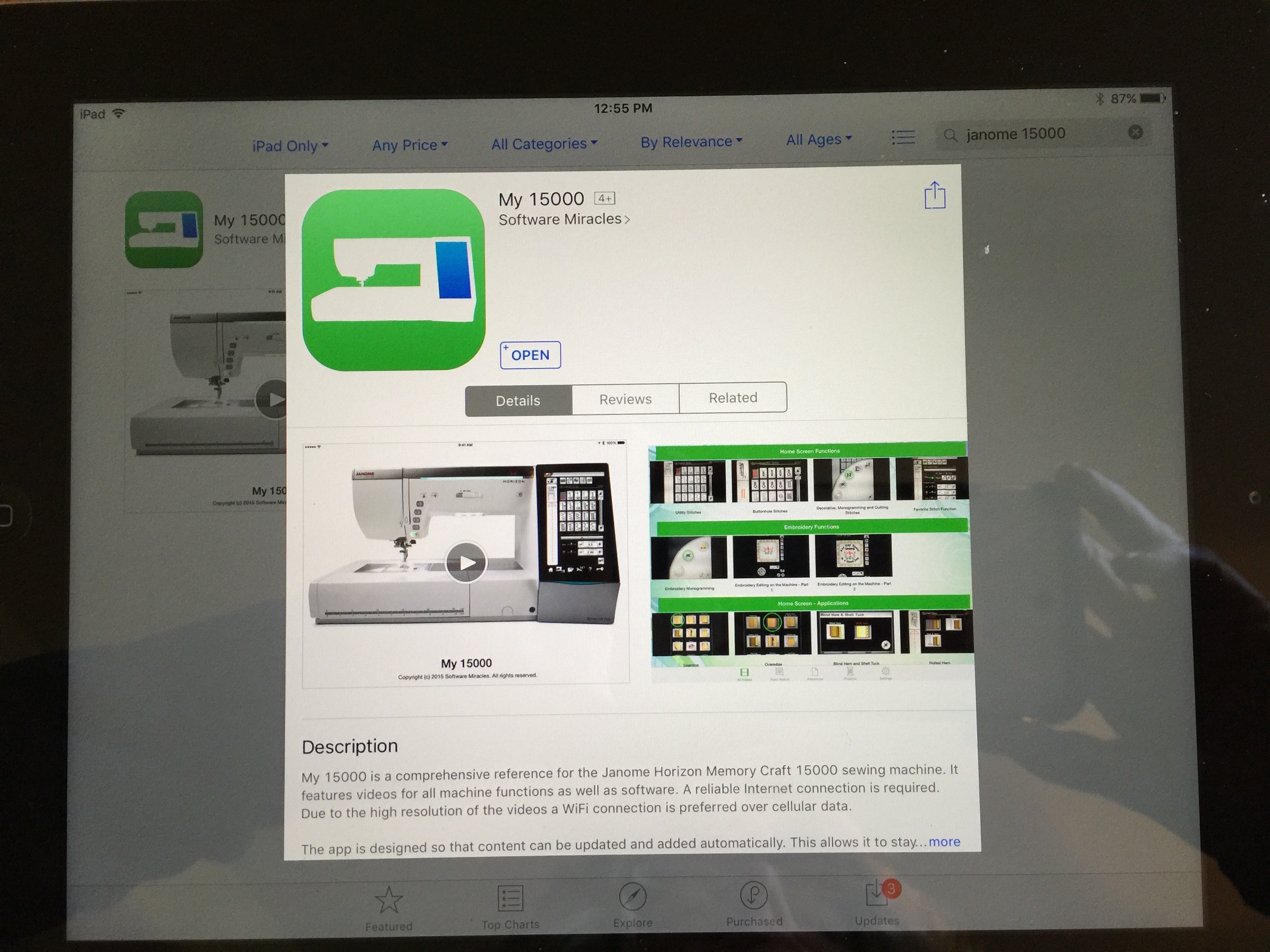
When you type Janome 15000 into the App Store search box, you’ll get this screen. You will see a “buy” and price. On mine, it has the Download box since I’ve already got it.

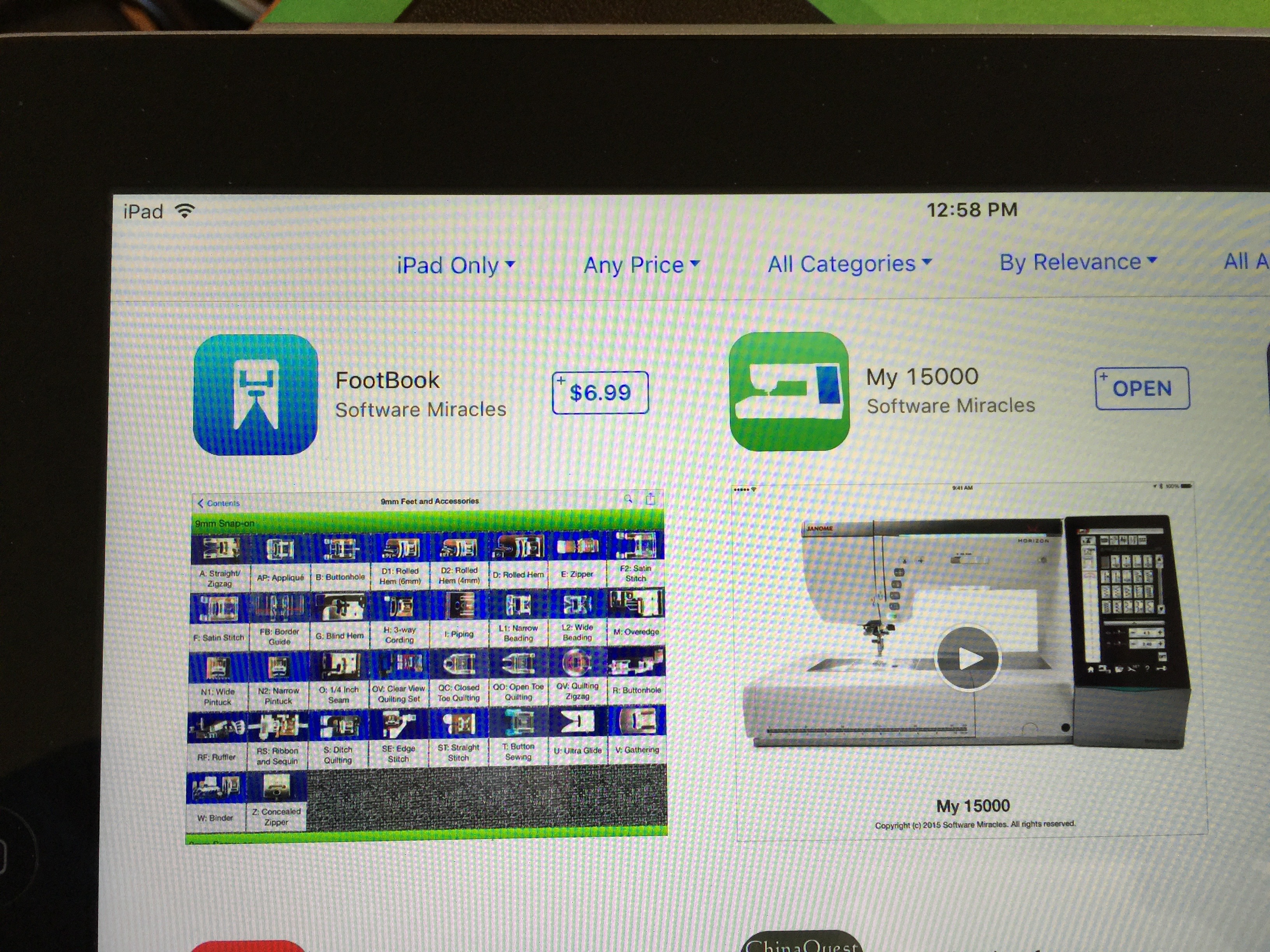
To buy it, you’ll want to use your iOS device (iPad usually but also works on iPhone, just smaller for seeing) to open the App store.  Type Janome 15000 into the search box to reach the App which sells for $59.95.  If you don’t have a Janome, you can still learn from Jim and Diane via the FootBook, their App (reviewed FootBook Review) about how to use Janome presser feet.  Don’t let that dissuade you:  this modestly priced ($6.99) app shows how to use various feet that are common to all machines.  Even though the foot name might be different from one brand to the next, how they work carries over.

When you go to the App store on your iOS device, put Software Miracles into the search box to bring up this screen.

When you go to the App store on your iOS device, put Software Miracles into the search box to bring up this screen.  The FootBook is pictured on the left.  The Janome 15000 pretty much covers all the territory on the FootBook, so you don’t need both.  However, since many of my readers aren’t lucky enough to have the 15000, I’m including this for their information.

The Janome 15000 App is a “manual” for the Janome 15000 with videos, photos, and incredible and extensive detail that covers

  • Home Screen Functions
  • Embroidery Functions
  • Home Screen Applications
  • Optional Feet
  • Quick Start Videos
  • Set Screen Functions (how to customize the machine)
  • HorizonLink Suite (an optional embroidery software from Janome)
  • iPad Apps (including the included with the 15000 Acu Monitor and AcuEdit)
  • Accessories (Using the optional Clothsetter)
  • Free Motion Quilting

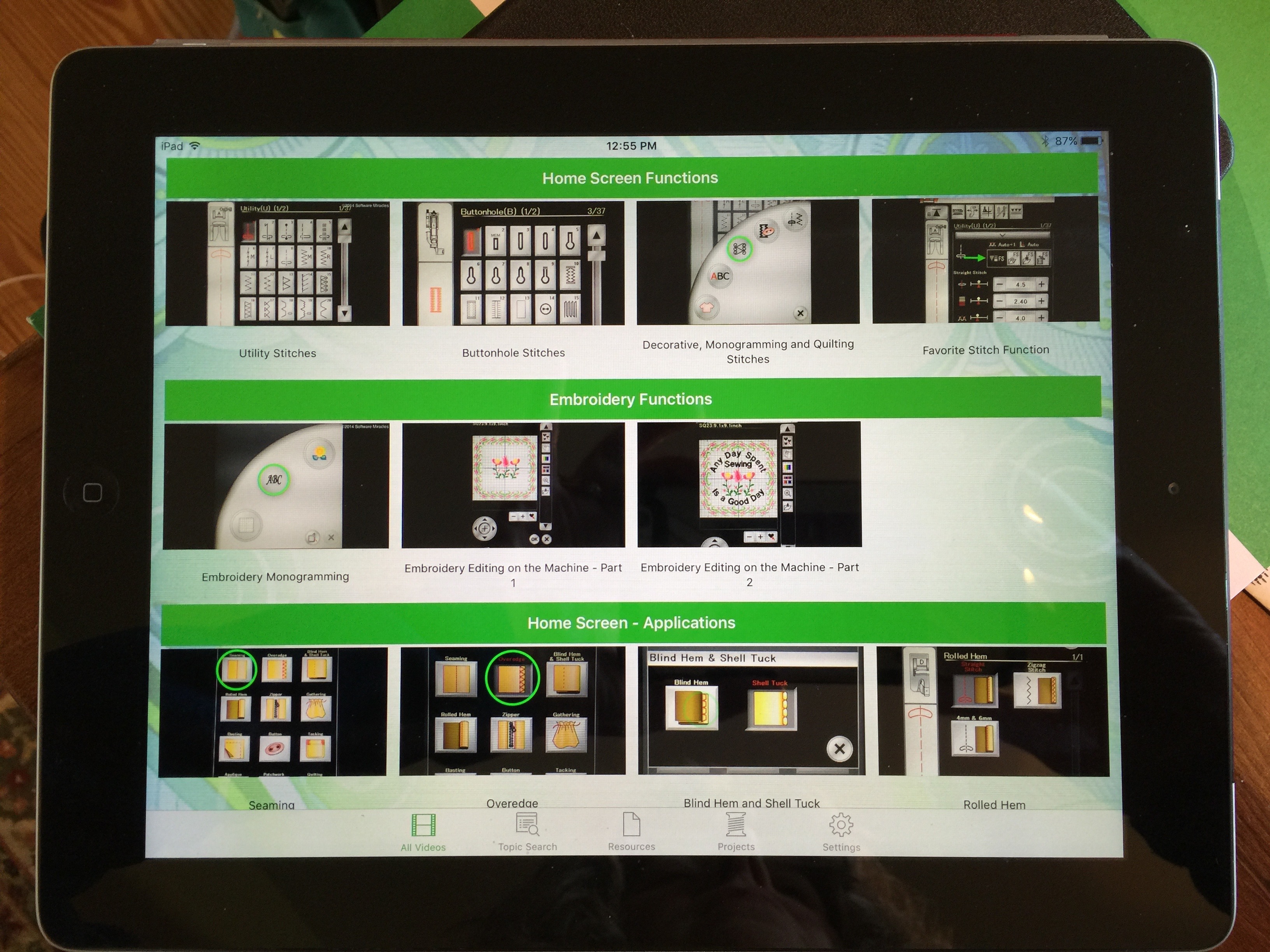
Here’s what you see when you open the App:

When you open the Janome 15000 App, here's what you see...don't forget to scroll down, there is a LOT more!

When you open the Janome 15000 App, here’s what you see…don’t forget to scroll down, there is a LOT more!

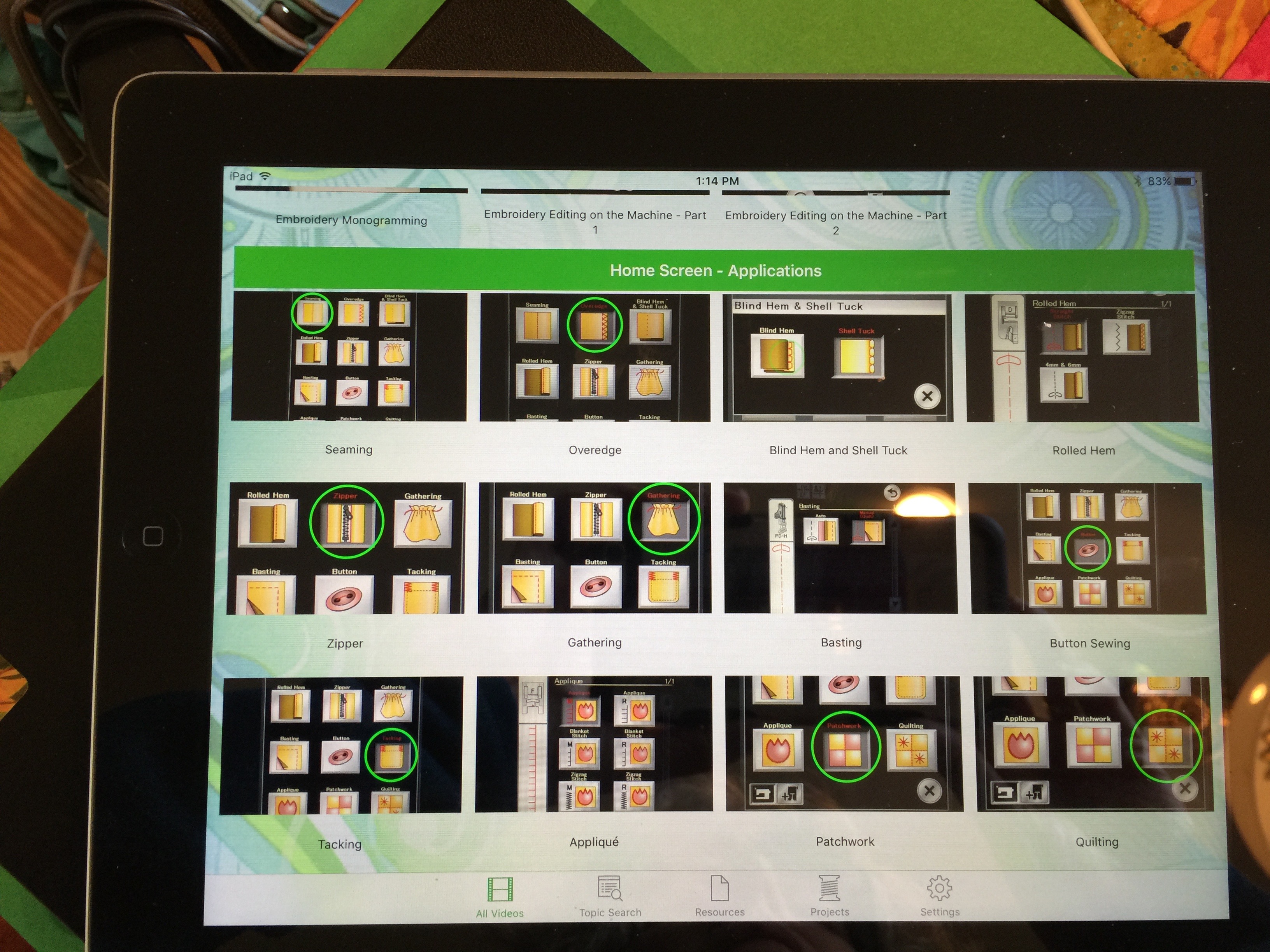
There are multiple videos and tutorials for each of the above major sections.  As with their impressive FootBook App (which is about how to use Janome feet, but frankly works for most feet/brands, blogpost here), there is a ton of information   In the Home Screen Applications section alone there are tutorials on (photo just below).

  • Seaming
  • Overedge
  • Blind Hem and Shell Tuck
  • Rolled Hem
  • Zippers
  • Gathering
  • Bating
  • Button Sewing
  • Tacking
  • Applique
  • Patchwork
  • Quilting
Here's just part of what is on this information-packed app.

Here’s just part of what is on this information-packed app.

This app is essentially a whose SERIES of sewing lessons that are useful even if you aren’t on the 15000 (though they are geared to using the screens and pre-sets on this machine).   And, because it is an App, not a disc, Jim and Diane can update the software easily.  Once there is an update, you can download the update as part of  your original purchase price, which means you get the benefit of improvements down the line.

As I said when I reviewed the FootBook, I have been hand-sewing since I was about 7, and Mother let me start to machine sew when I was about 9.  I am pretty close to expert having made garments, worked for an interior designer making high-end home dec items, and been both a traditional and art quilter (published, exhibited, yada yada).  Well, I learned stuff from this App, which means that it is crazy comprehensive.

For me, with my experience, the embroidery instructions are the most useful, and I am so grateful to have these on my iPad so I can watch them while I am working at my machine.   I don’t have the Horizon Link Suite (because I’m not wild for embroidery), but I can tell you if I did I would use these videos as my step-by-step learning process.  Another thing that is amazing, Jim has a Yahoo group for owners of the Janome 12000 and 15000.  I joined before Janome lent me one just to start learning.  Jim’s help there has also been phenomenal.   If you are interested, you can go Janome 15000 yahoo group to ask to join the group.

The Stutsmans have a website, OnLineSewing.com.  Here’s a link to the page with info on the Janome 15000 app, and another link for the FootBook. There is helpful information on what you need in terms of tablets for viewing (with generation etc).

Bottom Line and Last Word:  If you have the Janome 15000, unless you are the most expert Janome 15000 person on the planet, you will learn something from this App and be able to use and learn from it.


A new top!

Thursday, October 22nd, 2015

Among other things I’ve been doing, I have been making some clothing!   Several months back I fell in love with the Philip Jacobs (for Westminster Fabrics, he’s part of the KFC:  Kaffe Fassett Collective of designers) petunia print in the blues.  I was able to order it from Glorious Color (on Blue petunia fabric by Philip Jacobs, for as long as it is in stock!).  Philip designs (gloriously) for both Rowan and for his own line, Snow Leopard.   See his Westminster fabrics here or visit his Facebook page here.  He also has a horse named Neddy who approves his designs (grin!).

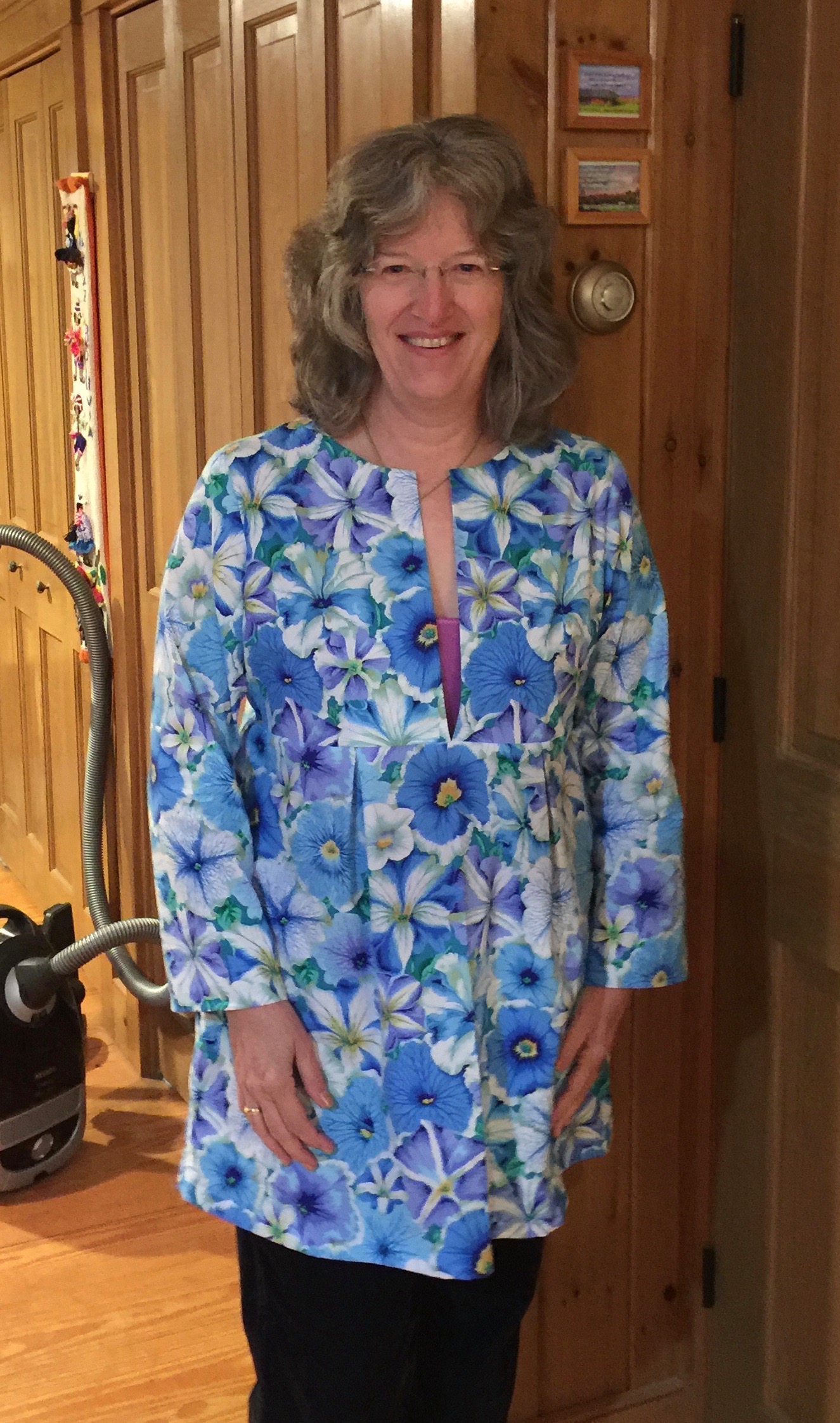
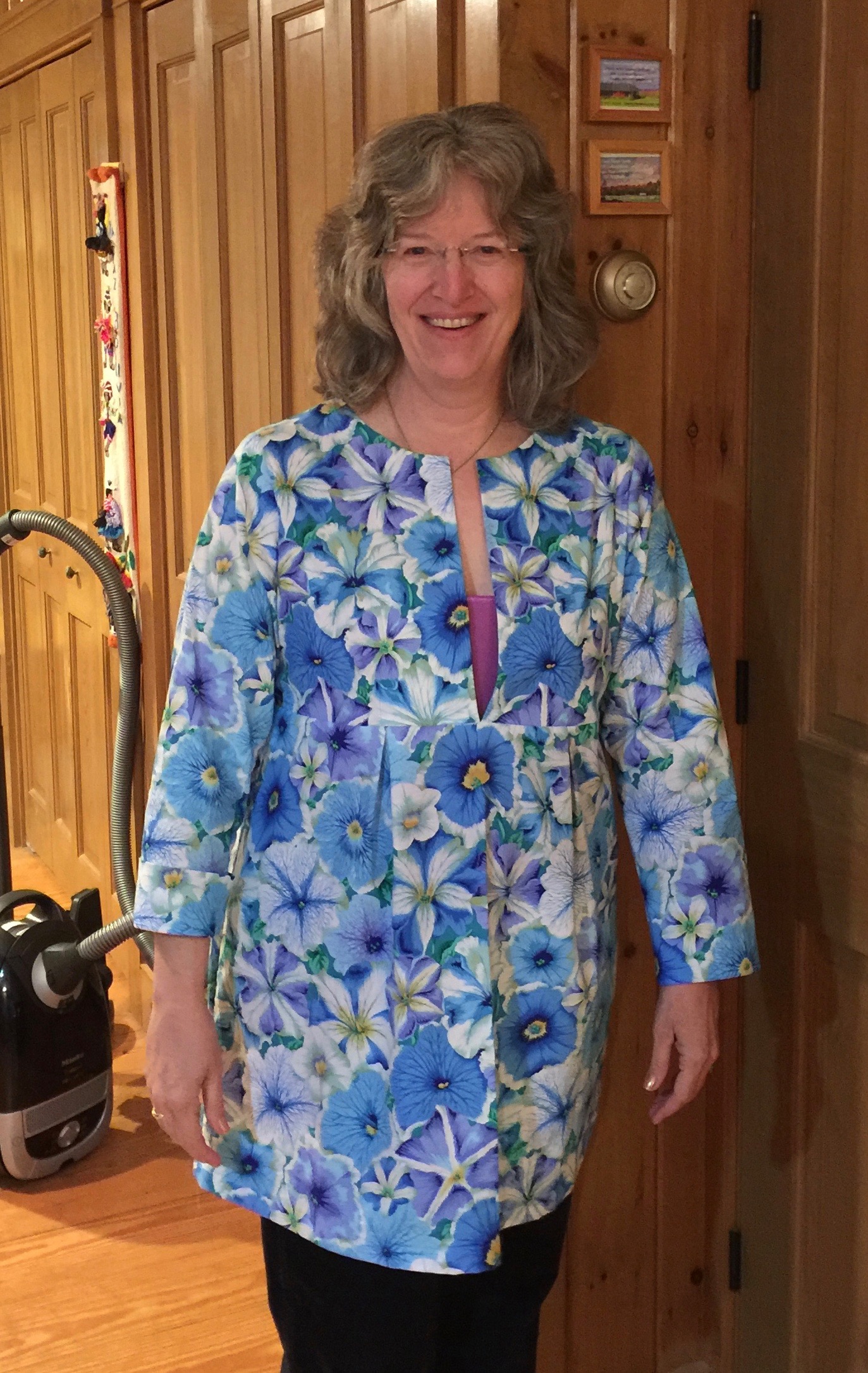
Sarah in her new tunic. The opening is deep and requires a camisole or decorative something underneath.

Sarah in her new tunic. The opening is deep and requires a camisole or decorative something underneath.  I lengthened the sleeves so I could wear a long-sleeve T under it in winter.  It gets cold up here in Maine!  By adding 6-8 inches you could make a lovely dress (or if you have shapely legs and don’t mind short, wear as a short dress as is).

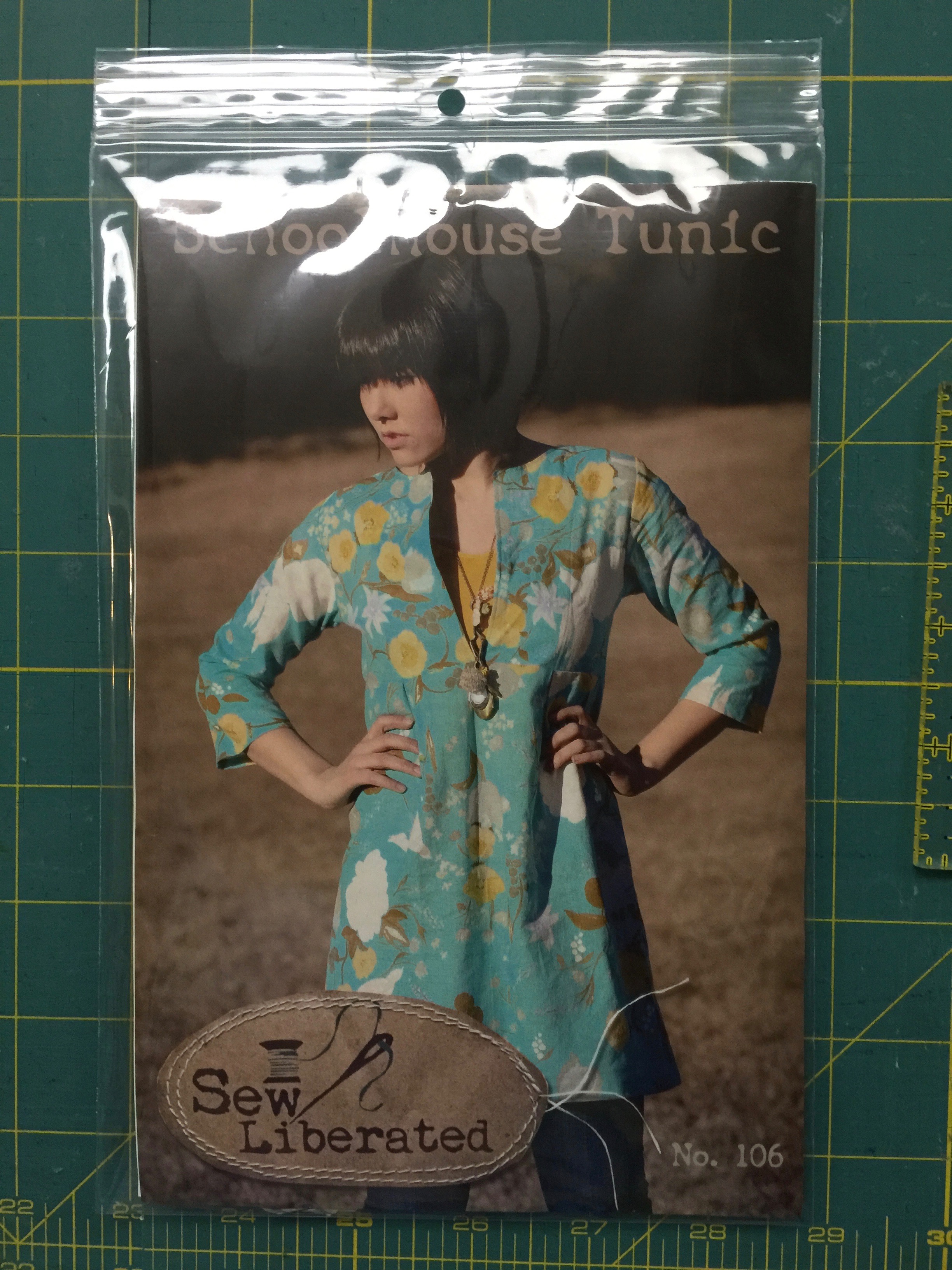
I used a pattern I have had in my stash for a while and that is wildly popular:  the Schoolhouse Tunic by Sew Liberated.  You can find it in many quilt shops including Alewives Fabrics (one of my great local shops).  The direct link to the pattern on the Alewives site is Schoolhouse Tunic.  An alewife, by the way, is a type of fish.  They are common in the area and they spawn by going upstream–just behind the shop.  You can always tell when the Alewives are running in spring because every sea bird, gull, cormorant in a many-mile-radius is squawking and flying about!

The pattern I used.

The pattern I used.  My friend Kate has made this in a lovely natural linen and in some shirtings and it looks great.  Flatters many figure types, too.   Notice the 3/4 length of the sleeves.

with sleeve turned up.

with sleeve on left of photo turned up.  I made the hems really deep so that I could turn up the sleeves in summer and still have it look pretty.

I have some jersey (t-shirt type) fabric–another splurge purchase at Alewives–that I want to use to make another one.  For that one, I will not use such a deep hem.   My size, alas, has increased somewhat.  I had thought by using the next-to-largest size I would have ample room for a shirt underneath.  I have room, just not ample room.   So when I make it in the jersey, I don’t think I will do the usual “go down a size to make up for the stretch.”  I can easily fine tune the fit by taking deeper seams on the sides if I decide I need to do that.

This top was one of the projects I sewed on Janome’s new Skyline S7 machine, which I will review on Monday, October 26th.   I used the blind hem stitch to overcast the edges.

Seam finishes in my tunic: bias facing, on the top, overcast edge at the armscye (set in sleeve seam) and French seam (enclosed raw edges) on the side seam.

Seam finishes in my tunic: bias facing, on the top, overcast edge at the armscye (set in sleeve seam) and French seam (enclosed raw edges) on the side seam.

Next up:  a review of an “App” for one’s iOS device (iPad etc) and the top of the line Janome 15000 on which I usually sew.   The App is incredible…that post will be up in a couple of days.


Lonni Rossi Embroidery design!

Wednesday, October 21st, 2015

So besides photography, what have I been up to these past six months and more?  Well, a lot of teaching, a lot of work, and not a lot of free time.  And oh yeah, being exhausted from the thyroid stuff (which is FINALLY improving…we may finally have the right RX…will see in a month).  So I have neglected the blog plain and simple.   I’ll try to fix that!  Today just a brief tease:

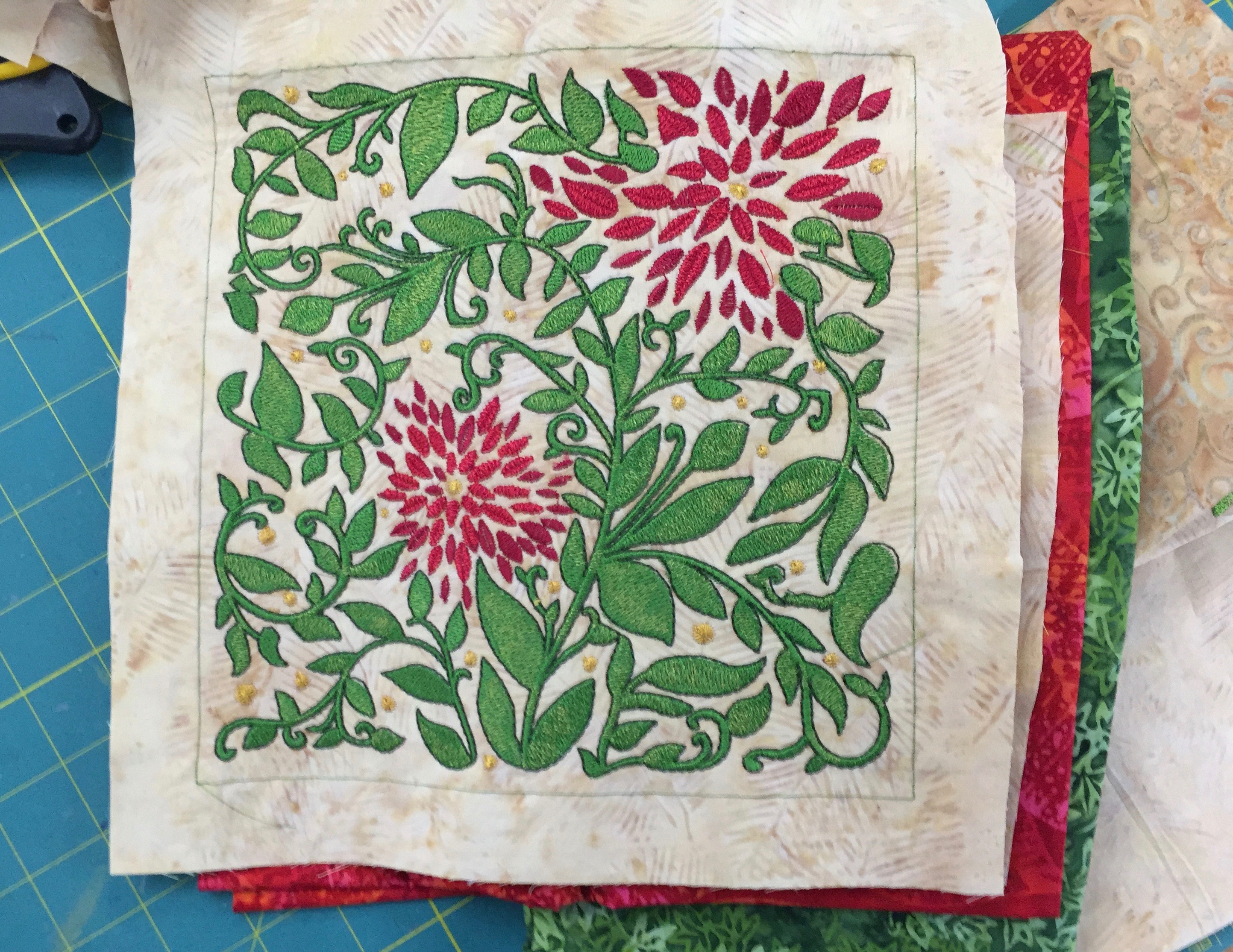
Lonnie Rossi embroidery design available from Janome, included on the Janome 15000.

Lonnie Rossi embroidery design available from Janome, included on the Janome 15000.  The red and green will be part of what I plan to do with this block.  Sorry the photo is a little blurry–I’ll fix that by the time I get the project done! 

Can you believe that I, the “never do anyone else’s designs” person and “embroidery really isn’t me”, have enjoyed learning about embroidery on the phenomenal Janome 15000 that I currently have on loan (thank you again Janome-America).  Most of the included designs are, well, why “embroidery is not me.”  But Lonni’s designs ROCK!   The one above was done in a totally different colorway–soft greens, some peach.   Well, not me.   Has opened up a world of possibilities, including perhaps some of MY designs finally getting refined and submitted for consideration by Janome!  [Taylor, I promise, I really have stuff for you! I just need to make it good enough to send in!]

As part of the Janome Artist-Teacher loan program, I make stuff that Janome can blog about or use in their booths to show what can be done with their machines.  I thought the flowers looked like poinsettia as well as chrysanthemums, so I changed up the thread colors to reds, green and gold (not metallic).

I am also not someone that loves fiddling with computerized stuff on a machine.  I have to say, this machine has made it SO EASY.   Another thing that has helped immensely if an App from Jim and Diane Stutsman, available for iOS devices (iPad and iPhone), that teaches you everything but everything about the 15000.  I’ll review that in my next post.  It costs only $59.95 US, and all I can say is that if you have this machine, you will NOT regret spending that $60.  Totally worth it.

Anyway, when the winter Janome project is made with this design, of course I’ll share here.  The pattern will be available for free (here or on Janome or both…I’ll let you know), along with exact thread colors, yardage, etc.   Stay tuned!

Gosh it feels good to be back in touch (and have a functioning brain and body…now, to do something about the pudge and lack of fitness….)!

Spiderweb TableRunner Free Pattern for Halloween!

Sunday, October 18th, 2015

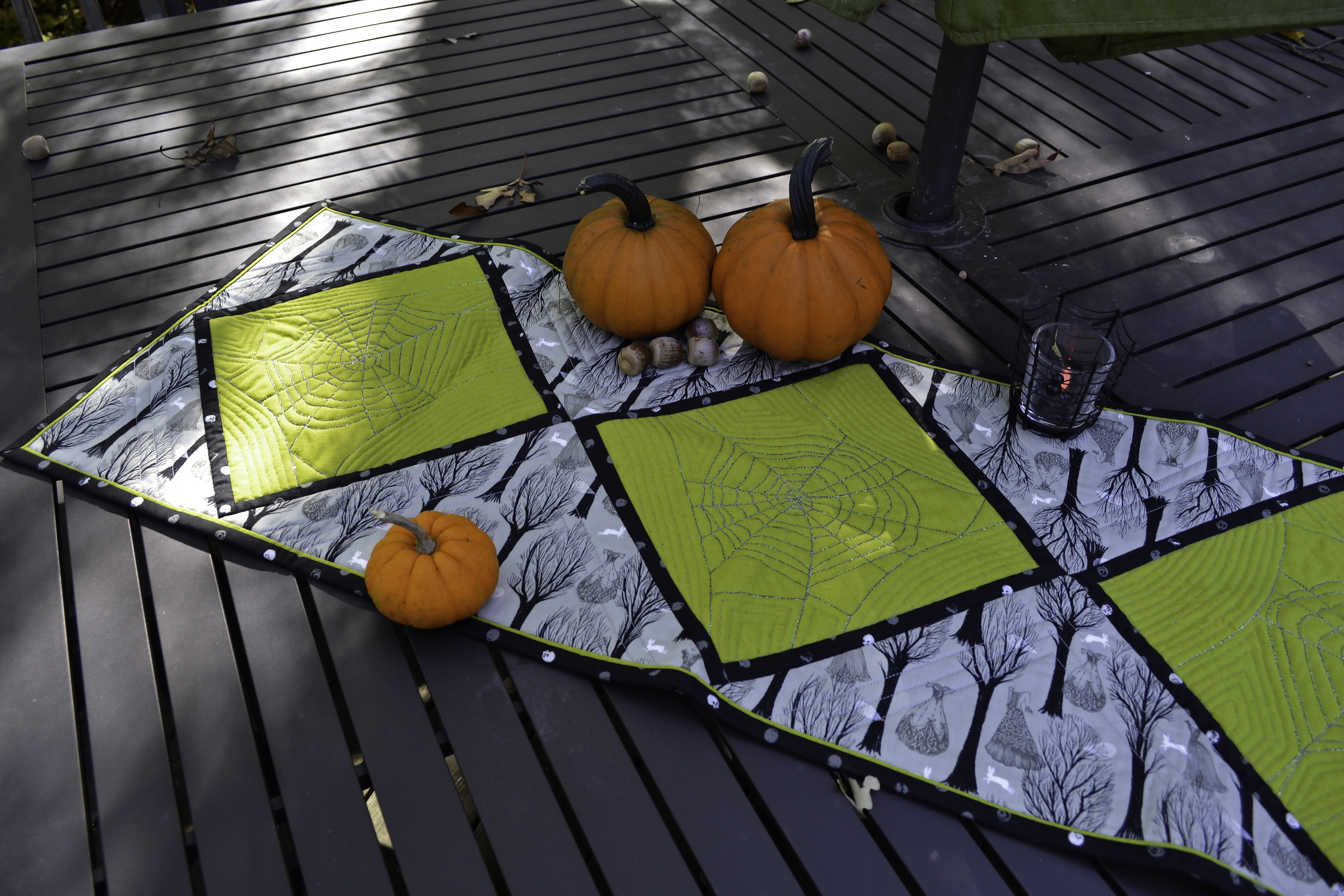
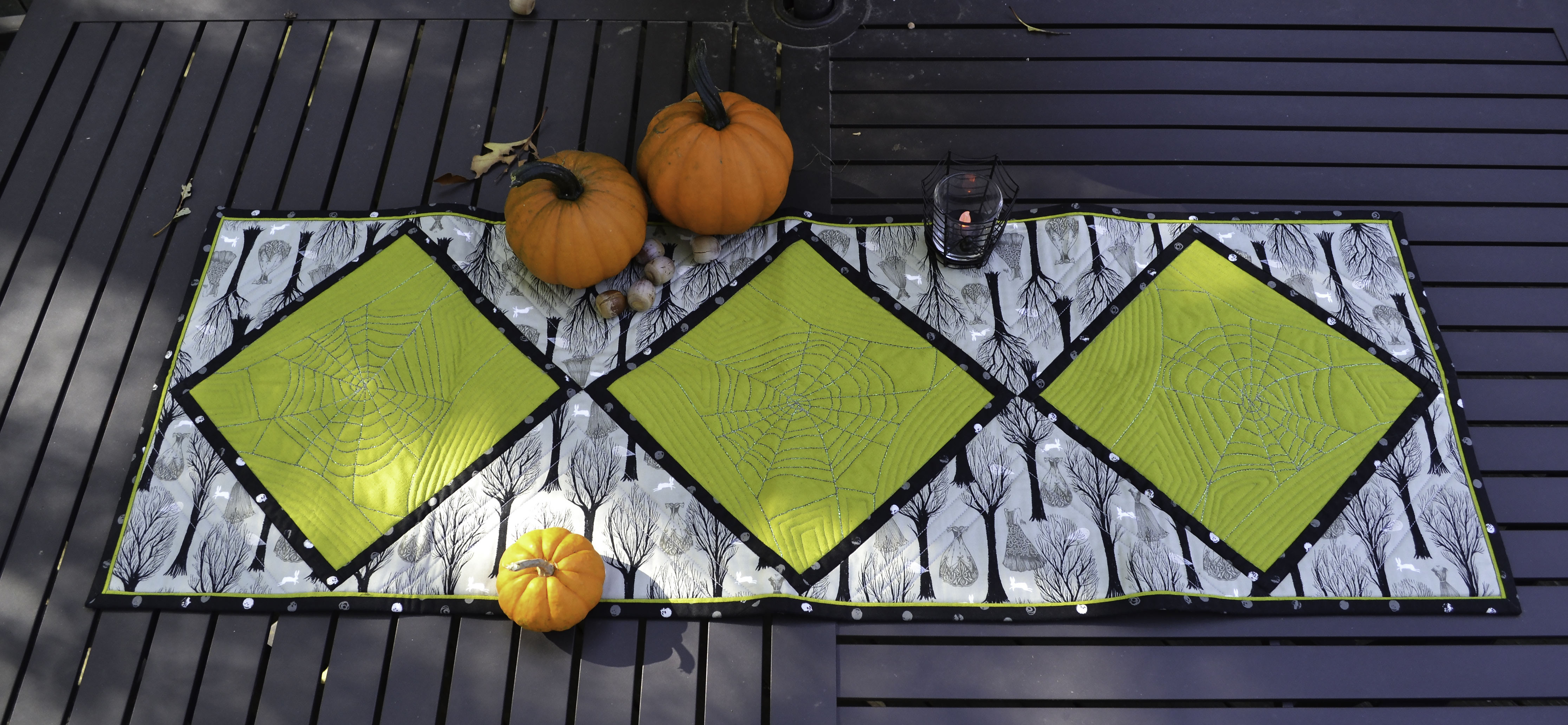
This tablerunner was featured at the Janome Institute late this past summer and it is now featured on their blog, here (scroll to October 15, 2015) and here on their projects page.  And I’m sharing the pattern with you here as a Halloween Treat!

Spiderwebs table runner (c) Sarah Ann Smith 2015.   Featured on the Janome America website/blog on October 15, and on Sarah’s blog.  Photo (c) Janome-America; used with permission and thanks!

Spiderwebs table runner (c) Sarah Ann Smith 2015. Featured on the Janome America website/blog on October 15, and on Sarah’s blog. Photo (c) Janome-America; used with permission and thanks!

For many years now I’ve been fortunate to be associated with Janome America.   I have been sewing on their machines since late 2004, moving up the product line so I’ve had a chance to test machines at all levels.  And in about a week  I will review here my test-drive of the reasonably priced Skyline S7, a brand-spanking-new machine (and to spill the beans–I can’t believe how much you get for the price!).  Anyway, I occasionally do projects for Janome.  Although this tablerunner was made on a top of the line Janome 15000, all you need is a machine that does a straight stitch.  If you have the triple-straight-stitch also, that’s good because it gives you a “bold” line on the spiderweb, but it isn’t necessary.  Even the most basic sewing machines (as long as they are not straight-stitch only) have this stitch (look for three vertical lines next to each other).

Most of my work is very involved and advanced, and the projects Janome features tend to be easier, so I drove down to one of my favorite local shops, Alewives Fabrics (here).  I found the fabulous Halloween fabric, and I’m not usually a major fan of decorating for this holiday.  But I love the ghostly dresses and the “polka dots” on the black that are really little skulls!   I also adore spiders (anything that eats mosquitoes is a friend of mine) and spiderwebs.  The green cotton-linen blend was perfect!

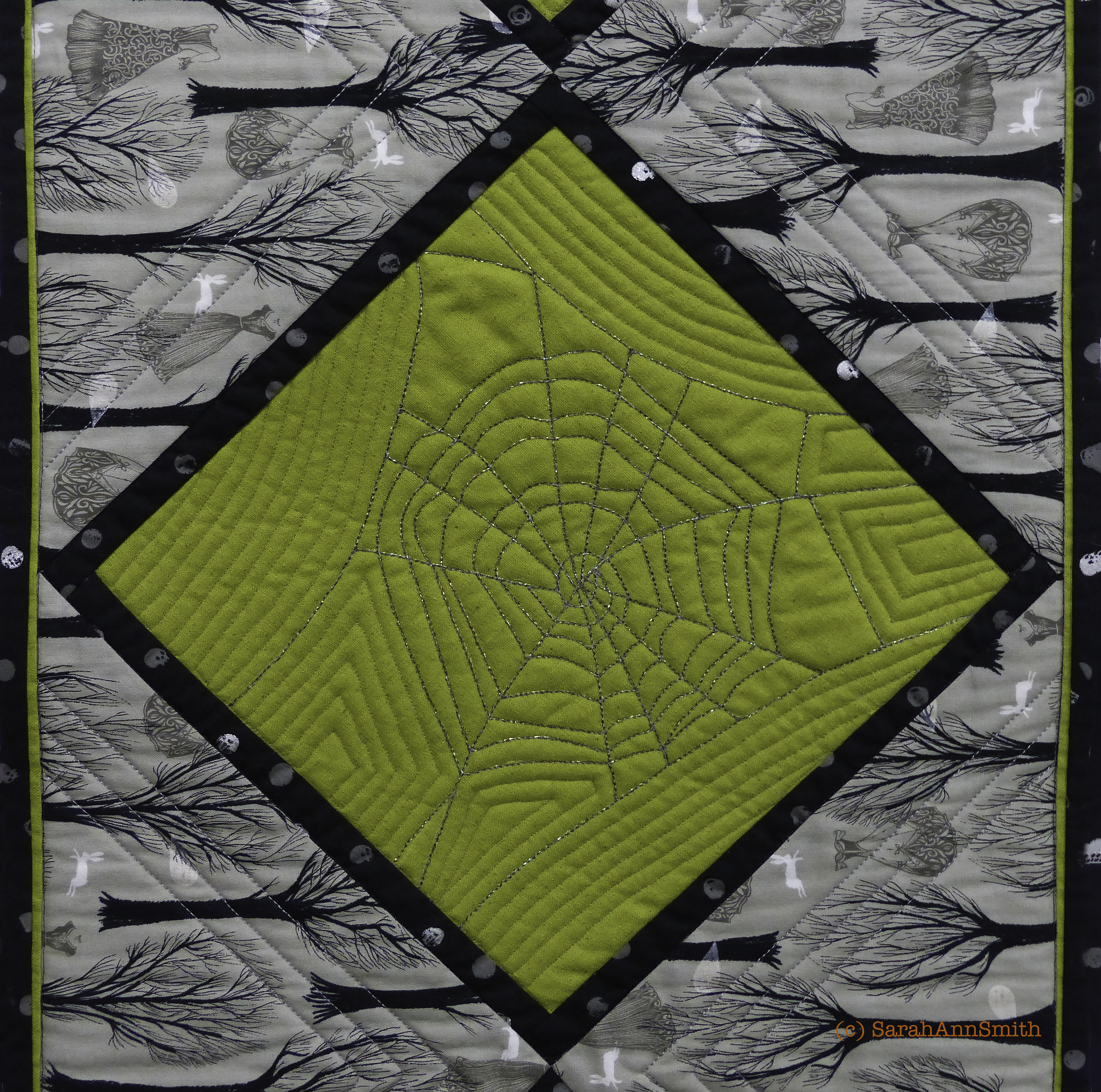
Detail of the spiderweb block.

Detail of the spiderweb block.

Spiderwebs for Halloween Table Runner  is the PDF for the pattern (also available on the Janome projects page, see link above).  Yep–this is a total freebie, including a full-size page of the spiderweb design which, of course, doesn’t need to be just like mine!   A friend had a great idea which I wish *I* had thought of:  to include a line of glow-in-the-dark thread with the stitching on the web!   If I were to make this again, I would feed the two threads together as if one (Thanks Lutra!)  through a large needle (size 16 or maybe even 18) to do the spiderweb stitching.

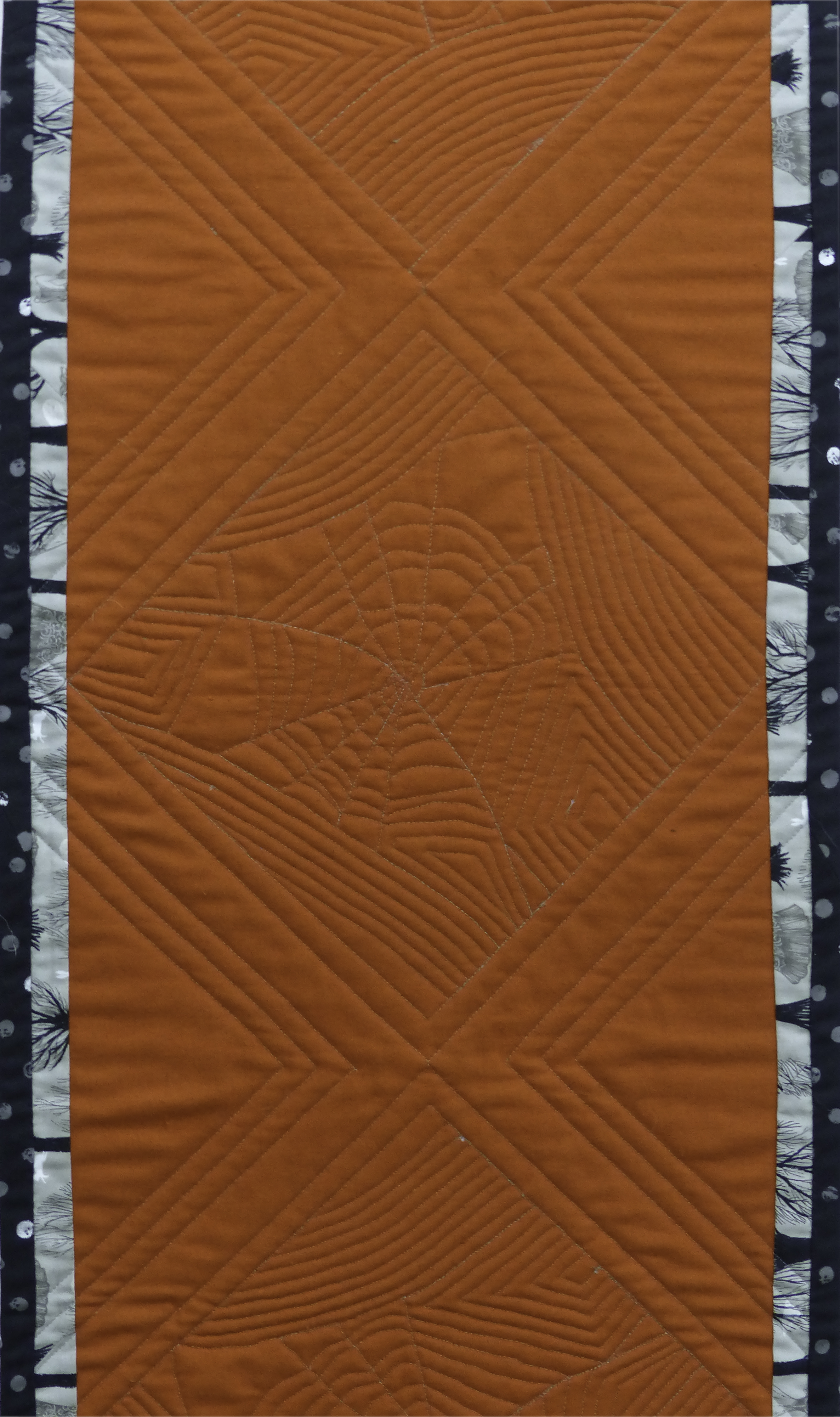
I always love the backs of things:

The quilting on the back of the tablerunner, so it is reversible if you want.

The quilting on the back of the tablerunner, so it is reversible if you want.

The fabric requirements on the pattern are SCANT–they are what I had, and I used every tiny little bit!   If you find you need to square things up a lot, buy a little more than I suggested.

Spiderwebs table runner (c) Sarah Ann Smith 2015.   Featured on the Janome America website/blog on October 15, and on Sarah’s blog.  Photo (c) Janome-America; used with permission and thanks!

Spiderwebs table runner (c) Sarah Ann Smith 2015. Featured on the Janome America website/blog on October 15, and on Sarah’s blog. Photo (c) Janome-America; used with permission and thanks!

An extra thanks to Taylor D. and Janome America for letting me use some of their photos (the nicely staged ones on the table)–I forgot to take nice photos before I sent it off to them for Institute!   And as always, thanks to Janome for having me in their Artist-Teacher program for so many years.  I truly appreciate it–and best of all, for making such great machines.  Yes, I’m affiliated, but I’d say the same things if I paid full MSRP!