email Youtube

Home
Galleries
Blog
Workshops & Calendar
Store
Resources
About
Contact

Archive for the ‘Janome’ Category

Janome 9400 review

Monday, December 5th, 2016

As many of you know, I’ve been fortunate to be affiliated with Janome America for many years and sew on their great machines.   They’ve come out with a new top-of-the-line NON-embroidery machine, the 9400.  And as I have come to expect, they take something that is already really good and make it even better.  We’re getting close to perfect!   To see the machine on the Janome site, go here.
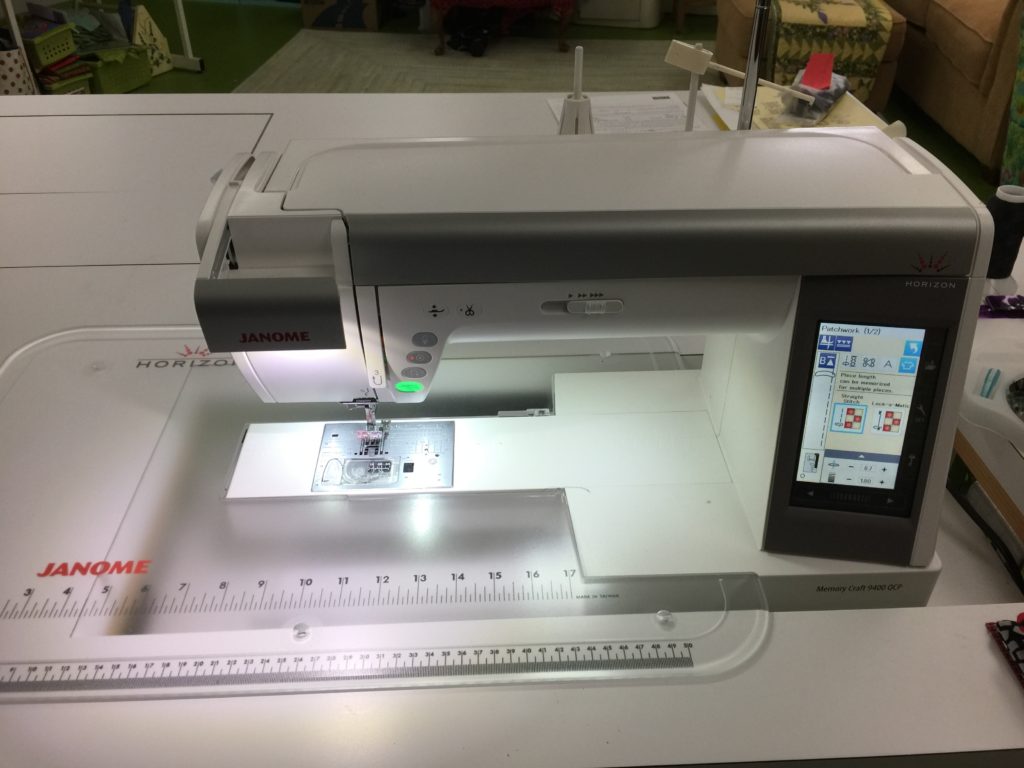
My newest sewing love, the Janome 9400!

My newest sewing love, the Janome 9400!  Notice the FABULOUS lighting?  I love the pull-out light, too!

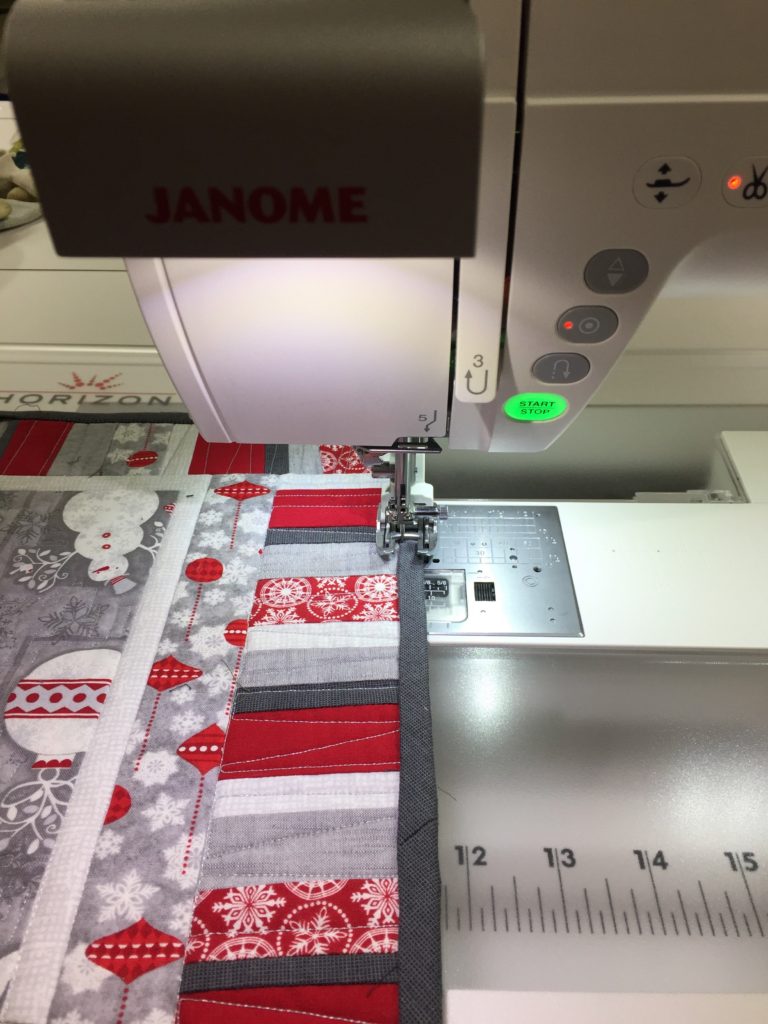
Over the past few months I’ve been able to put the machine through its paces, making a knit top, finishing a set of quilted placemats, finishing a small bag with zipper, and (who me?) piecing several quilt tops.   The machine excelled at everything I threw at it!  The 9400 has taken many features from the top of the line embroidery and sewing 15000 machine, including that awesome light on the top left that slides out.  I think the design of it  on the 9400 is even better than on the 15000, as it curves a bit.

One of the first things I did was some class samples for my Easy-Peasy Inside-Out Bag….including installing a zipper.
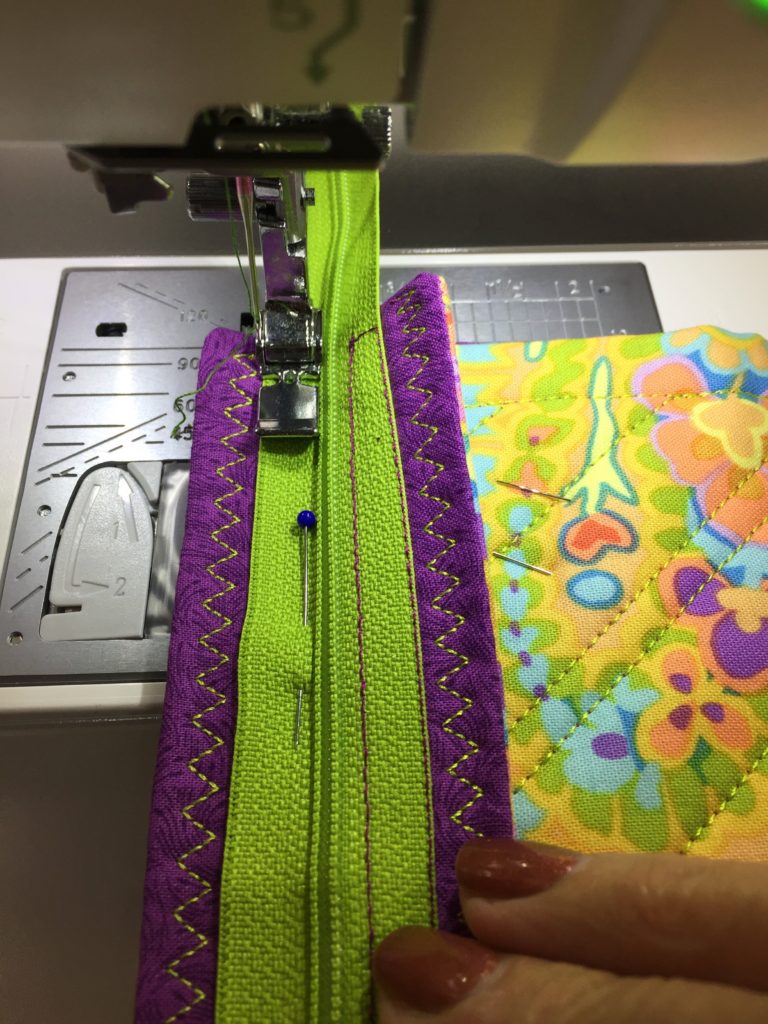
Zipper insertion for my Easy-Peasy Inside-Out Bag class sample.   Notice how the zipper foot fits PERFECTLY, allowing me to use the zipper coil as a guide and getting the stitching **perfect** ?  I used plum stitching as a decorative accent on the right side of the zipper, and am now stitching the second side of the left half of the zipper.

Zipper insertion for my Easy-Peasy Inside-Out Bag class sample. Notice how the zipper foot fits PERFECTLY, allowing me to use the zipper coil as a guide and getting the stitching **perfect** ? I used plum stitching as a decorative accent on the right side of the zipper, and am now stitching the second side of the zipper.

A bigger challenge, for both me and the machine, was to make a new top.  I fell in love with the plum knit and bought it a year or so ago.   I also love the aqua top, which is showing its age.  I did a “rub off” which is where you make your own pattern using an existing garment.  You can trace (with garment on top of paper) or rub (with garment under paper) to feel the edges and create pattern pieces.  I extended the sleeves from 3/4 to full length, and am delighted at the machine and the results.
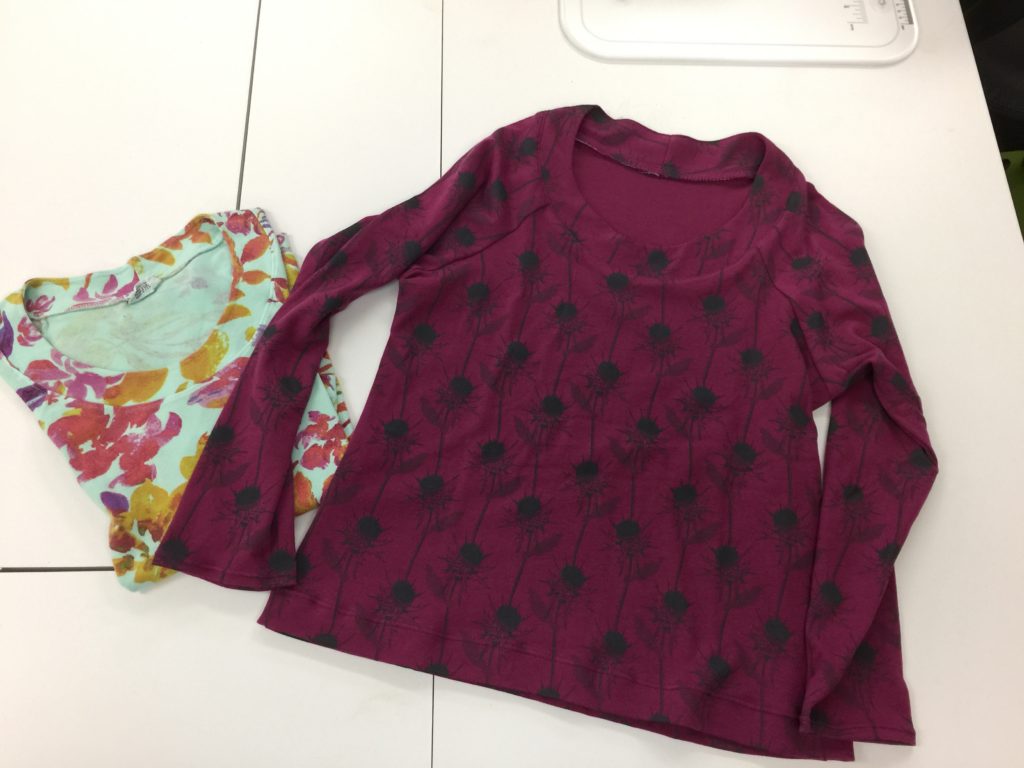
Success!  I actually made a KNIT garment.  The original shirt (purchased) is on the left. After making the pattern from that shirt, I made the plum one on the right.  I'll do a separate blogpost later this week with more info on how I did it and which stitches used.

Success! I actually made a KNIT garment. The original shirt (purchased) is on the left. After making the pattern from that shirt, I made the plum one on the right. I’ll do a separate blogpost later this week with more info on how I did it and which stitches used.

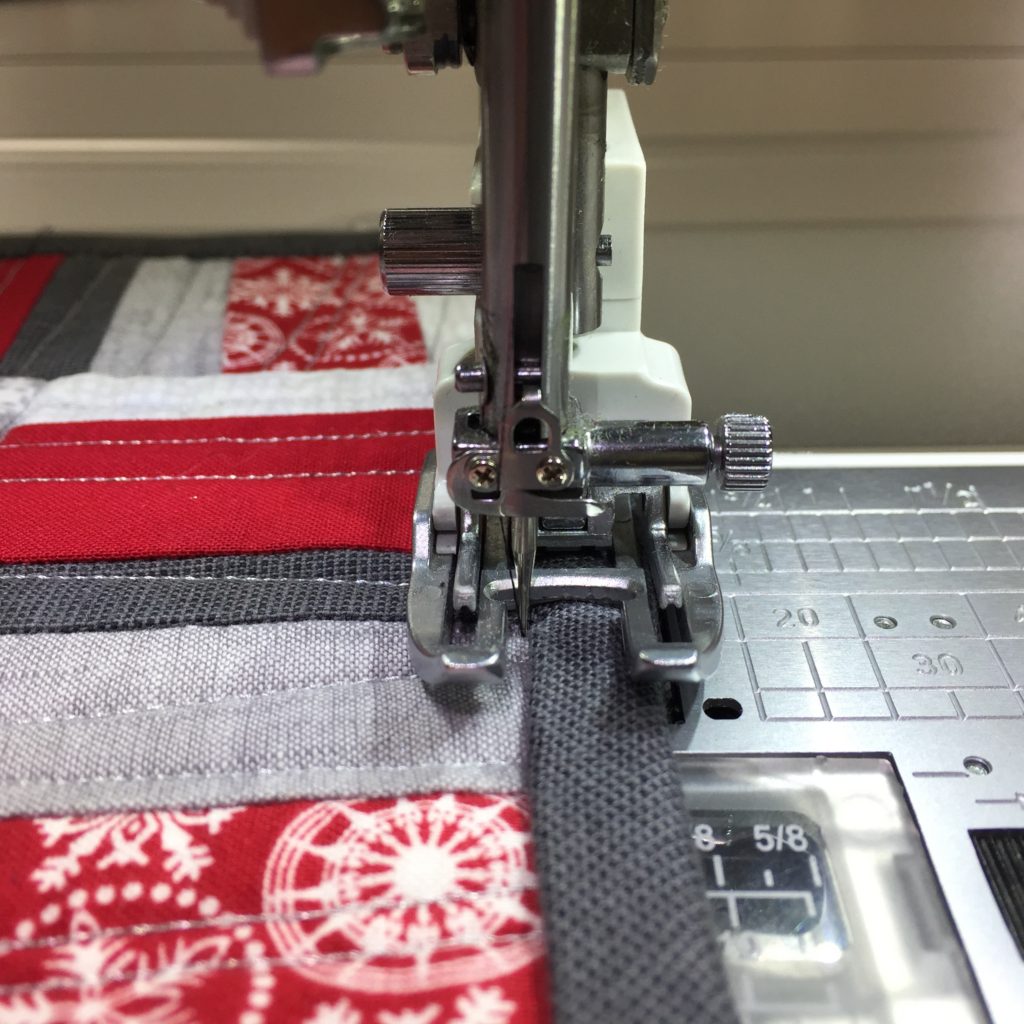
I also have done quite a lot of piecing.  I used the P foot which comes with the machine for my quarter inch seams, but decided to use the optional Clearview foot which I prefer.   In a second project (which I can’t share yet because it is a Christmas surprise) I was astounded at how accurate my results were; I am NOT a piecer, and the feed on the machine worked very well (until my attention wandered, at which point I simply cut the threads, went back to my oops and fixed it).
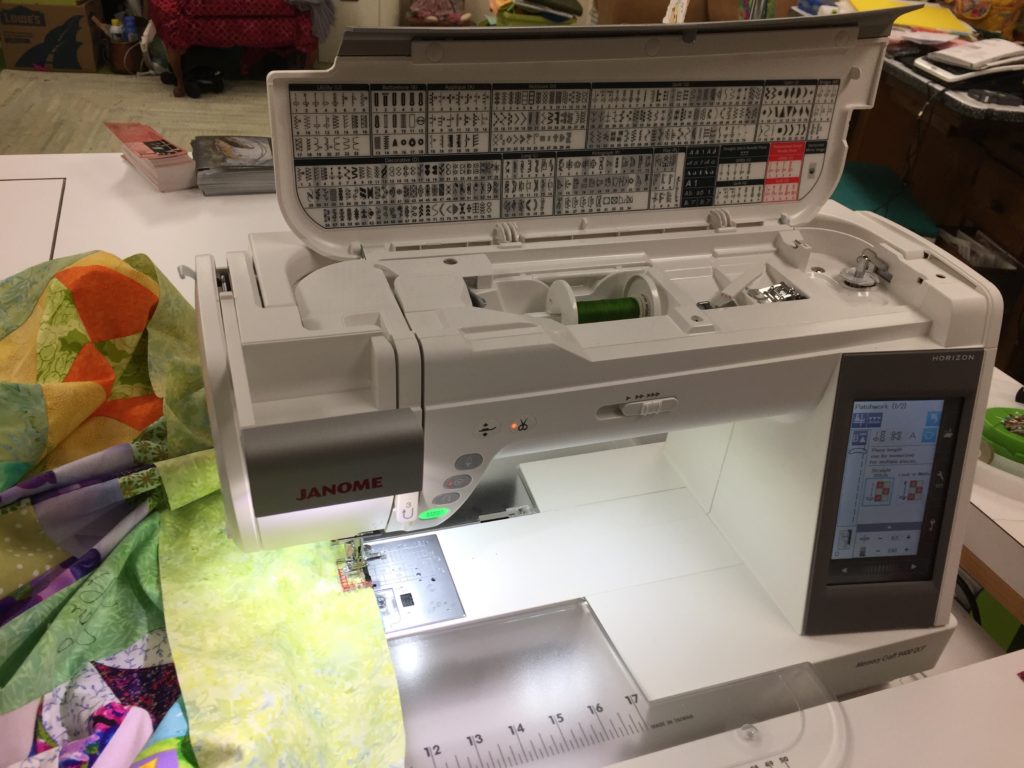
Using the ClearView foot for piecing

Using the ClearView foot for piecing.  I really like the red 1/8 and 1/4″ markings. This foot is available for both Janome’s  7mm and 9mm machines (the 7 and 9 refer to the maximum stitch width–you need to be sure you get the correct one to fit the “ankle” for your machine). Have I said how much I love it?

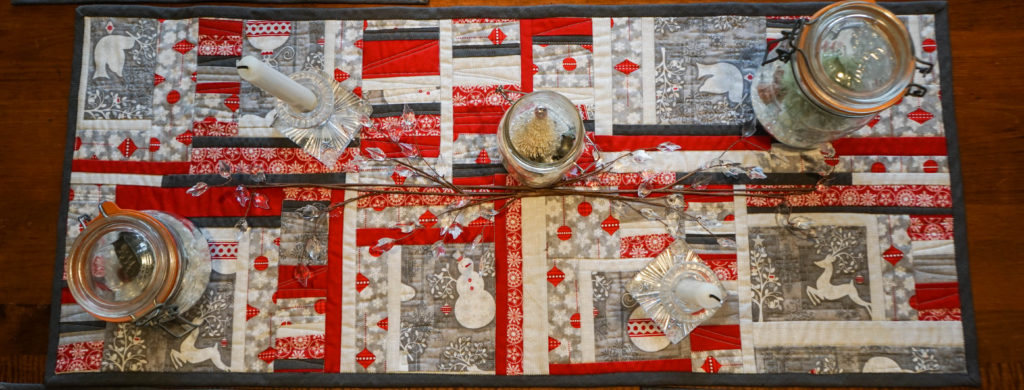
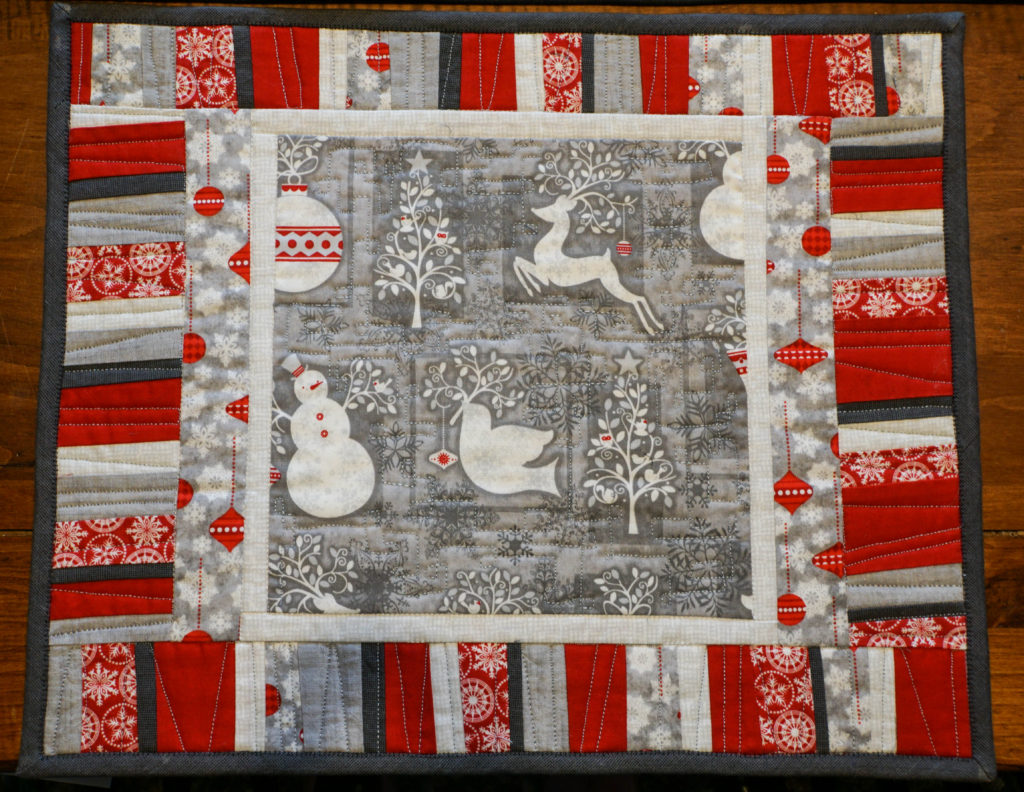
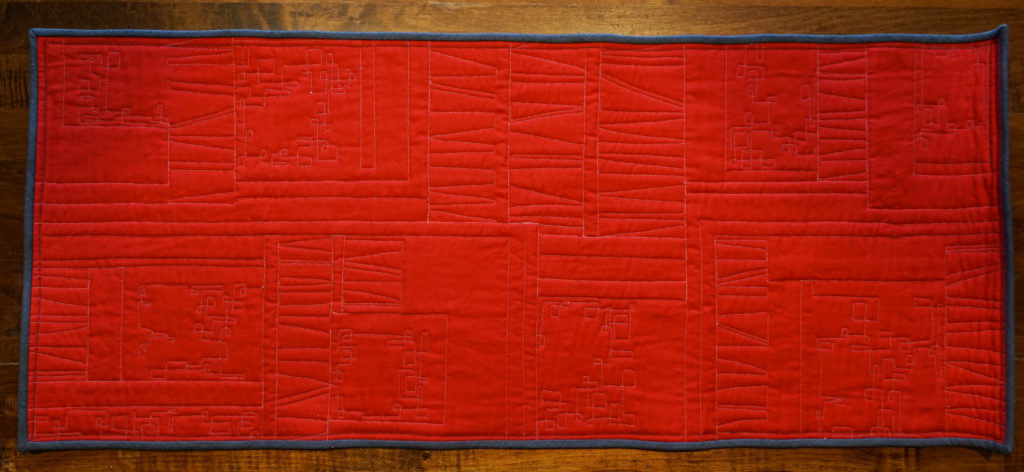
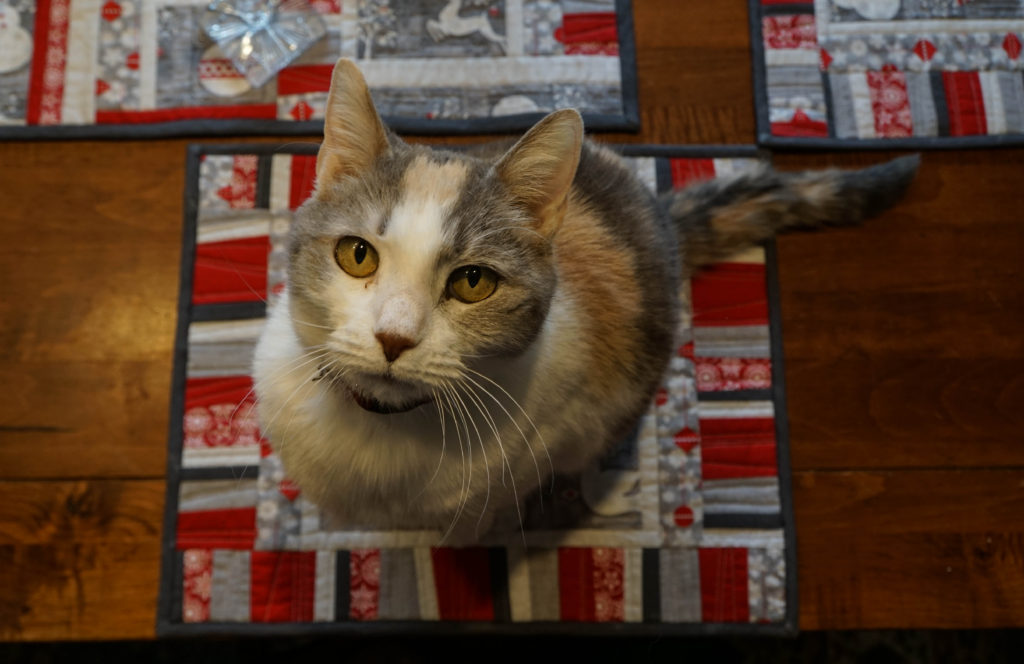
I also have been able to do both free-motion and walking foot quilting, though not as much yet as I would have liked.   I finished a set of placemats and table runner called Modern Winter, which I prepared for Janome’s blog.  You can find the pattern and information here.
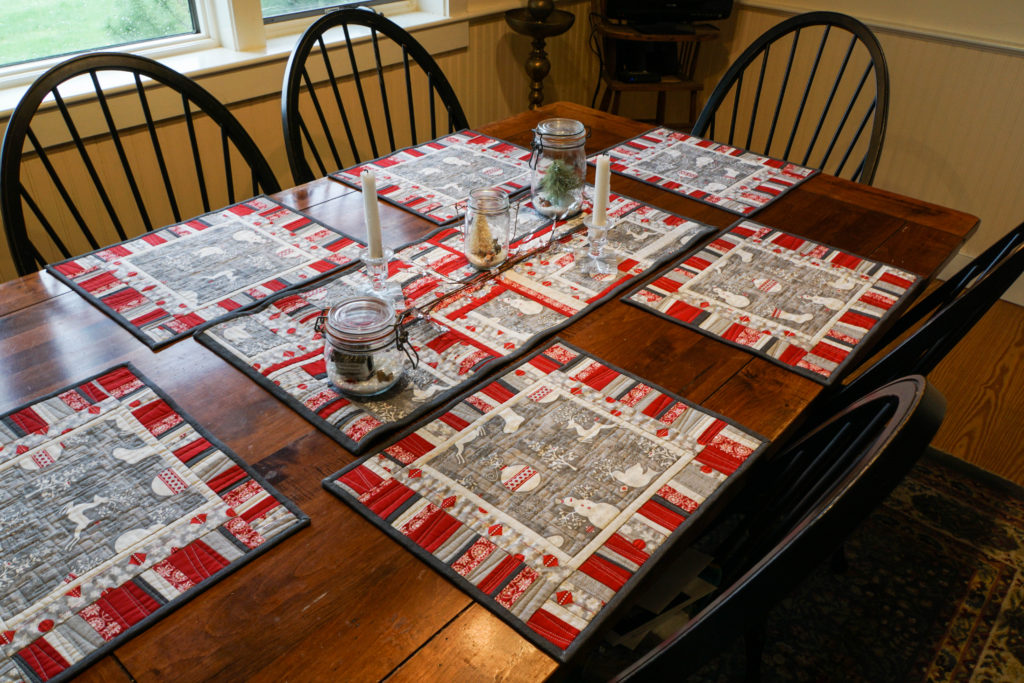
Modern Winter placemats and table runner.

Modern Winter placemats and table runner. Instructions/pattern on the Janome site at the link.  

The one thing I keep trying to convince Janome to do is to create feet for the top of the line machines that is similar to the convertible FMQ (free motion quilting)  feet for the Janome 8900/8200 and similar which I think are the best quilting feet Janome makes.   In addition to the traditional “hopping” or darning foot used for free-motion quilting, the 9400, 15000, 12000 all have the QO and QC skimming FMQ feet which snap on to the ankle (which is really quick and easy).  However, these feet are clear plastic and not round.   They work great for most people’s purposes, but if you look at pretty much ALL quilting machines, the preferred and nearly universally available feet are metal CIRCLES.  The metal is stronger and can, therefore, be thinner, which affords greater visibility.  And by being a circle, you can echo quilt around (for example) an appliqué, then  continue with free motion without having to change feet.  This is a small quibble but one that is important to me.
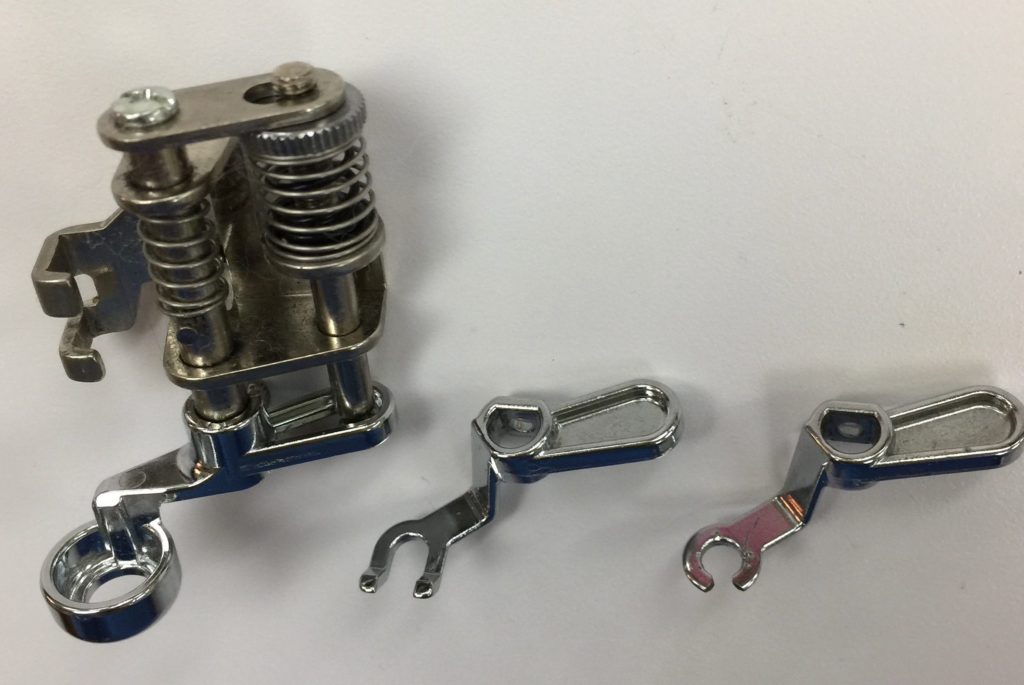
The foot on the left is the Ruler Foot for the 8900, and the two bits on the right are the optional bottoms for FMQ, the open U (as Janome made it) and the circle (which Janome made closed, but I used my Dremel to open up a tiny bit)

The foot on the left is the Ruler Foot for the 8900, and the two bits on the right are the optional bottoms for FMQ, the open U (as Janome made it) and the circle (which Janome made closed, but I used my Dremel to open up a tiny bit).  I would LOVE these options for the top of the line Janome machines (9400, 12000 and 15000).
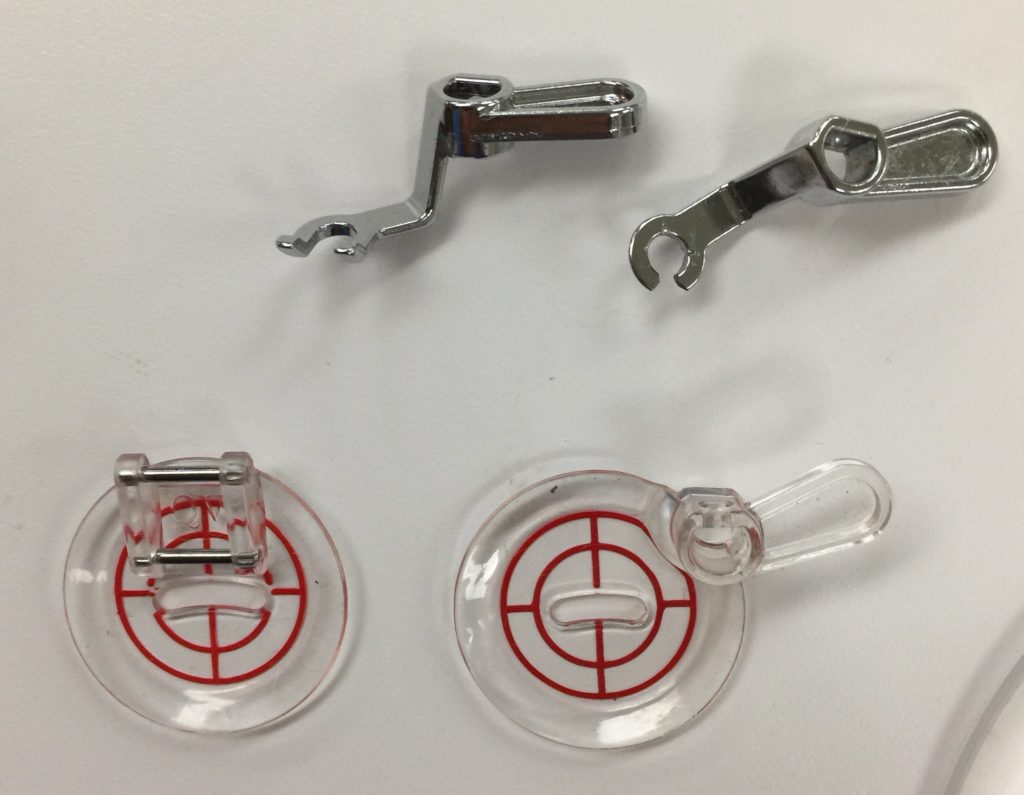
One of the

One of the really cool things about the 9400 (which came down to it from the 15000) is the snap on feature for some of the quilting feet.  In this image, you can see the echo quilting foot, the clear disc with red circles/lines, for the 9400 on the lower left.  It just pops on and off the ankle like regular feet–fast, easy and effective.  The other three in this image are from the bottom of the convertible FMQ foot for the 8900; you have to screw them on to the holder which is a small fuss.  

I was MOST impressed at International Quilt Festival, Houston, this year.  I introduced myself to the president of Janome America to say thank you for Janome’s continued support for the past decade-plus, and to ask about developing these feet for the 9400 and 15000 (and 12000).  He whipped out a notebook and took notes!   So as soon as I finish this post, I’m going to follow up with him with details I’ve been mulling over on how best to meet ALL needs for quilting–both hopping and skimming. Love Janome’s responsiveness!  He said he’d send the info to headquarters in Japan–can’t do more than that!

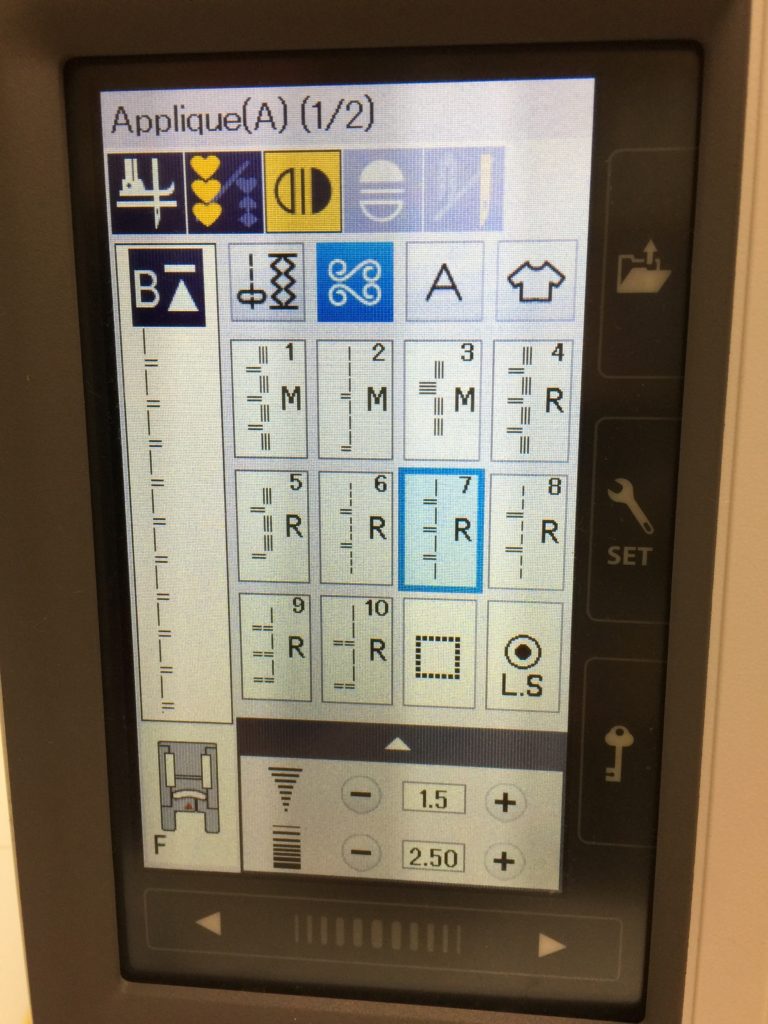
Although you can read it on Janome’s site, I’m adding some info about the features and accessories included on this machine.  Best of all, a lot of stores are offering “Holiday Incentives” on the price!
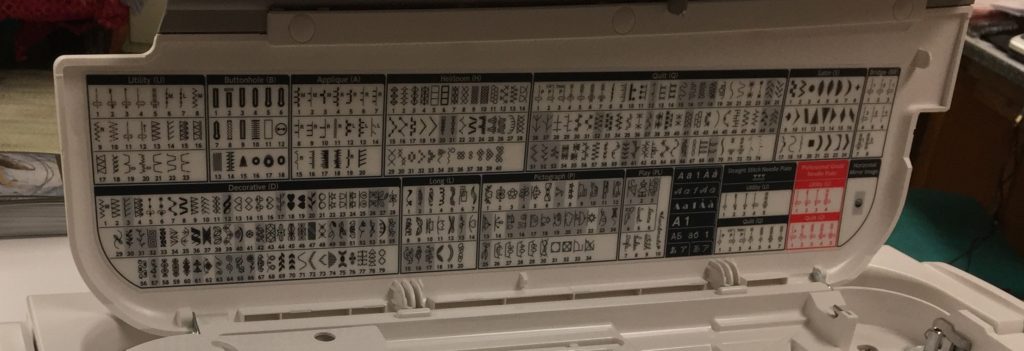
Janome 9400 Stitch Chart

Janome 9400 Stitch Chart…hooray, my favorite stitches are still here!

Key Features:

  • Top Loading Full Rotary Hook Bobbin System
  • 350 Built-In Stitches and 4 Alphabets
  • Superior Needle Threader
  • Cloth Guide Included
  • One-Step Needle Plate Conversion with 3 Included Plates
  • Detachable AcuFeed Flex Layered Fabric Feeding System
  • USB Port and Direct PC Connection
  • Stitch Composer Stitch Creation Software
  • Variable Zig Zag for Free Motion Quilting
  • Straight Stitch Needle Plate with Left Needle Position for 1/4″ Seam Foot
  • Professional HP Needle Plate and Foot
  • Advanced Plate Markings
  • Full Color LCD Touchscreen (4.4″ x 2.5″)
  • Sewing Applications On-Screen Support
  • Maximum Sewing Speed: 1,060 SPM
  • Full Intensity Lighting System with 9 White LED Lamps in 4 Locations
  • 11″ to the Right of the Needle
  • Retractable High Light

Included Accessories:

  • 1/4 Inch Seam Foot O
  • AcuFeed Flex™ Dual Feed Holder with AD Foot
  • Automatic Buttonhole Foot
  • Blind Hem Foot G
  • Button Sewing Foot
  • Cloth Guide
  • Darning Foot
  • Extra Large Foot Controller
  • Free Motion Quilting Closed Toe Foot
  • HP Plate and Foot Set
  • Open Toe Satin Stitch Foot
  • Overedge Foot M
  • Remote Thread Cutter Switch
  • Rolled Hem Foot
  • Satin Stitch Foot
  • Seam Ripper
  • Straight Stitch Needle Plate
  • Zig-Zag Foot
  • Zipper Foot E

So that’s my recap!  I’ll do a couple follow-up posts on the placemats and shirt projects.  Stay tuned!

Teaching at Quilt Festival Houston–sign up soon

Sunday, October 2nd, 2016

Online signups for classes at International Quilt Festival in Houston end on October 7th !!!!! I’d love to see you in one of my classes.  Here’s my very busy line up!

Screen Shot 2016-07-19 at 4.39.58 PM

I’m thrilled to be so busy and hope to meet many of you.  Here’s a blogpost about The Nest, a new and totally fun half-day (or full day if a guild wants a full day) class, it’s a blast and the extensive kit/materials provided make it easy to prep.  I’m also teaching my intermediate/advanced Tame Fussy, Fiddly Threads for Machine Quilting class for those of you who want to learn more about the “cranky” threads–that really aren’t cranky if you just learn how to use them!

Houston has revamped the catalog a little bit. There are now (yeah!) pictures in the catalog (not just online) and there are weblinks so you can go to my website for the FULL supply list and handouts.   To shorten the process, if any of the above look good to you, you can go to my class listings page here for info about my classes.  Each description has a hotlink to the pdf Supply list.  If I have blogged about a class, that also is in the description.  You can also find all my supply lists in one place on my Resources page.  If you click on “Resources,” Look at the jump links at the top.  Click on Class Supply Lists and it will jump you down the page (instead of having to scroll down).

Here are some more blogposts about the classes I’m offering in Houston:

Decorative Stitch Applique here and here

Easy-Peasy Inside-Out Bag here

Can’t wait to see you in Houston!


A virtual visit to C3: Color, Cloth, Collage

Saturday, September 10th, 2016

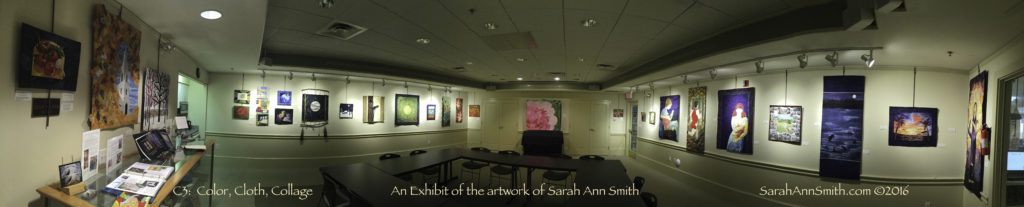
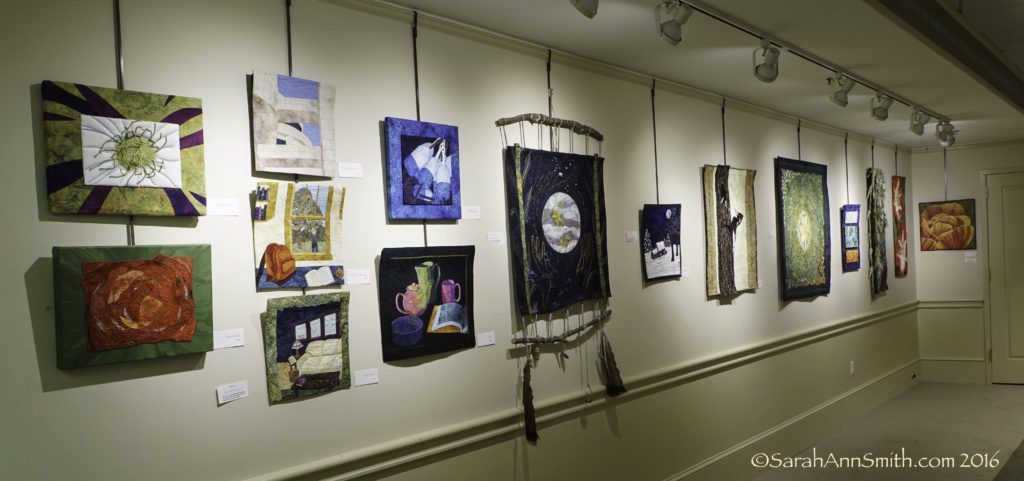
Well, I promised I would blog about the Artist’s Reception and take pictures.  So I remembered to take a picture of the food table (so boring it isn’t here), and as I was packing up I realized I hadn’t taken a single photo as I was busy talking with people, being the gracious hostess and…..I forgot.  But I CAN share the one photo we did get (thank you Terri Tooley!) plus the others I took not-during-the-reception.  And just for Patricia W, at long last a detail photo of the peony (OK, I was gonna share it anyway, but Patricia has asked and I’m happy to share now)!   Thank you so much to everyone who came on Thursday, has been, has visited virtually here and on Facebook, and will get here later this month.  For all the Library photos, if you click on them you can see them larger.

Click on the image to view larger!

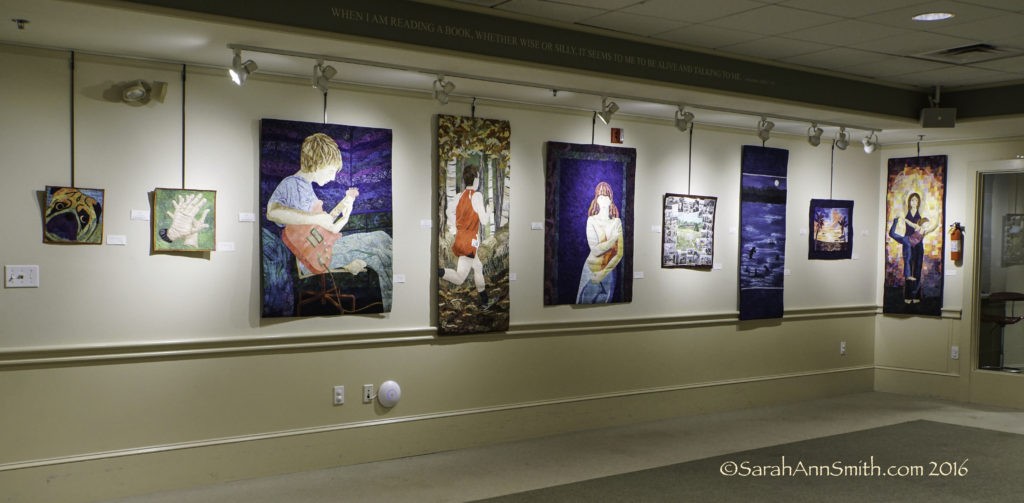
Click on the image to view larger! I’m standing in the doorway to the Picker Room and got it all!

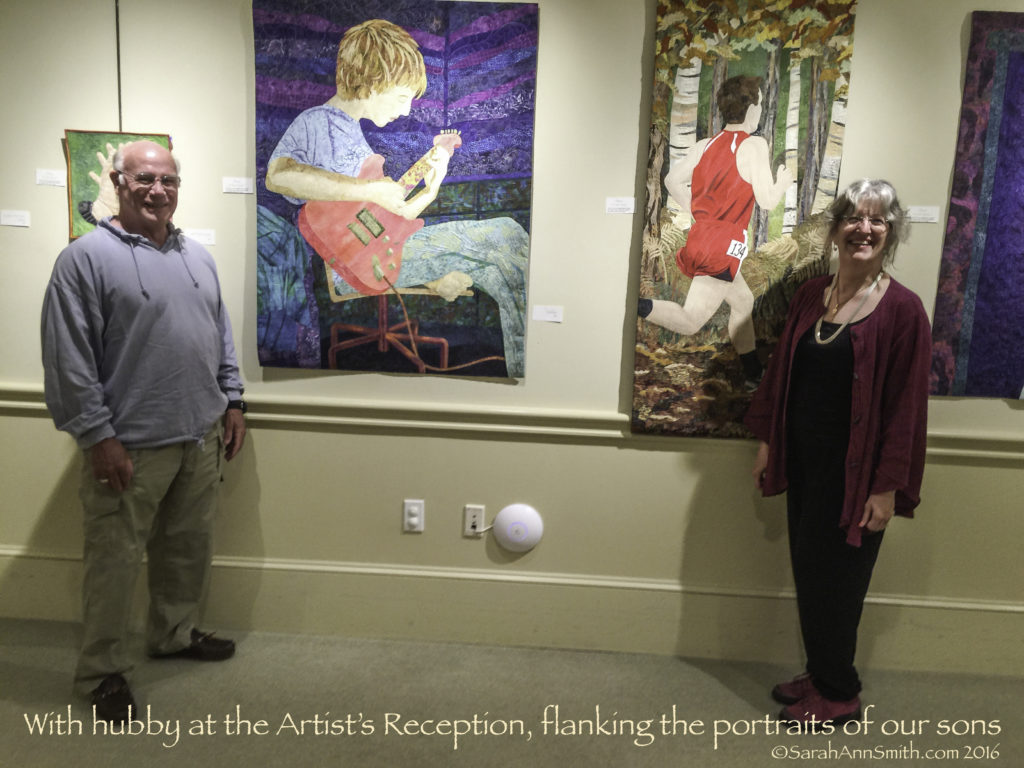
When I finally realized I had forgotten to take pictures, friend and fellow wrestling mom Terri Tooley was still there.  She stepped in to take a photo…Paul said, “this isn’t going to be shared is it?” to which I replied, of course it is!  So here is a RARE photo of Paul, and he’s even smiling!

Husband and wife, flanking their sons (in cloth). Both quilts were of the boys at age 16. Joshua is on the left, Eli on the right.

Husband and wife, flanking their sons (in cloth). Both quilts were of the boys at age 16. Joshua is on the left, Eli on the right.

This is the Rogue's Gallery, also known as the Family wall (and seen above). From left to right you've got Pigwidgeon (of the dog walks photos on Facebook), my hands, Joshua, Eli, me, a family "scrapbook" quilt called the Two of Us which was in the book and exhibit Inspired by the Beatles, the blue orcas quilt, an older painted silk sunset, and the "yoga" quilt.

This is the Rogue’s Gallery, also known as the Family wall (and seen above). From left to right you’ve got Pigwidgeon (of the dog walkies photos on Facebook), my hands, Joshua, Eli, me, a family “scrapbook” quilt called the Two of Us which was in the book and exhibit Inspired by the Beatles, the blue orcas quilt, an older painted silk sunset, and the “yoga” quilt. Unofficially, I am also calling this the Dinner@8 wall, since the five large pieces were all made for juried invitational exhibits put on by Leslie Tucker Jenison and Jamie Fingal.  You can learn more about those exhibits and this year’s here.  My best work over the past six to seven years has consistently been for this exhibit, and I’m honored to be a part of it again this year.

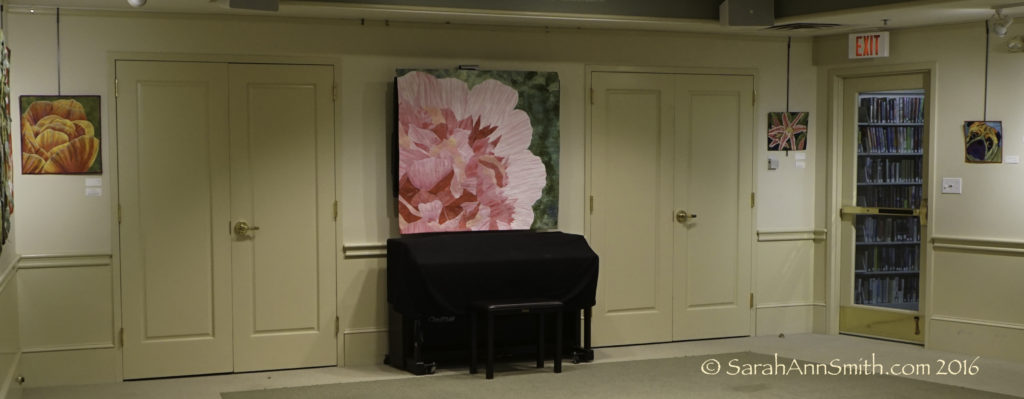
The far wall has two small pieces and my newest, the Peony. The center is challenging to hang, since there is a TV behind the quilt that is used a couple times a month, but it is THE most eye-catching spot.

The far wall has two small pieces and my newest, the Peony. The center is challenging to hang, since there is a TV behind the quilt that is used a couple times a month, but it is THE most eye-catching spot.

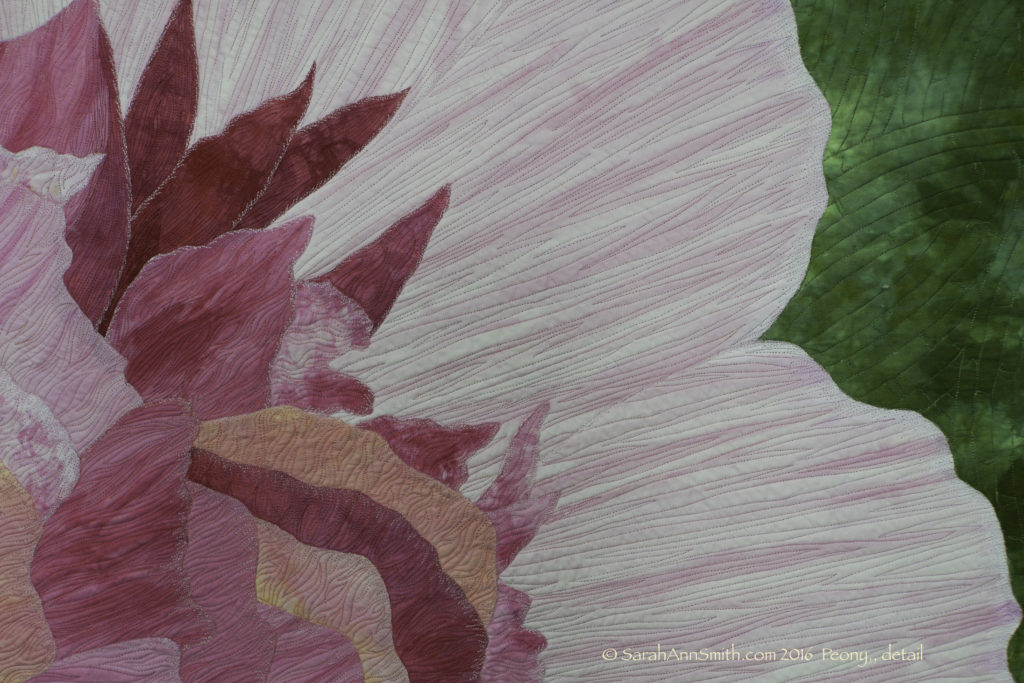
Detail, Peony. I think I need to take more and better detail shots!

Detail, Peony. I think I need to take more and better detail shots!  I believe I used 12 pinks, a white, and a couple variegated greens in this quilt.

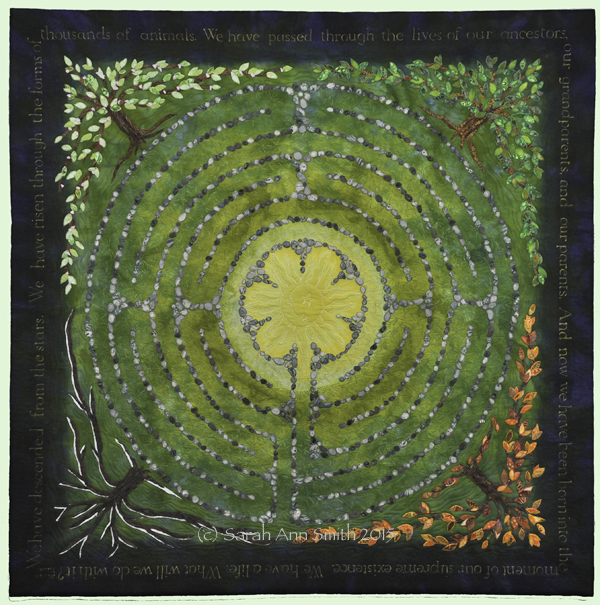
The left wall as you enter is the second most visible spot after over-the-piano/in-front-of-the-tv. I knew I wanted my labyrinth, Descended From the Stars, to anchor that wall. This side of the room is really about my life, and my life in Maine.

The left wall as you enter is the second most visible spot after over-the-piano/in-front-of-the-tv. I knew I wanted my labyrinth, Descended From the Stars, to anchor that wall. This side of the room is really about my life, and my life in Maine and nature.

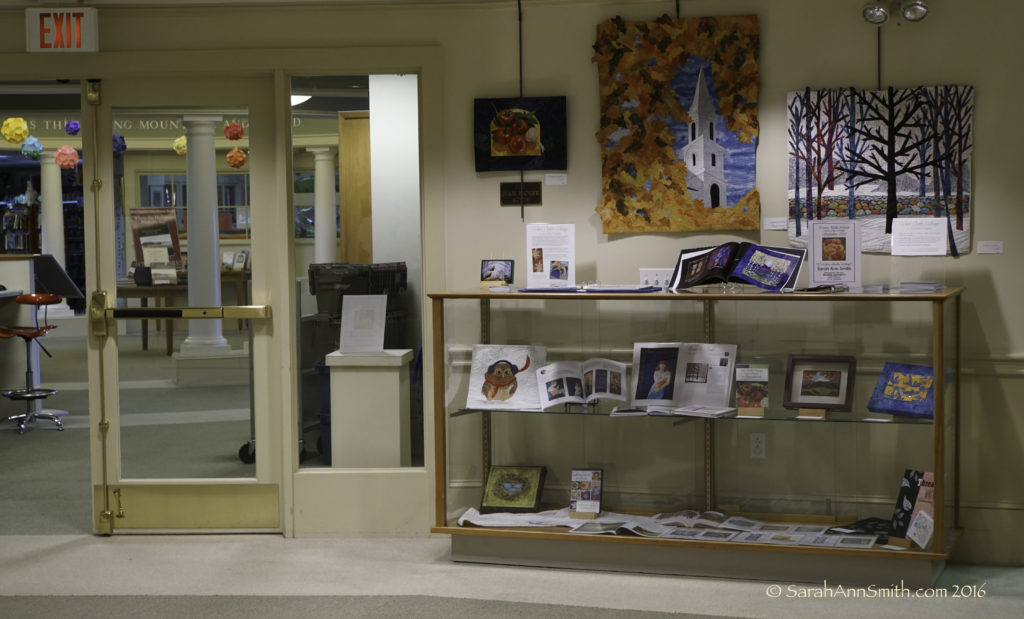
Between the entrance and the mini kitchen area, is a cabinet with a bit of wall.

Between the entrance and the mini kitchen area, is a cabinet with a bit of wall.

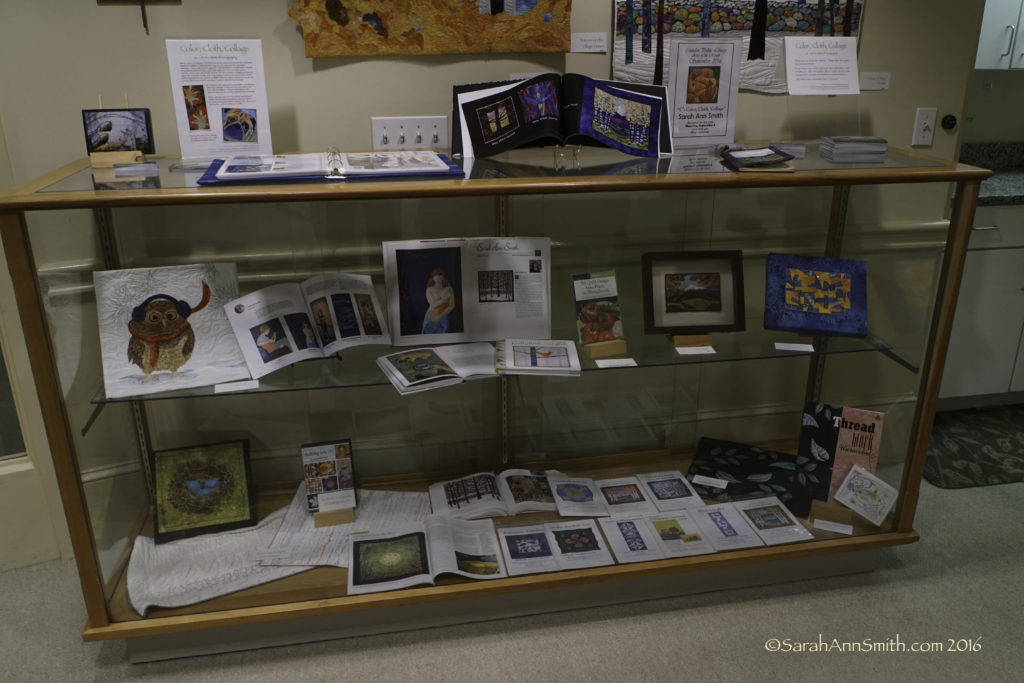
In the case, I put a few of the many books and magazines in which I have been published inside the case, along with my book ThreadWork Unraveled, my DVD workshop, patterns, some class samples and smaller pieces.

In the case, I put a few of the many books and magazines in which I have been published inside the case, along with my book ThreadWork Unraveled, my DVD workshop, patterns, some class samples and smaller pieces.

So there we are!

Thanks to all who could come in person, and to all who are visiting virtually.   I’m so delighted, relieved it looks good, and pleased.  Thank you to the Camden Public Library and Ken Gross, who is in charge of the exhibits among many other duties, for this opportunity. Thanks go to Jamie Fingal and Leslie Tucker Jenison of Dinner@8 Artists for the opportunity to create works for their fabulous juried exhibits.

And last but decidedly not least and so very important, MANY thanks to the companies whose products I use and who have supported me over the years including  MistyFuse, Janome America and Superior Threads.  I couldn’t do what I do without quality materials and machines!   I appreciate your support and encouragement more than you can know.

Descended From the Stars, Part 3

Wednesday, July 20th, 2016
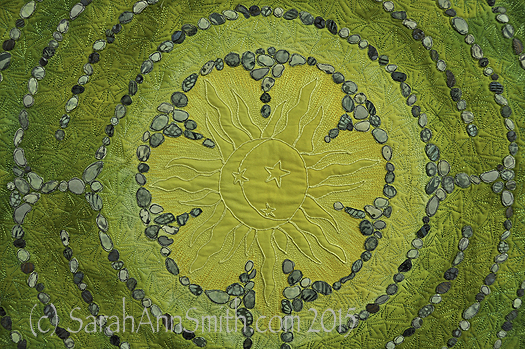
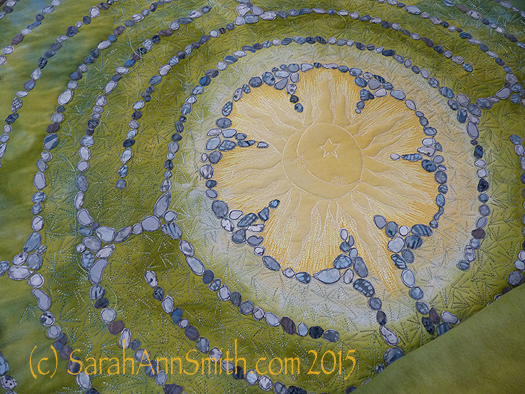
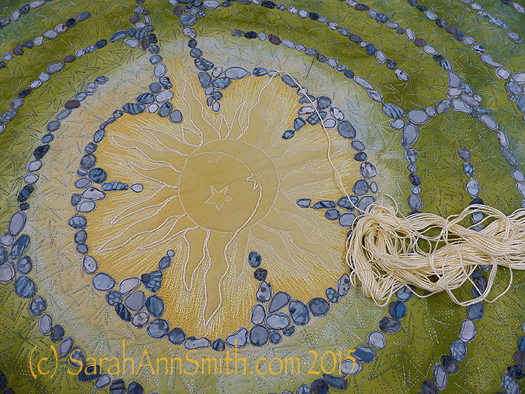
The sun in the center of Descended From the Stars

The sun in the center of Descended From the Stars

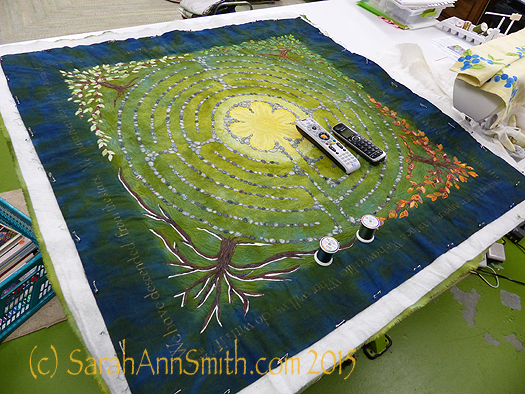
When I left on in my last post about this quilt, I had shared the dyeing process and the stones and lettering.   Next, I fused trees in the four seasons into the corners.  I distorted the shape so the tree canopy served as a frame.  I had thought initially I might need an inner border, perhaps couched yarn or stitching of some sort, but the shape of the tree worked so well I didn’t need anything extra.   As I did with the stones, I cut out leaves, LOTS of leaves, separating the colors into the ice cube tray so I could place them carefully.

Detail, upper left corner, Spring Tree of Life.

Detail, upper left corner, Spring Tree of Life.  Each of the leaves is free-motion stitched with several rounds of thread on each leaf.  The nice part about doing this at the top stage is that I could use the scissors on my Janome 15000.  I didn’t have to bury thread tails!

Detail, top right, Summer Tree of Life.

Detail, top right, Summer Tree of Life.

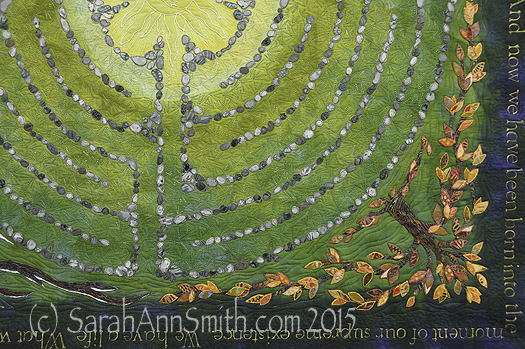
Detail of the lower right corner, showing the autumn tree of life.

Detail of the lower right corner, showing the autumn tree of life.

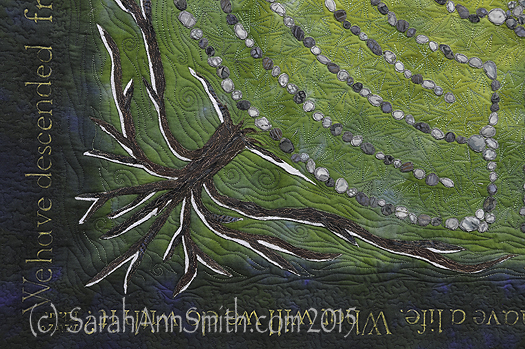
Detail of the lower left corner, with the winter tree kissed by snow.

Detail of the lower left corner, with the winter tree kissed by snow.

I did the stitching around the stones and on the trees, including the leaves, at the top stage with stabilizer underneath.  (See my post here to learn more about my current article for Machine Quilting Unlimited on the Fourth Layer–stabilizer– for densely thread painted quilts.)  I removed the stabilizer everywhere except for under the center because I knew I would want to quilt that area more densely than the rest of the quilt.

Here

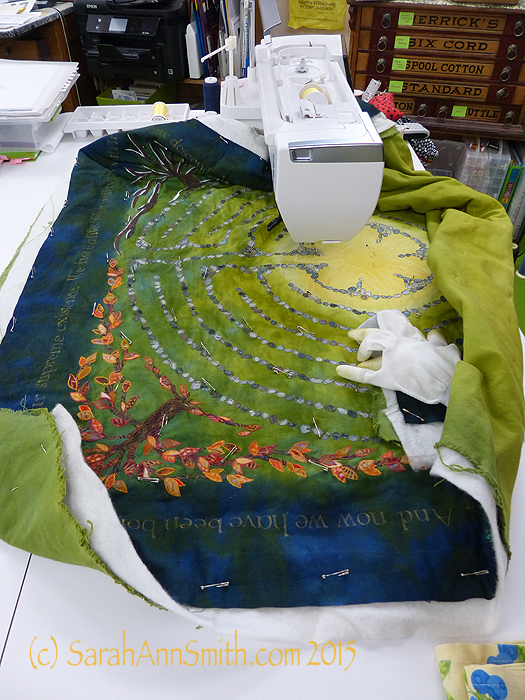
Here I have begun quilting.  You can see the custom-dyed cotton duck on the back.  The use of heavier cloth helps keep the quilt flat and stable; it also helps minimize shrinkage.  The final piece had to be 40 x 40 inches, and I wanted to have a balanced amount of blue on both sides of the lettering, so I needed to control the shrinkage that happens with dense quilting.

Next,

asdfa

Superior Threads (Thank you Bob and Heather Purcell!) has come out with some tone-on-tone variegated threads.   I have been pestering Bob for YEARS to make threads like these as I prefer blendy to contrasty.  I ordered up all of the new earth-tone blendy variegateds in the Fantastico line and used them.  I began with a light green blend in the first row around the sun, switched to another in the next to rings, and then a third in the fourth ring that you see here.  If you look at the left, you can see how I snuck some of the current thread color into the next ring to get even more color blending.

Then, I had to decide what threads to use in the dark areas.  My sewing tables (two back to back) are each 24 inches, so I have a nice, HUGE flat surface to support the quilt as I work.

asdf

Choosing thread:  dark, pine-y green and deep blue.

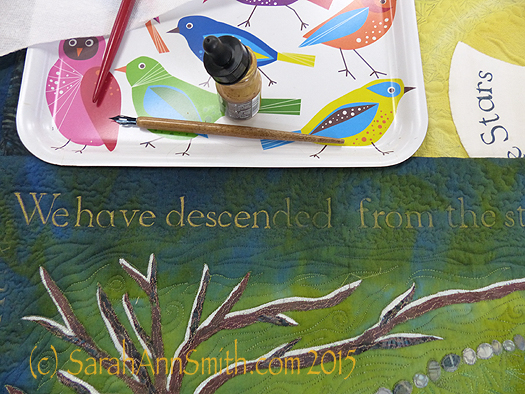
With all the manipulation, I realized that some of the ink had rubbed off, despite being REALLY careful to heat set it according to directions.  I wrote immediately to friends Judy Coates Perez and Susan Brubaker Knapp to seek guidance.  Judy had only used the regular colors, not the metallics.  And Susan had an article in the just-out issue of Quilting Arts about lettering, including these inks!  She too discovered that the metallics seem to “shed” a bit.

After quiting, some of the bling had rubbed off my quilt, so I had to do it AGAIN!

After quiting, some of the bling had rubbed off my quilt, so I had to do it AGAIN!  You can see where I have inked over the letters and what is left to re-do.

After re-inking and heat setting, I tested on my scrap cloth several products to seal the ink including GAC 900 (a textile medium that one adds to paint), a UV Coating, matte gel medium, and Krylon Spray Fixative which says it is acid-free, archival and safe on fabric.  Only the Krylon didn’t leave tell-tale signs that it had been used.  So I carefully masked off the rest of the quilt, leaving only the lettering area exposed and sprayed the Krylon on it (stinky!) in hopes that will help prevent the mica flakes in the gold ink from coming off.

I was nearly done, except that I didn’t really care for the multiple layers of thread I had used stitching the sun.  Picking it out did NOT appeal to me.  So I trekked down to Clementine fabrics in Rockland and bought some perle cotton in the right color.

I wasn't happy with the way the stitching looked, so I couched perle cotton on top of the outline of the sun.  MUCH better!  You can see the difference in this half-way-through shot.

I wasn’t happy with the way the stitching looked, so I couched perle cotton on top of the outline of the sun. MUCH better! You can see the difference in this half-way-through shot.

At last, it was nearly DONE!  Time for facings, sleeve and label.

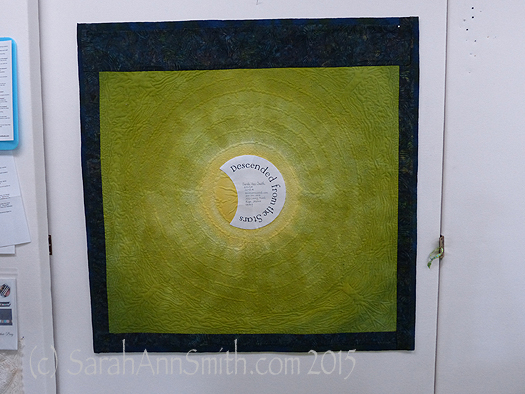
The back side of the quilt.  By dyeing the back to correspond with the front, the quilting design shows up on the back as it does on the front.

The back side of the quilt. By dyeing the back to correspond with the front, the quilting design shows up on the back as it does on the front.

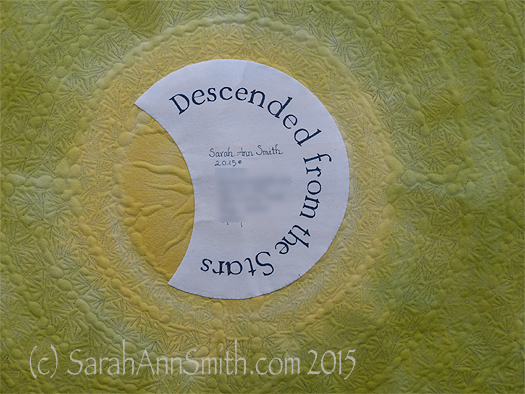
And I couldn’t resist the temptation to place a moon behind the sun as my label.  One more time with the dip pen!

The End--the label is on, the sleeve is done, the facings are stitched!

The End–the label is on, the sleeve is done, the facings are stitched!

(c)Sarah Ann Smith 2015; quote (c) Mirza Khan, used with permission

(c)Sarah Ann Smith 2015; quote (c) Mirza Khan, used with permission

This quilt will be for sale–another reason I opted to not include a lot of personal details in the quilt.   As I said before, I am happy!

A labor of love–a quilt from A grandmother’s wardrobe

Wednesday, March 2nd, 2016
A snuggle quilt

A snuggle quilt

I honestly don’t know how long I had the fabric for the two lap quilts I just made.  Maybe 18 months ago (?) Joshua’s sweetie Ashley asked if I could make a lap quilt from some of her Grandmother’s clothes.  Of course I said yes!   Her gramma had died recently, and Ashley’s mom, Sue, was really missing her.  I looked up some quilts on the internet, hoping for a pieced pattern that would work for a scrappy quilt, look good, yet not take a ton of time to assemble.

When Thanksgiving rolled around and her mom came up to Maine for the holiday, she brought with her….gulp…three white kitchen garbage bags FULL of clothes:  turtlenecks, sweatshirts, fleece tops, a fleece bathrobe and a couple of nighties.   Oh.  My.  Not a single woven anything.  Wish I had taken pictures before I began the deconstruction process!

These are just a few of the leftovers!!!! Yes, that is one of those huge IKEA bags. I started with the equivalent of three of those!

These are just a few of the leftovers!!!! Yes, that is one of those huge IKEA bags. I started with the equivalent of three of those!

And Sue asked if I could make two quilts, not one–one for her and one for her brother.  Sure!   I showed Sue the images of quilts I’d found and she picked the square in a square design you see above.   The original was quite scrappy, and went from lights in the center to mediums to darks, with a half-drop on the columns.  Alas, I seem to have deleted the original photo, plus I don’t know where I saw it anyway!

The second quit, on my sewing table. It is about 60x66 inches finished.

The second quit, on my sewing table. It is about 60×66 inches finished.

Well, let me tell you–the lesson is to make sure FIRST what the fabrics are.   Then see if you can ask (I didn’t) if you could buy and use something woven for the back.   I didn’t fully realize how much time it was going to take to prepare the fabrics.  First I had to cut apart the shirts and sweatshirts and nighties.   Then I figured out how I could maximize the fabric in the body and sleeves.   I cut those bits a bit oversized and, having made a trip to Joann’s Fabrics with a fifty percent off coupon to buy a bolt of tricot interfacing, I starting fusing the interfacing to the stretchy turtleneck fabric. Then I made another trip to Joann’s and bought another bolt (almost used up).

FINALLY, I could start cutting out the pieces.  I decided given the fabric, it would be best if I used a 3/8″ seam (from needle to edge of walking foot) and pressed the seams open.  And I decided to use only turtlenecks and nighties for the top, leaving the sweatshirts I had deconstructed for the backs.   I sorted and stacked.  I sewed blocks, trying not to duplicate any pairing of fabric.   I realized that I had lights and darks, but no mediums.  OK, the point of this quilt is love and family, not duplicating a picture from the internet.  Mental adjustment.

Once I got to sewing, it went fairly quickly:  sewing the blocks for and assembling the two tops took less time (by quite a bit) than prepping the fabric!   I divided the blocks into two pretty equal piles and started plopping them on the design wall.  Turned out I had enough for two very similar quilt tops six by seven blocks (they are about 9.5 inches finished).

Next:  backing.  I laid out the sweatshirt fabric:  enough for one backing.  So I also cut apart the fleece tops.  I decided to make one quilt with only sweatshirt fabric, the other with only fleece, to avoid “bad behavior” on the part of the fabrics.

Laying out the fleece for the second backing

Laying out the fleece for the second backing

I cut batting (poly needle punched from Quilters Dream) a little larger than I needed.  Then I sewed the larger squares to the batting batting by overlapping the edges and using a zigzag to join the “seam” and attach it to the more stable batting.  Regular seams would have been ridiculously bulky and stiff.  I didn’t interface the backing as the quilt was going to weigh a ton already, plus I didn’t think the interfacing would stay stuck long enough to do any good.

I used the walking foot (thank heavens) on my Janome 15000 (thank you again to Janome America for their support and the loan of this phenomenal machine) to quilt a spiral from the center out, then switching to straight lines in the dark border.  I used a variegated light color for the center, and a purplish variegated for the outside (Superior Threads).

Quilting in progress....it was a workout

Quilting in progress….it was a workout

The two lap quilts, the one with the sweatshirts on the back is on the right, back side up. Can I just say it weighs a flipping TON!

The two lap quilts, the one with the sweatshirts on the back is on the right, back side up. Can I just say it weighs a flipping TON!

The two quilts, the one with fleece on the back folded and on top of the other one.

The two quilts, the one with fleece on the back folded and on top of the other one.

The only thing from those three big bags I did not use was the green fleece bathrobe!  I have a few sorta larger pieces of fleece left, and then stuff like the cuffs and top of shirts left.  And oh….I used a dark blue solid for the binding.   Done!

The slivery bits too small to use for anything else

The slivery bits too small to use for anything else–yes, my garbage in my studio is one of those big garden tubs!

I’m so glad they are done, and so glad I was able to make them.   It will be a while, though, until I do another something like this–I may need to lift weights to be ready for the quilting process!  Eli may want a t-shirt quilt for college, but I’ve already told him, it must have woven cotton sashing on the front and a regular quilting cotton on the back!   I’m really looking forward to being able to give these to Sue (or have the kids take them down to Connecticut to her) and really, really hope she and her brother like them and enjoy being snuggled in a “hug” from their mom / mom’s quilt!