email Youtube

Home
Galleries
Blog
Workshops & Calendar
Store
Resources
About
Contact

Author Archive

Miriam Coffey, Janome Educator, at the Janome Education Summit 2018 Post #5

Monday, July 9th, 2018

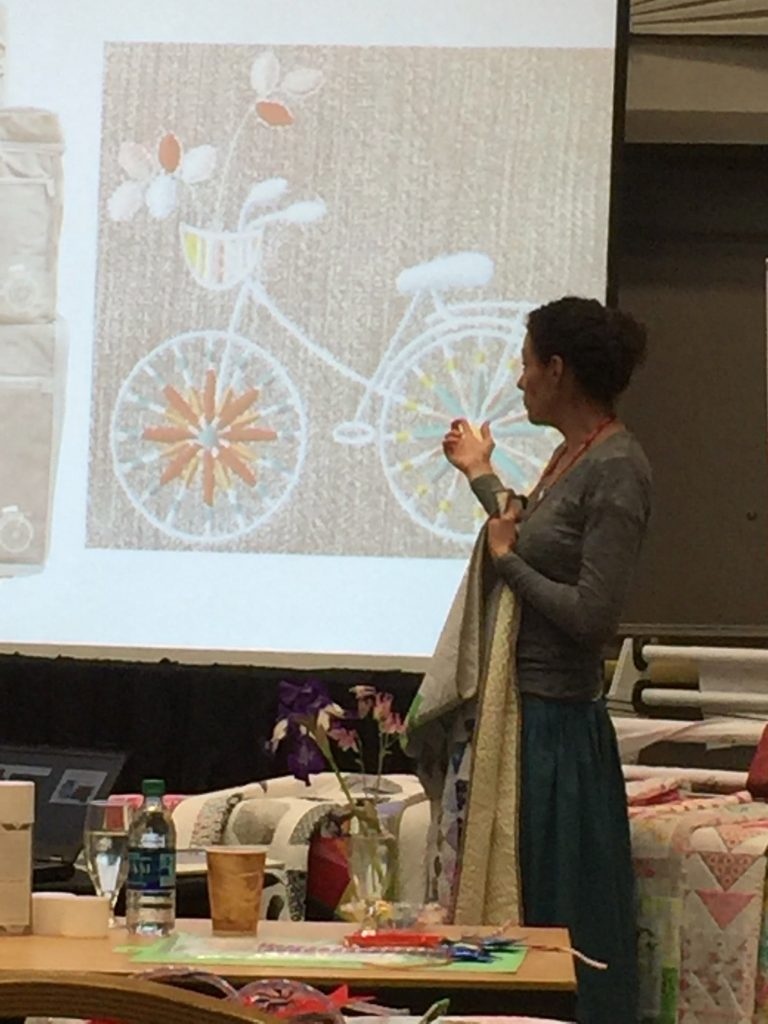
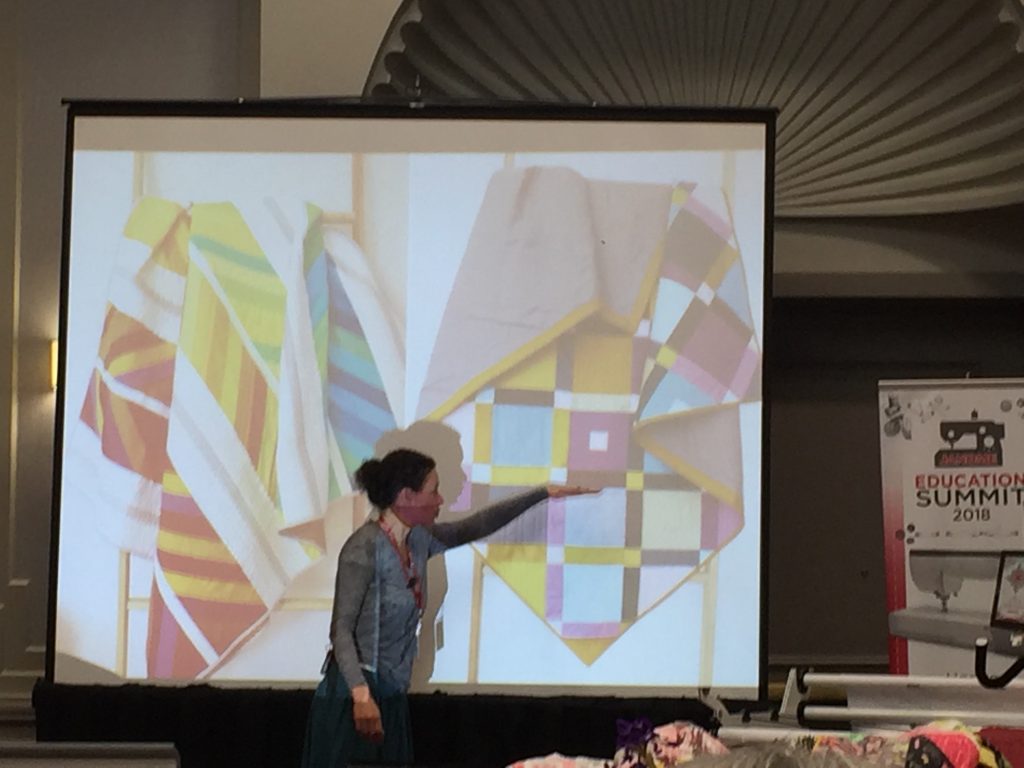
Several years back I had the great good fortune to have Miriam as the educator in one of the classes I taught in Houston.  It was fun to see her again at the Summit, and a jaw-dropping experience when we got to see some of the goodies she has made.  As she put it, she’s not a bows and teddy bears sort, but she DOES to machine embroidery on her Janome embroidery machine. I don’t do hearts and bows either, so I love how her entire approach–totally in keeping with her personality–is fresh and fun and inspiring.
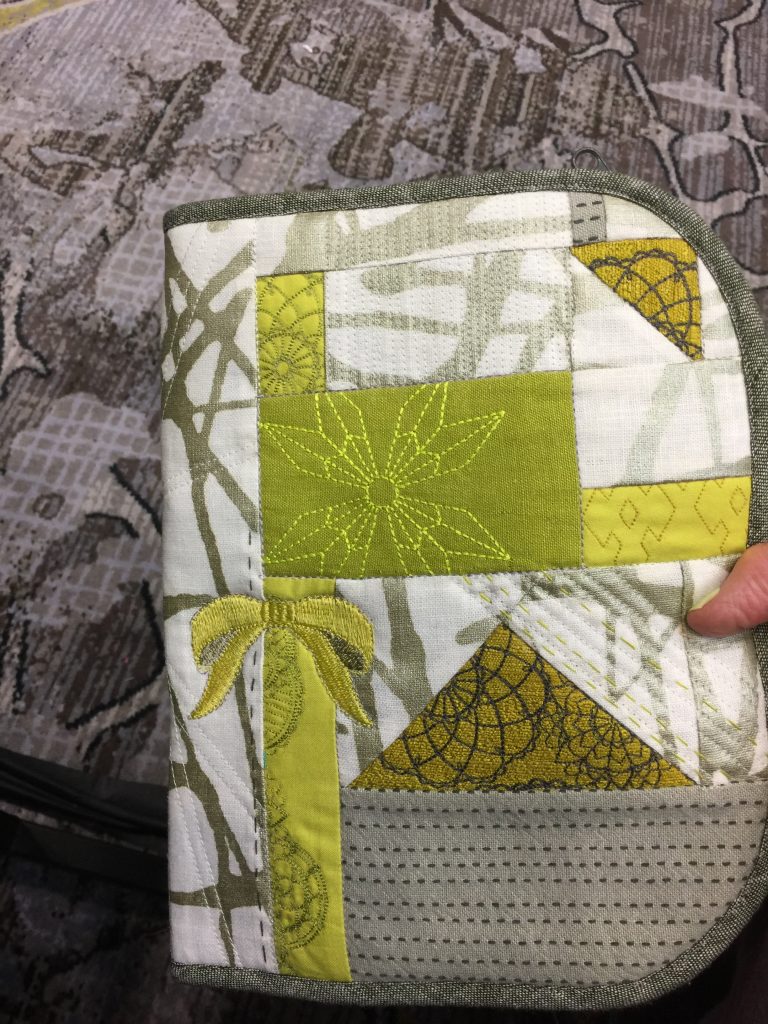
Miriam brought show and tell, and it’s a miracle none of us tried to sneak home some of her goodies, except we wouldn’t do that to her! This sewing items case (could easily be an iPad cover etc), she used the embroidery module to create fabric, then cut the stitched fabric designs apart to use in patchwork. All those green bits were solid / plain fabric until she decorated them with embroidery.
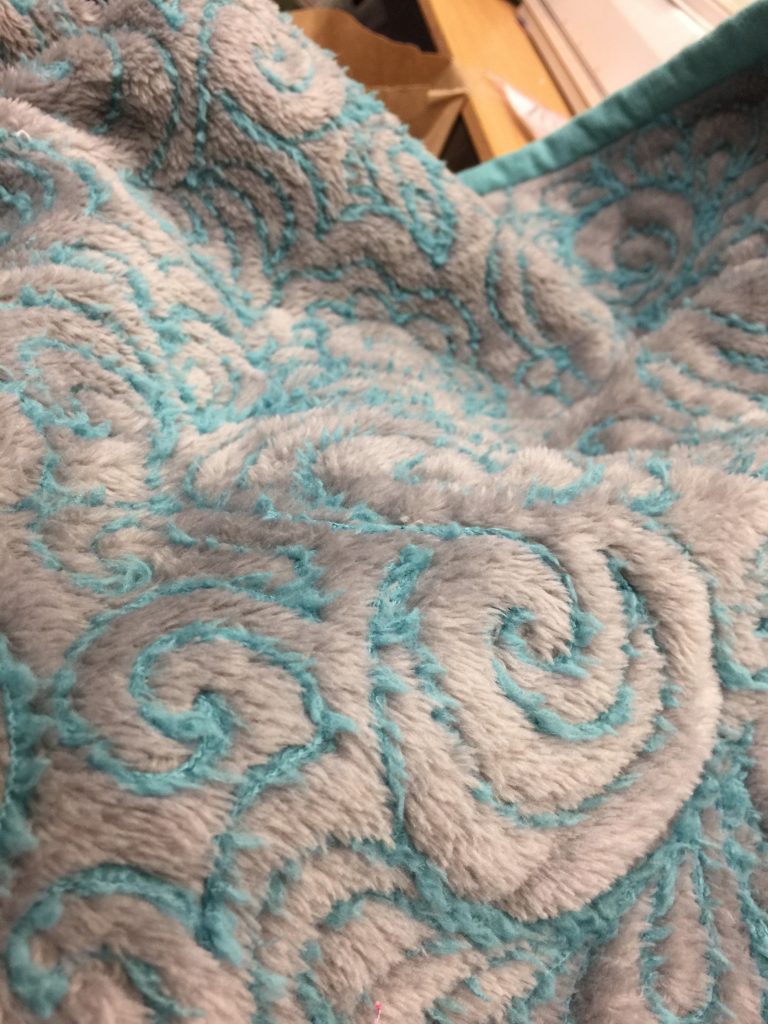
Miriam must have been sitting under a vent because she was wrapped in this snuggle throw. It was made from flannel on one side, the Cuddle fleece (see earlier post) on the other, then free-motion quilted using fuzzy yarn and the couching foot. Let me just say I loved it so much I have already ordered fleece which is waiting for me in my workroom!
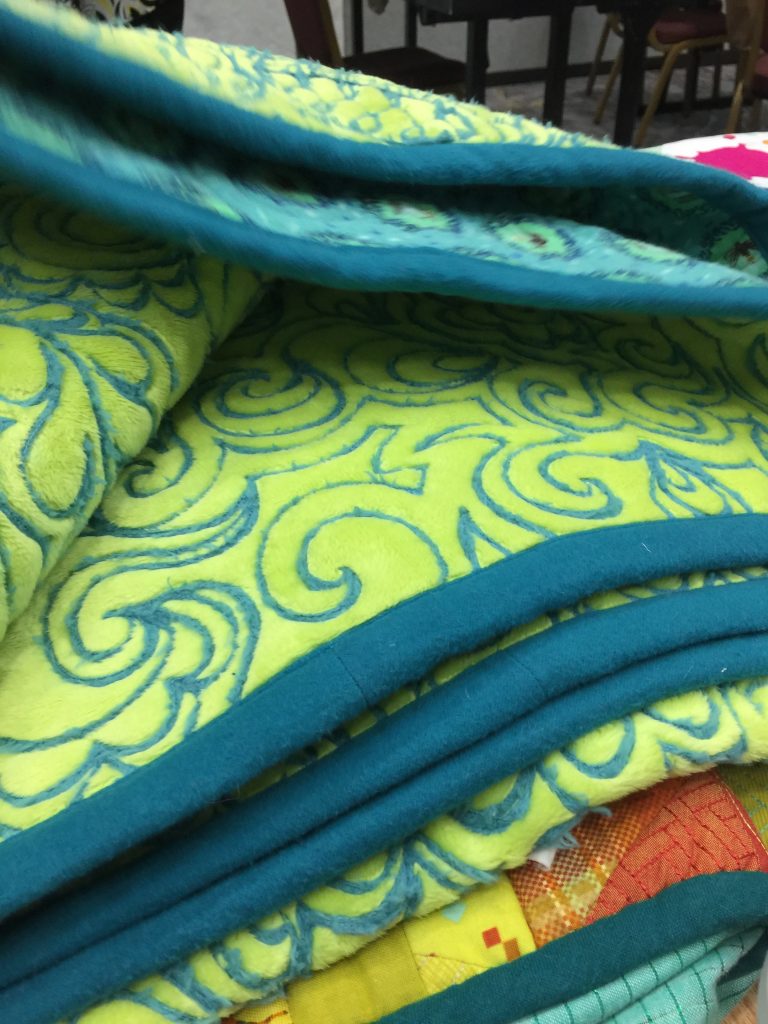
And another one of those throws. WANT!
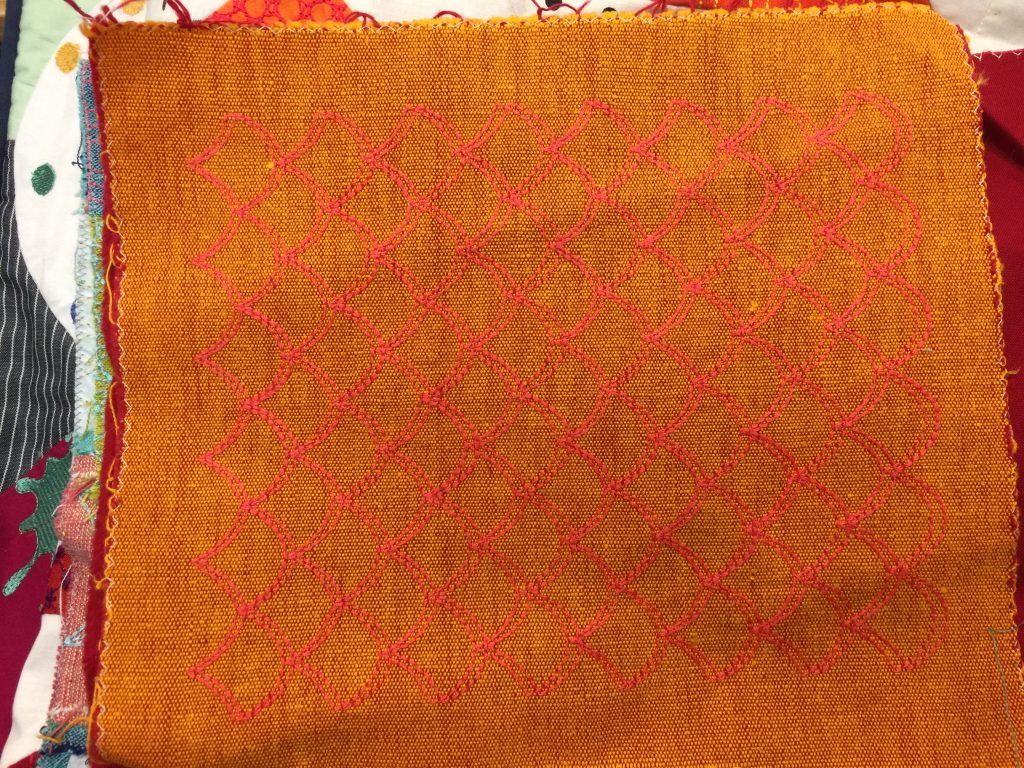
Here’s a close up of a sample: Miriam hooped the fabric, embroidered it with a sashiko pattern (I think using a twin needle)
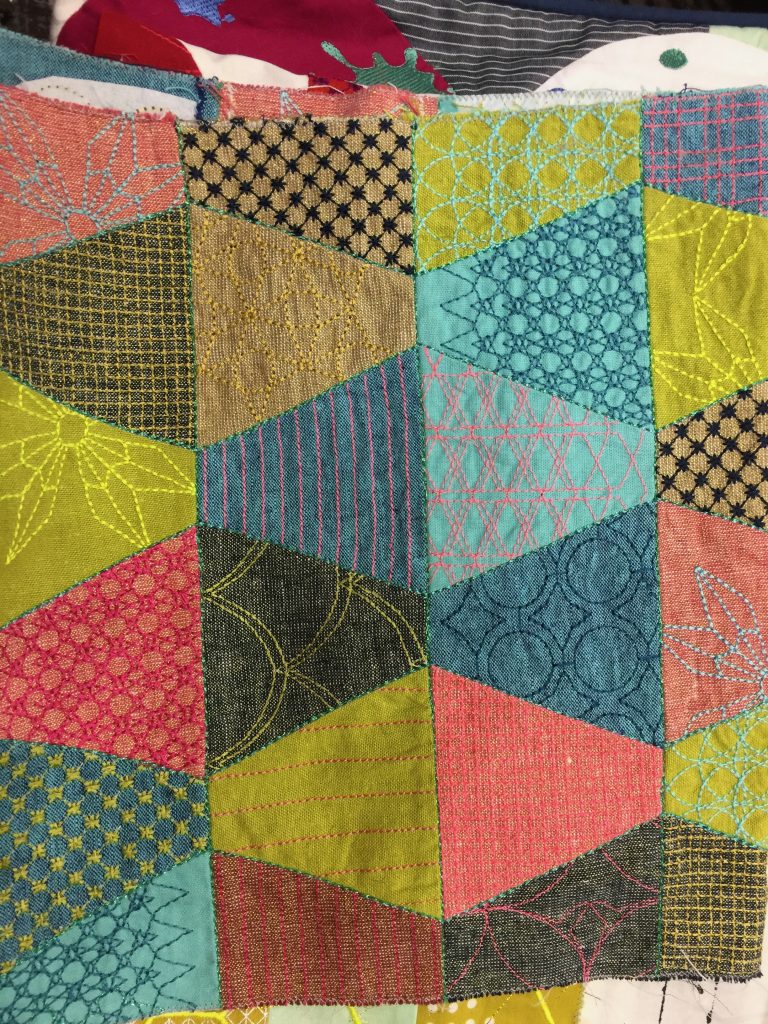
Lookit how modern the tumbling blocks pattern become hen using cloth that Miriam “made” by embroidering a simple solid.  With a little imagination, it would be possible to achieve some of this effect just using the decorative stitches on most machines.
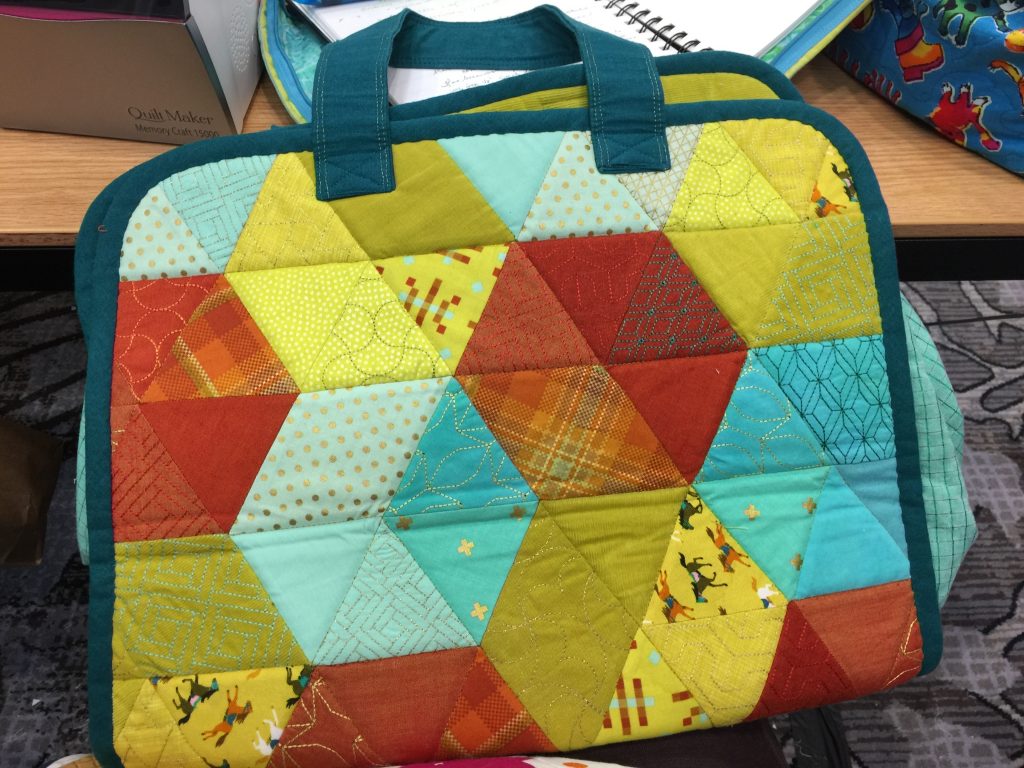
A case Miriam made…same idea!
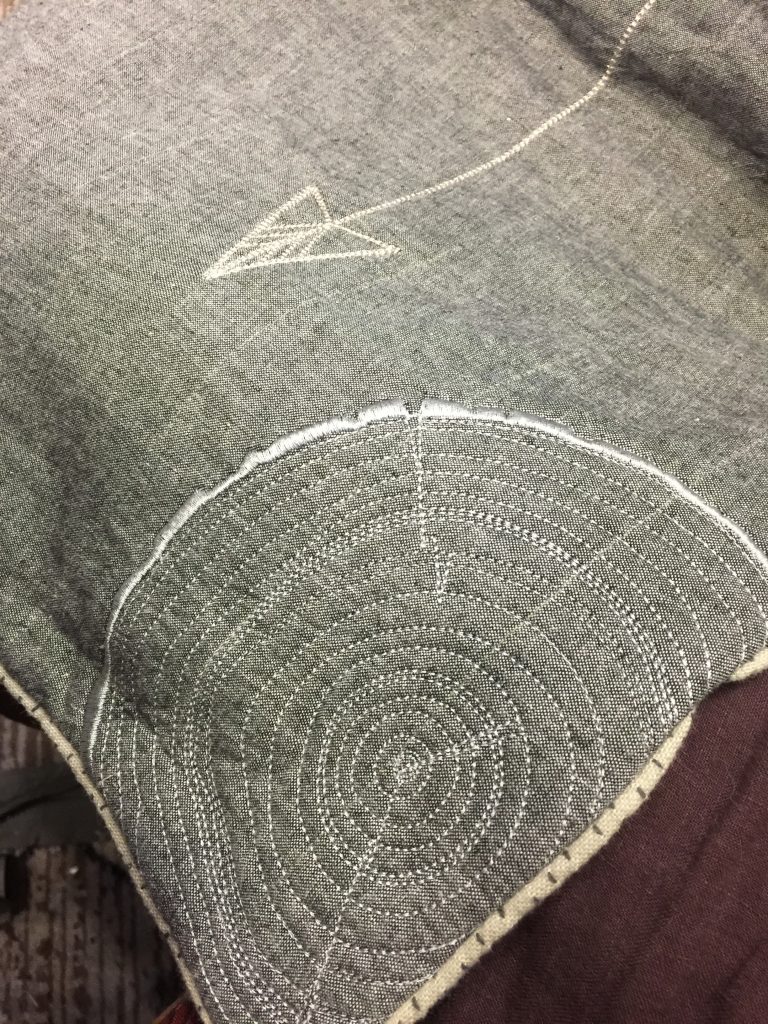
This is part of a wall hanging Miriam made using programmed designs. But I want to try to re-create that cross-cut of tree bark and tree rings just using the variable zigzag feature on my 9440 and free-motion stitching.
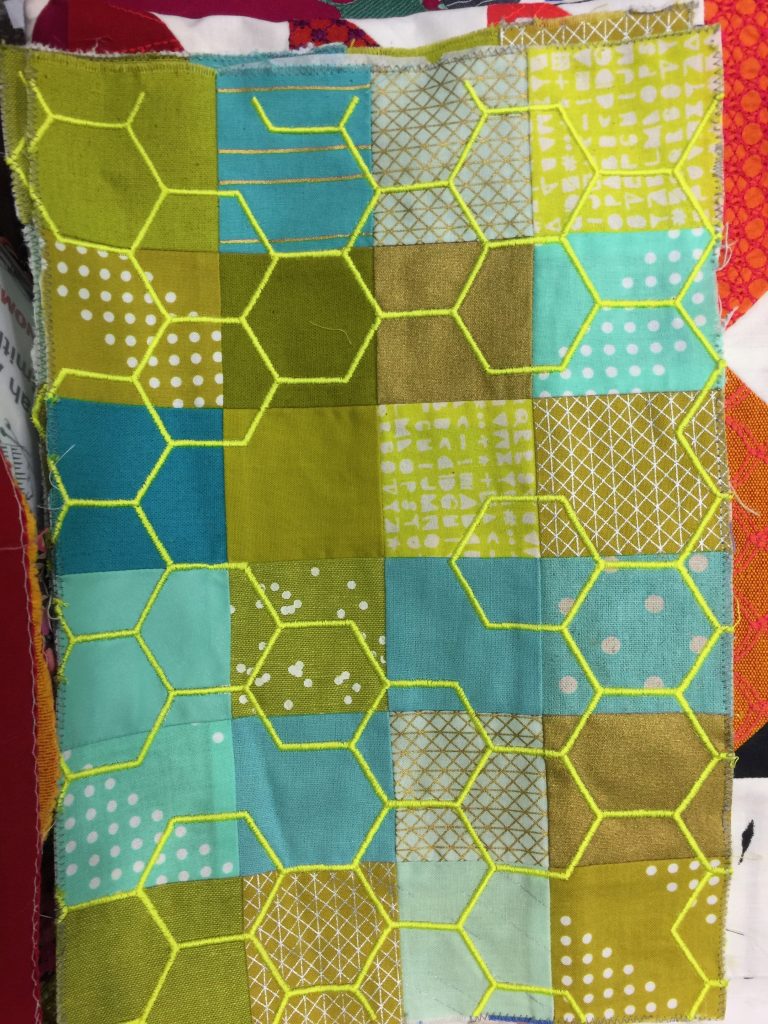
And a sample of a honeycomb programmed stitch (done on the embroidery module) on top of pieced squares.   It would be a fuss, but you could do this (probably not as perfectly!) using careful marking and a satin stitch, but obviously lots easier when it is a programmed design on the 15000 that you hoop and hit “start.”   It’s almost enough to convince me to try embroidery LOL!

Anyway, Miriam was so much fun to have in class…helpful, professional, capable, and obviously has a lot of creativity and skill to teach and share.  Thanks for schlepping ALL those things to share with us, Miriam!
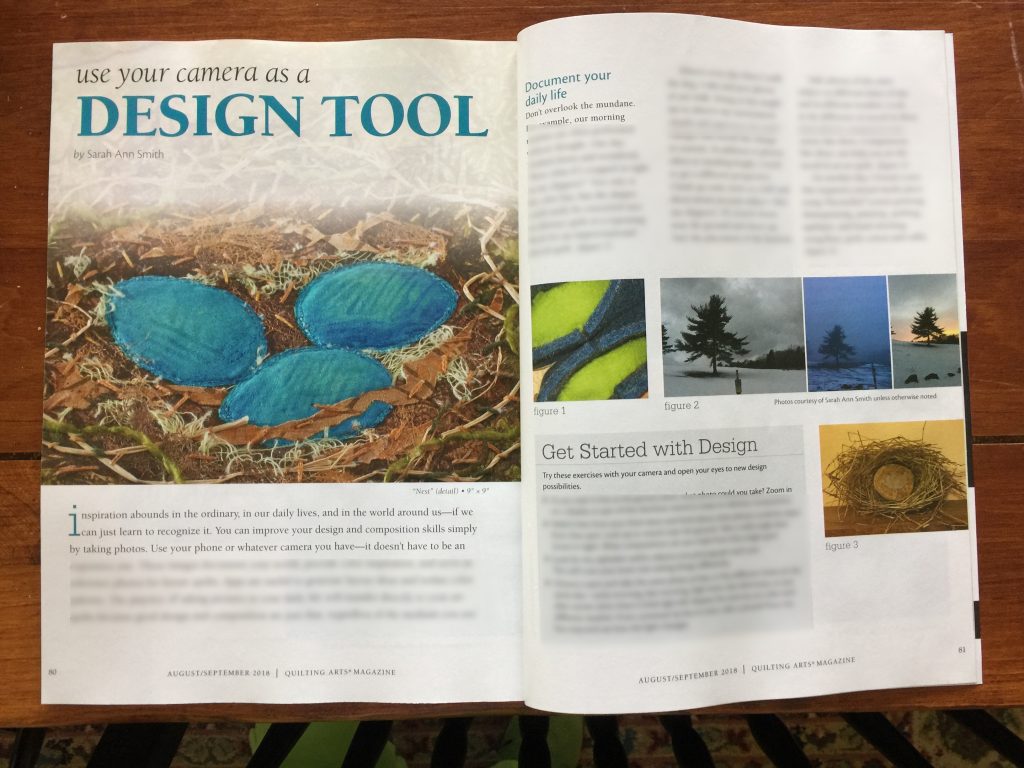
Quilting Arts–my article on using your camera as a design tool

Saturday, July 7th, 2018

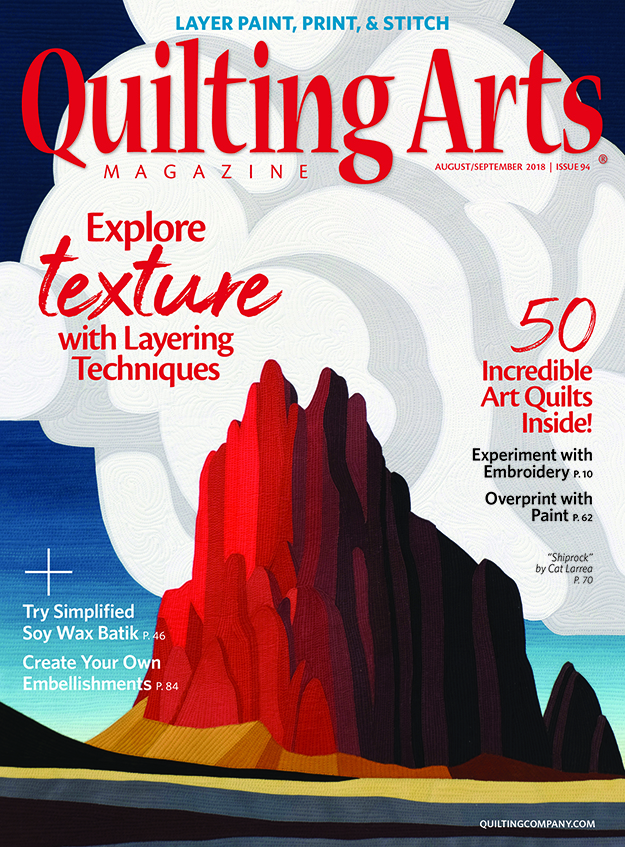
Delighted to share that I have a new article, “Use you camera as a Design Tool” in the August/September 2018 (just came out) issue of Quilting Arts magazine.  The article is inspired by my “Inspiration in the Ordinary” lecture which encourages quilters–traditional, art, modern, any and every kind–to look for inspiration in the world around them.  All the photos in this quilt and in my lecture were taken in my daily dog walkies and a couple forays (to the farmer’s market).

Delighted to be published in Quilting Arts magazine again…gosh, I just realized the first time I was published in QA (and in a national magazine ever) was twelve years ago!

The cover of the issue with my article and some great ones by friends that I can’t wait to read!

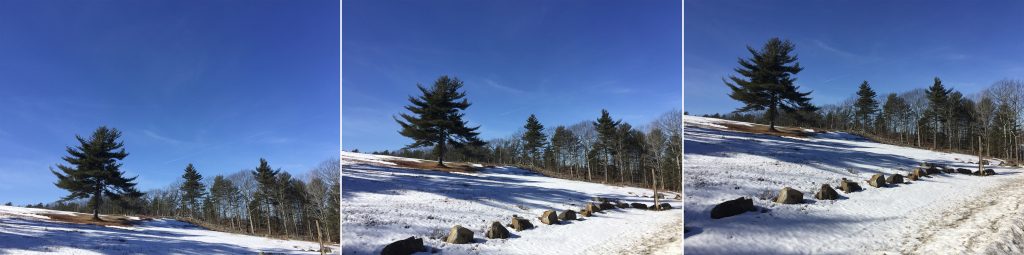
There are examples of my world (including my slippers), some challenges for you to try to think, or re-think, how you approach design.   After all, good design, a good composition, is just that.  It doesn’t matter if it is a photograph, a quilt, a painting, a garden.  The same principles apply.  In the next couple of weeks I’ll share a few more tidbits that didn’t fit into the article so by coming to my blog, you get even more!   Here’s today’s tidbit:  pause briefly and take three shots changing only the horizon line.

Look at what a difference changing the horizon line makes in your composition. Three quick snaps with your phone on a dog walk to practice design.


I’ll be back soon with more tidbits!

SaveSave

Tamara Kate of Kayajoy Designs, Janome Education Summit 2018, Post #4

Friday, July 6th, 2018

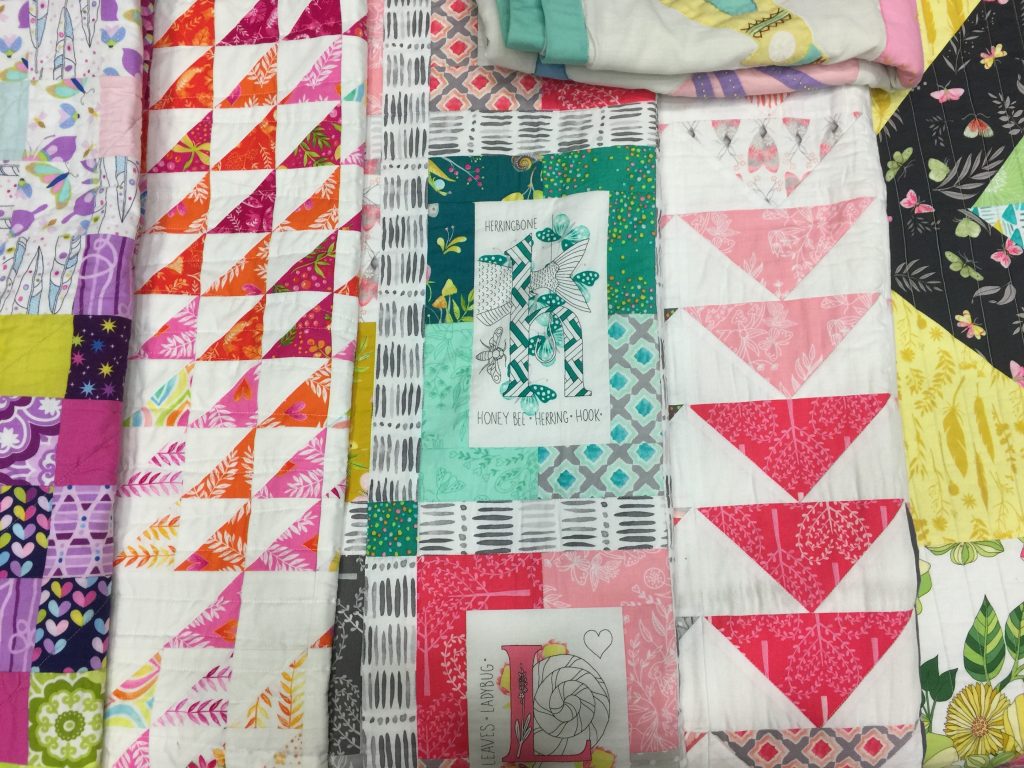
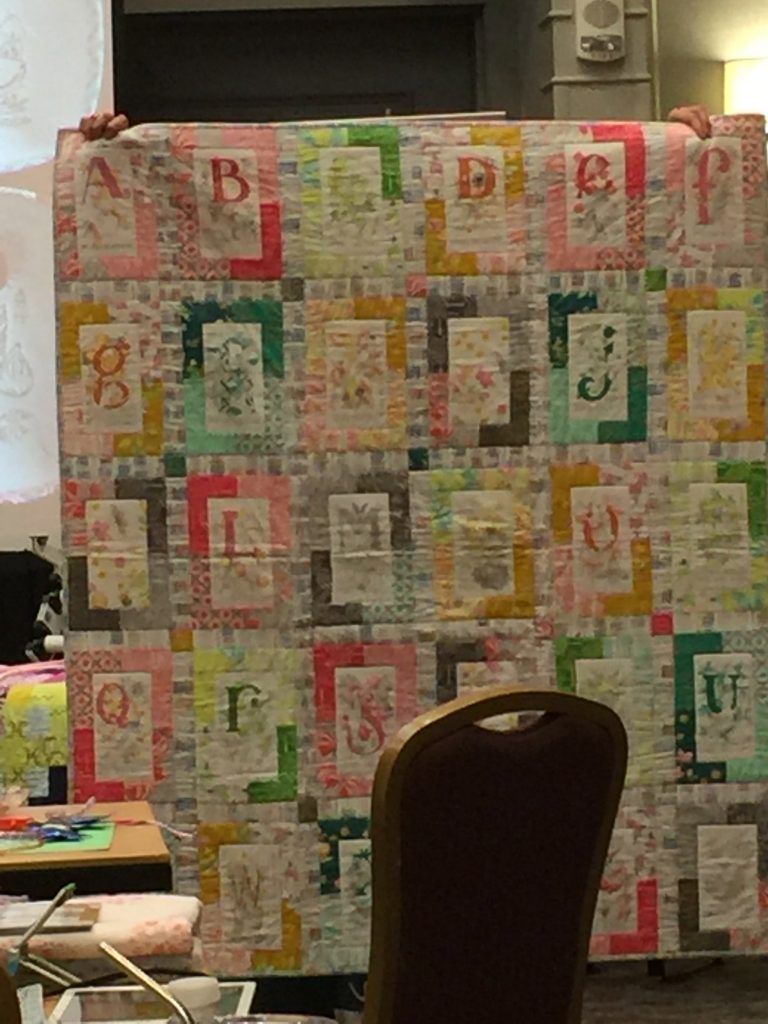
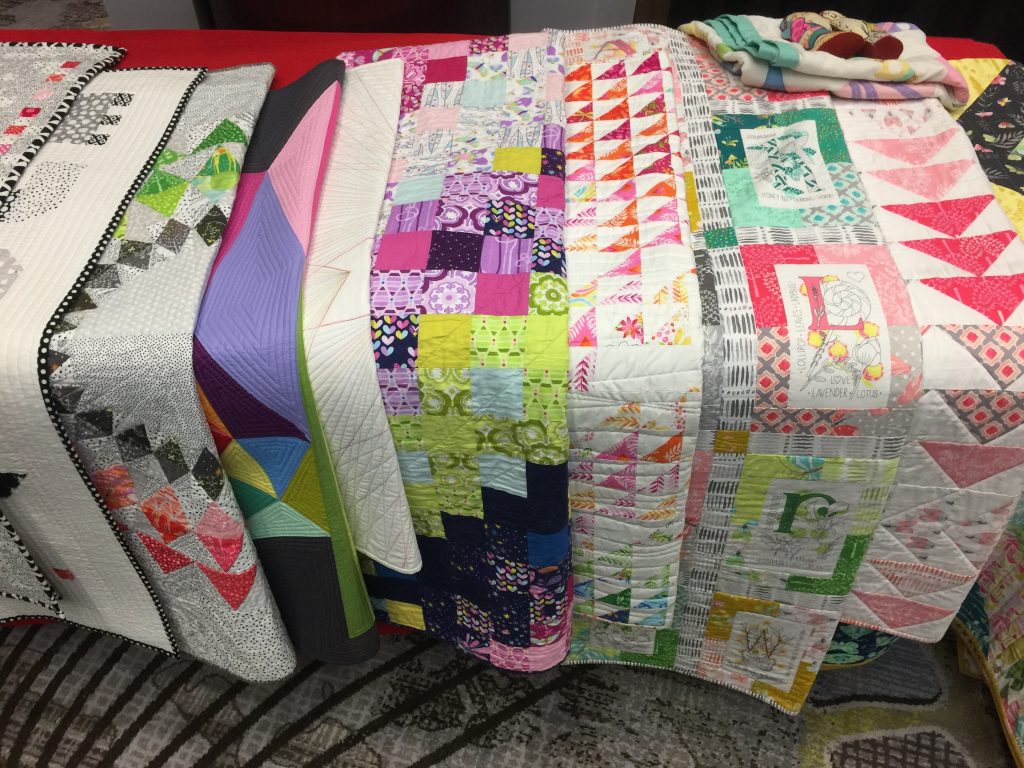
An enticing bit of Tamara Kate’s beautiful quilts and style.  These are made with her fabrics, and the “h” and “L” are her embroidery and printed fabric designs.   I absolutely love her color palette!

Hi everyone…thought I’d rap up my posts on the Janome Education Summit in late May before they are ancient history.   One the first day, I noticed what this woman was doing across the aisle from me with Kimberly Einmo’s flying geese units and fabric, and was smitten instantly.  Turns out it is Tamara Kate Serrao of Kayajoy Designs.  Her quilts, embroidery and fabrics are so inspiring…if she had had yardage there I would have gone home with a whole bunch!  You can find her on FB as well as her website.

Here is Tamara Kate showing one of her embroidery designs (that was on a tote we got in our swag!)

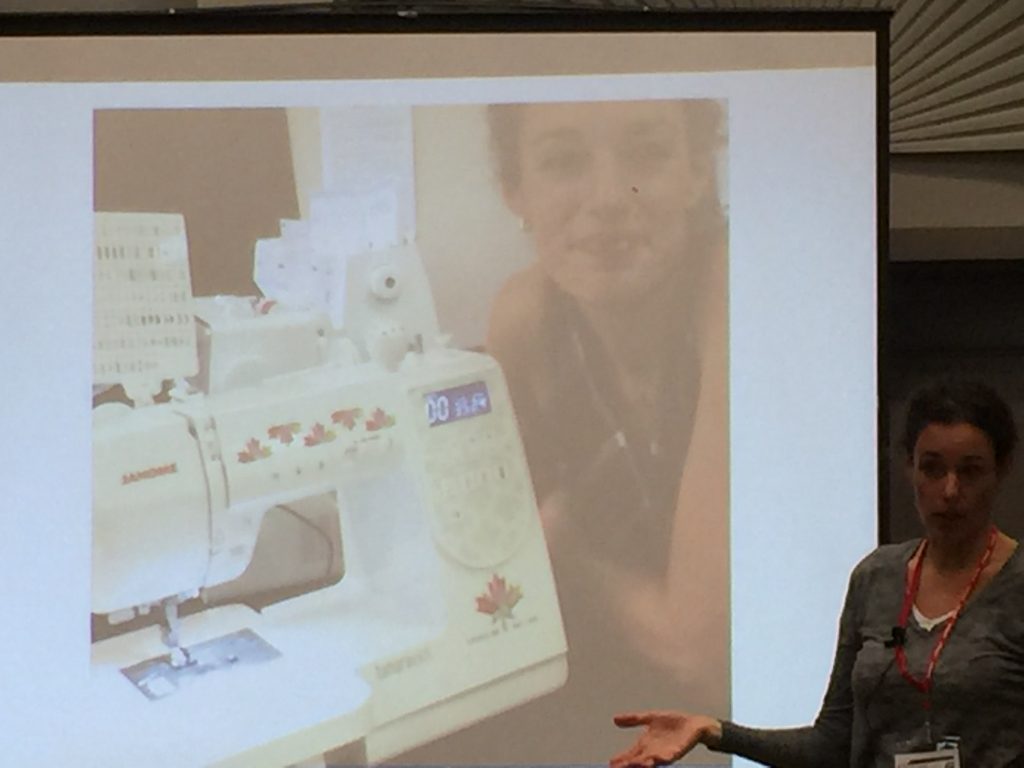
Tamara Kate has a fascinating background, being from both Nova Scotia and Trinidad.  She is the Janome Canada spokesperson, and designed a phenomenal Maple Leaf Quilt as well as a special (gosh I wish I’d known about it) Janome machine for Canada’s 150th anniversary a couple years ago.

Tamara Kate showing an advert with the machine she designed, complete with maple leaf.

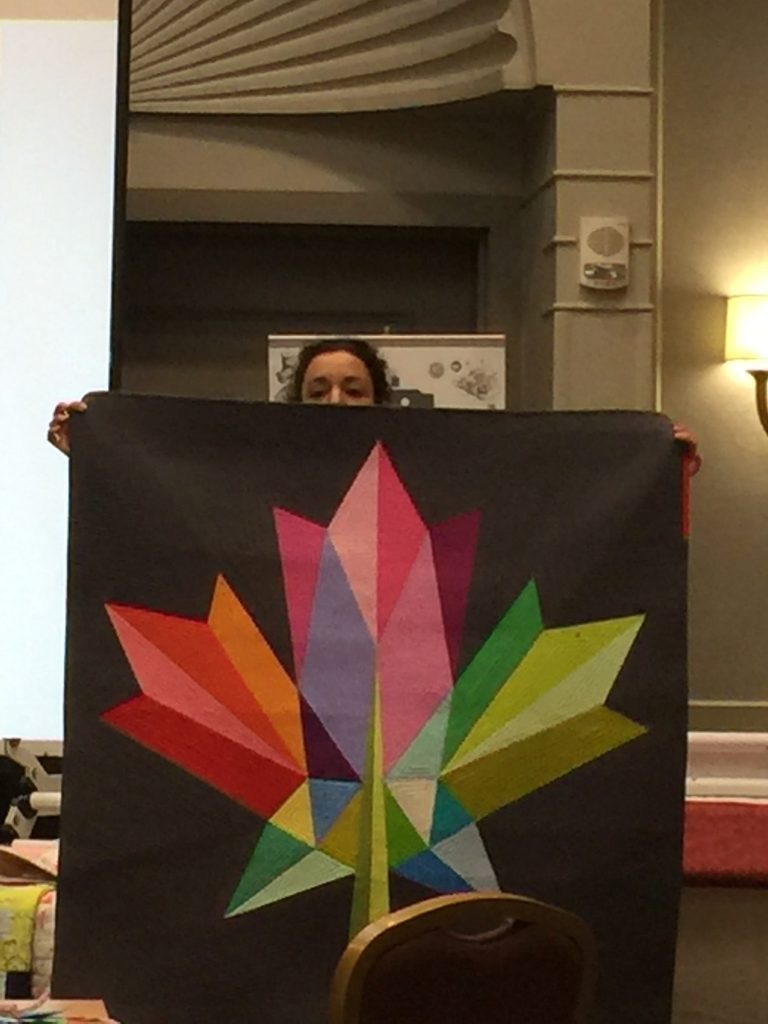
And here is that QUILT….her work is very much in the Modern Quilt aesthetic, but it also is infused with this like watercolor-y feel, palette and fresh vibe that still pays homage to our quilting history.

Tamara Kate Serrao’s phenomenal and inspiring Maple leaf quilt.  Pattern available here.

You can see this quilt on her website and find the first of several blogposts at JanomeLife.com with instructions on making this quilt here: https://janomelife.wordpress.com/2016/09/07/tamara-kate-quilt-along-part-1/  Have I mentioned recently how much I love her colors?

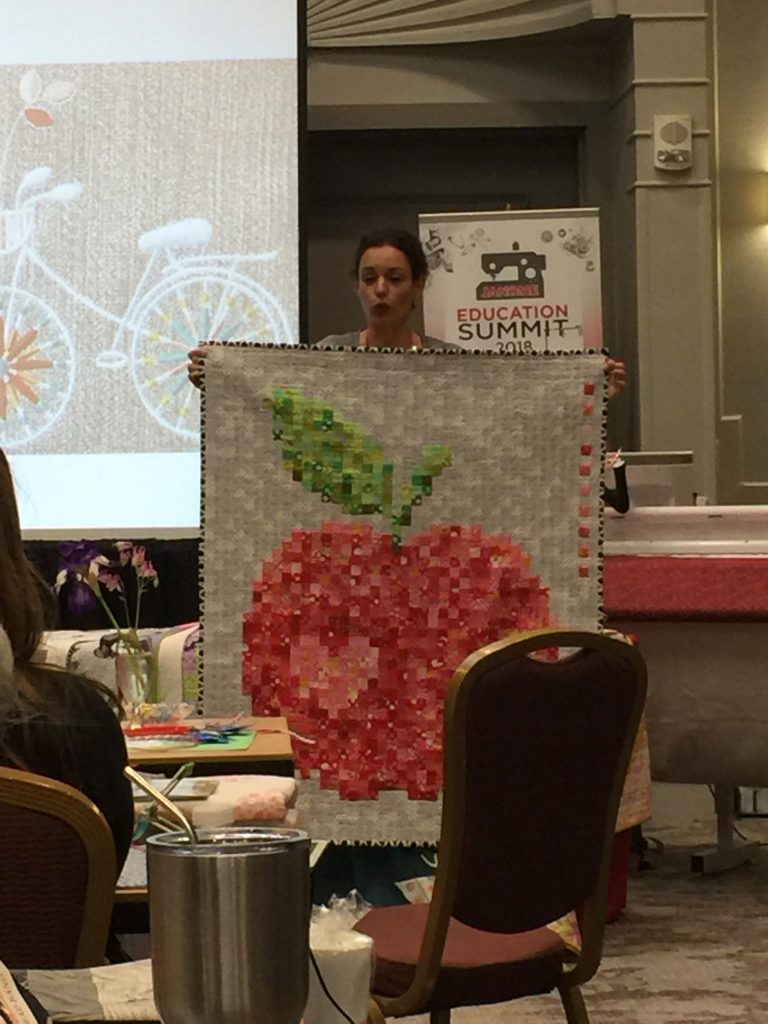
More wonderfulness from Tamara Kate; check her Quilt Tutorials page for info on the quilt above and the one below:  https://www.kayajoydesigns.com/tutorials/quilts/

I WISH I had seen the fabric and whatnot when it was available… i love the joyfulness of this quilt.

One more chance to enjoy her quilts…..Makes me want to not do the things I am supposed to be doing and just cut fabric and sew something joyful!

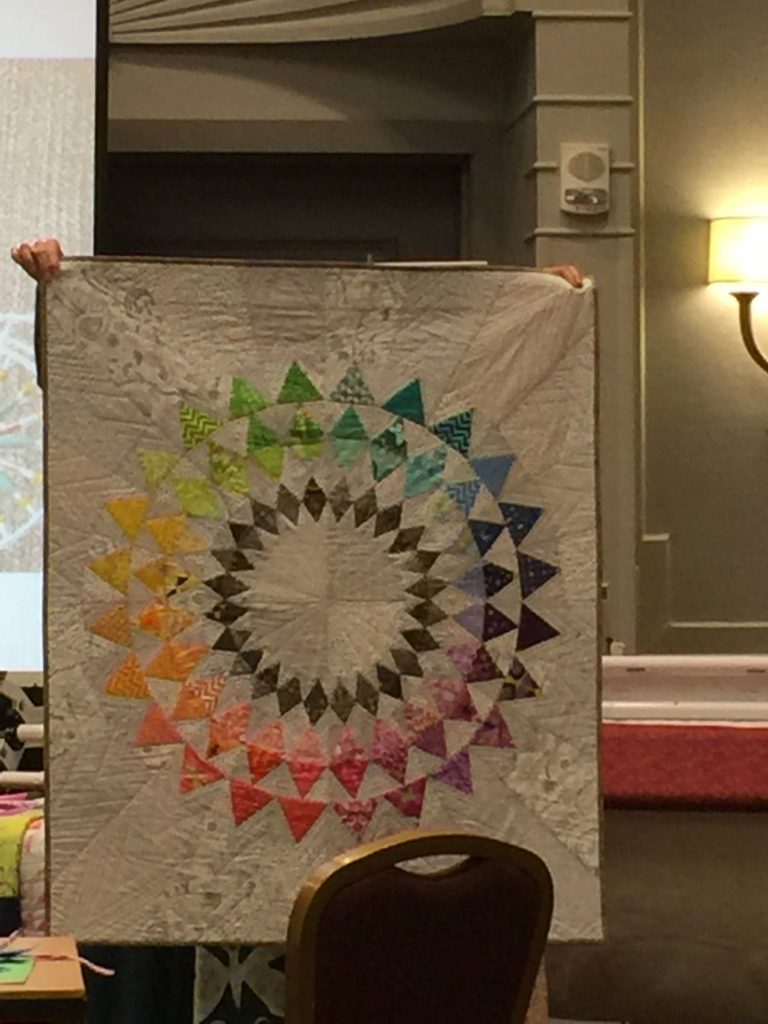
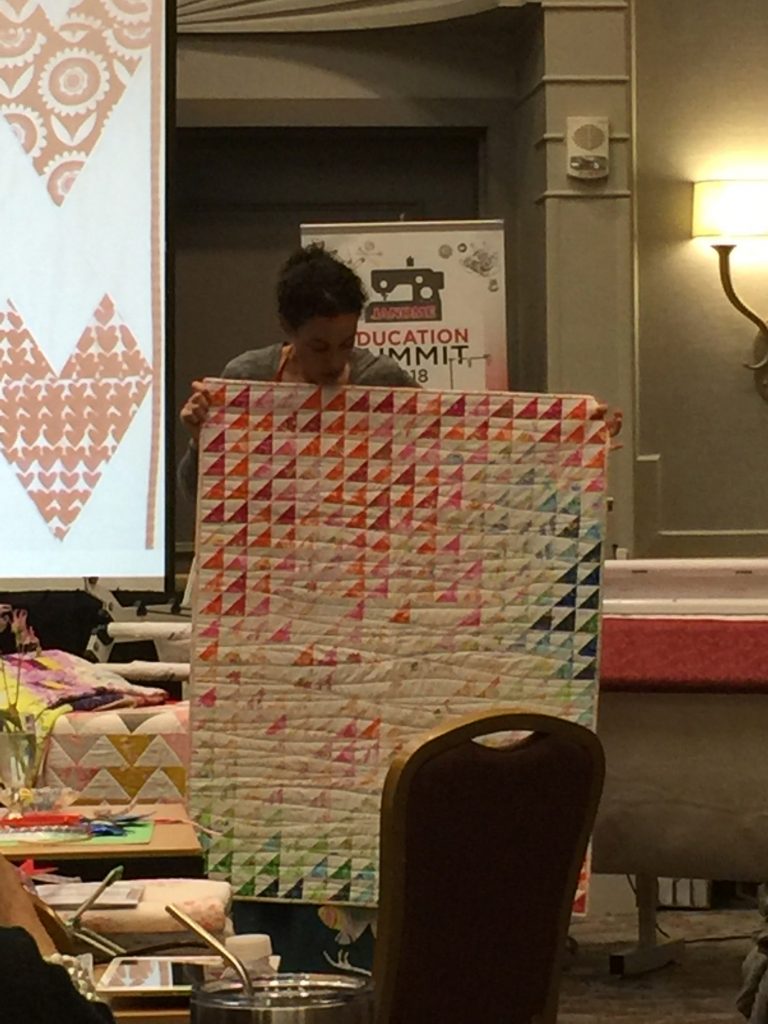
A fresh approach to half square triangles

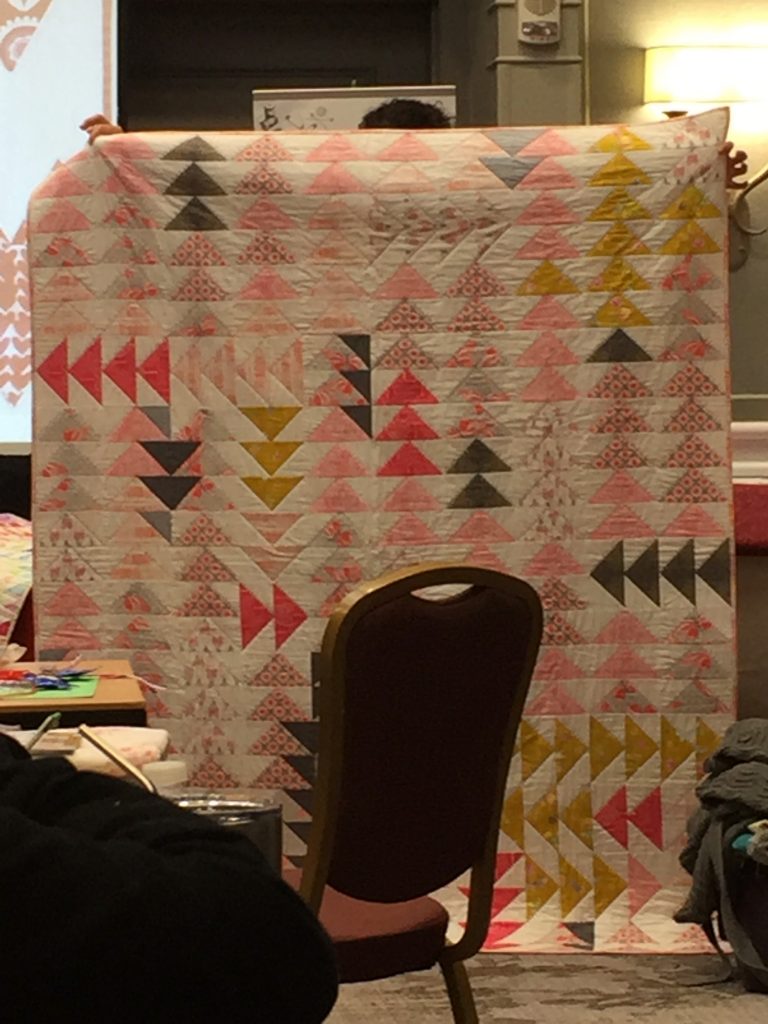
Be still my beating heart…THIS is flying geese quilt!

And Tamara Kate showing a few more of her quilts

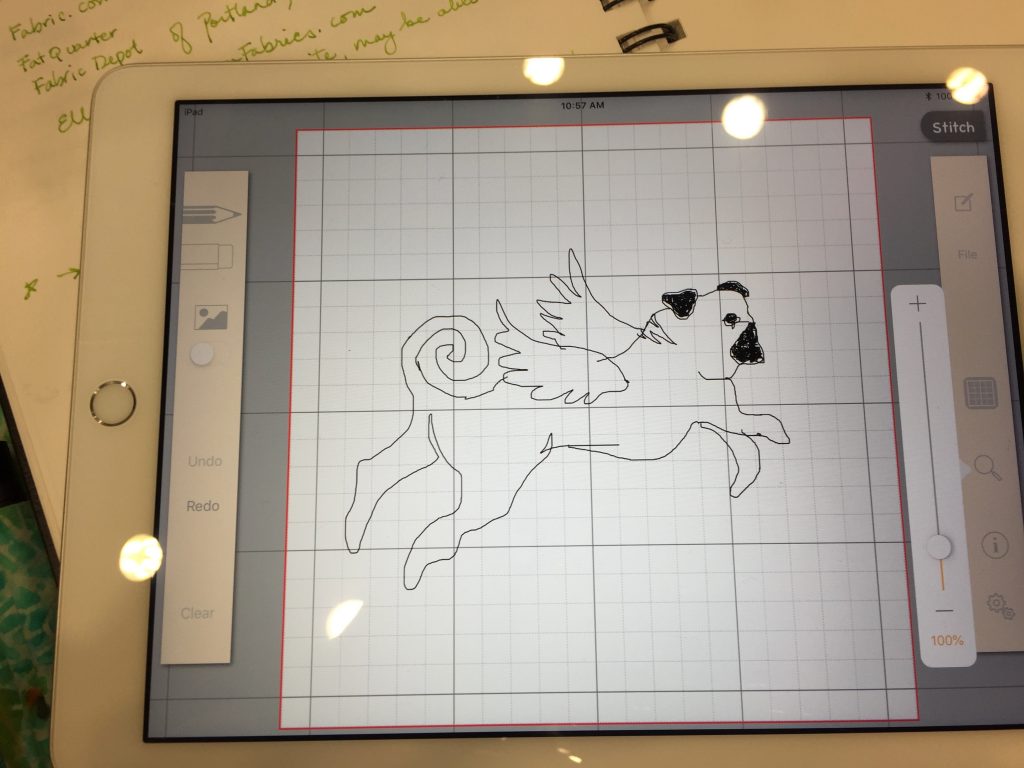
And the last pic…Janome had brought in their top of the line 15000 machines and iPads and stylus for us all to try sketching our own designs.  Due to slow wifi, we did a test-quilt (in a hoop using the embroidery module) using a pre-loaded design.  But of course I had to do a quick (and wobbly) sketch of the Flying Pug!

It was really quite easy to create a design…this was done in a rush. I’m thinking with even a little practice one could get quite fun results easily. I had a loaner 15000 machine. I’m not an embroidery person, but the machine was easy to use without special instruction and the table runner I made using it is one of my favorites.

Yep, I think I have to confess to being a total fan-girl!   More fun stuff from the Education Summit in the coming days.

SaveSave

SaveSave

She persisted/Ocean quilt published in Quiltmania

Tuesday, July 3rd, 2018

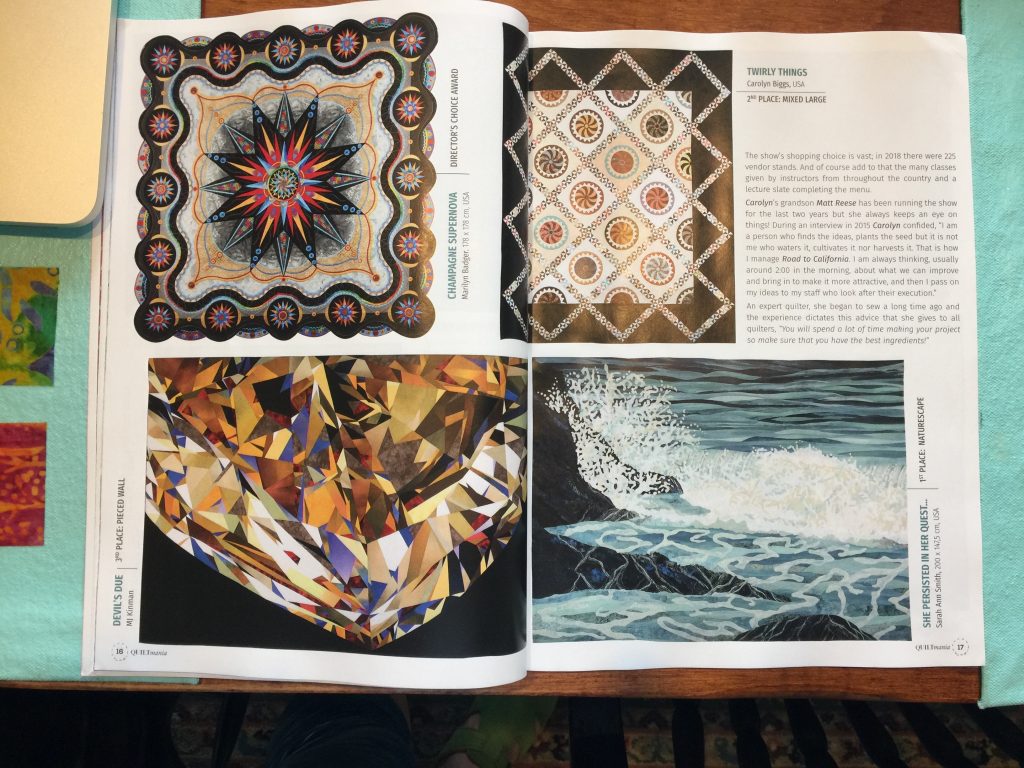
My ocean quilt, She persisted in her quest to reach the shore and sing the anthem of the sea, was one of 16 quilts featured in an article on the 2018 Road to California shows (where it won a First Place art quilt ribbon no less). The other quilts in the article are all stupendous, so I am quite blown away and honored to be included.

Thank you so much Martha Sielman, Executive Director of SAQA (Studio Art Quilt Associates) and Quiltmania! Martha emailed a couple days ago asking if I had seen my quilt, She persisted in her quest to reach the shore and sing the anthem of the sea, in Quiltmania. I had no clue and the nearest place that might (?) still have a copy of this issue is over an hour away. So Martha sent me her copy which I’ll now add to my groaning (lucky me!) shelf of published works. Sixteen quilts, all wonderful, widely ranging in style, were published from the Road to California 2018 show. I SO need to go see this show. Maybe I need to apply to teach! Thank you again, Martha!!!

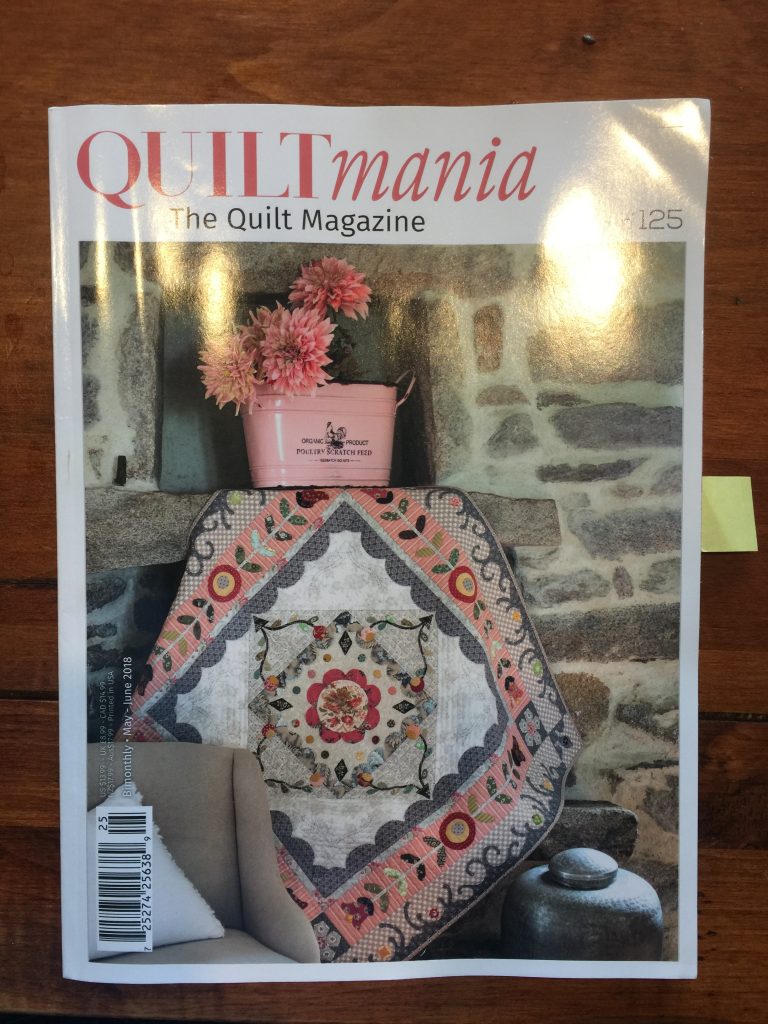
Quiltmania, a French magazine that is also published in English and available in the US

Getting ready for the next quilt….the herald of summer in Maine

Sunday, July 1st, 2018

Before I can start in on the fusing and collaging process, I find that I now need to dye fabric specifically for a project.   While working on my Lilies of the Valley Quilt, I used up most of my good “summer” greens.   My next piece is for Explorations at the New England Quilt Museum (in Lowell, Mass.), a regional SAQA (Studio Art Quilt Associates) show.  I’ve had several ideas I wanted to try for this piece, and really wanted to push myself to do something different and unexpected.  Unfortunately, those ideas are just not wanting to fit into the required vertical orientation and size required!   So I’m going to do a large piece on something I’ve been wanting to do for a while:  Maine’s lupines that bloom in late May and early June and herald the summer.

SAQA members from Massachusetts, Rhode Island, Maine, New Hampshire and Vermont were invited to submit a body of work.  If selected, artists would then make a 30×50″ art quilt featuring a specific technique.  We were advised to submit several techniques, so I suggested dyeing, fused collage and machine quilting/threadwork.   I am delighted that I am one of 24 artists selected!  There will be two exhibits of 12 artists each.  We won’t know whether we will be in the Oct-Dec 2018 exhibit or the Jan-April 2019 exhibit until the works are completed and submitted August 1.  That means I need to work FAST!

I was chosen to showcase fused collage.  The exhibit is about techniques, with in depth information and supplementary materials.  From the acceptance letter:

In the exhibit, your piece will be accompanied by a number of items, including your artist statement, a brief bio, a photo of you in your studio, and materials which explain your technique. Each artist has a 20″ x 50″ area that they can use to explain their process. You can use process photos, sample pieces, written materials, even video presentations if you can figure out how to make it work.

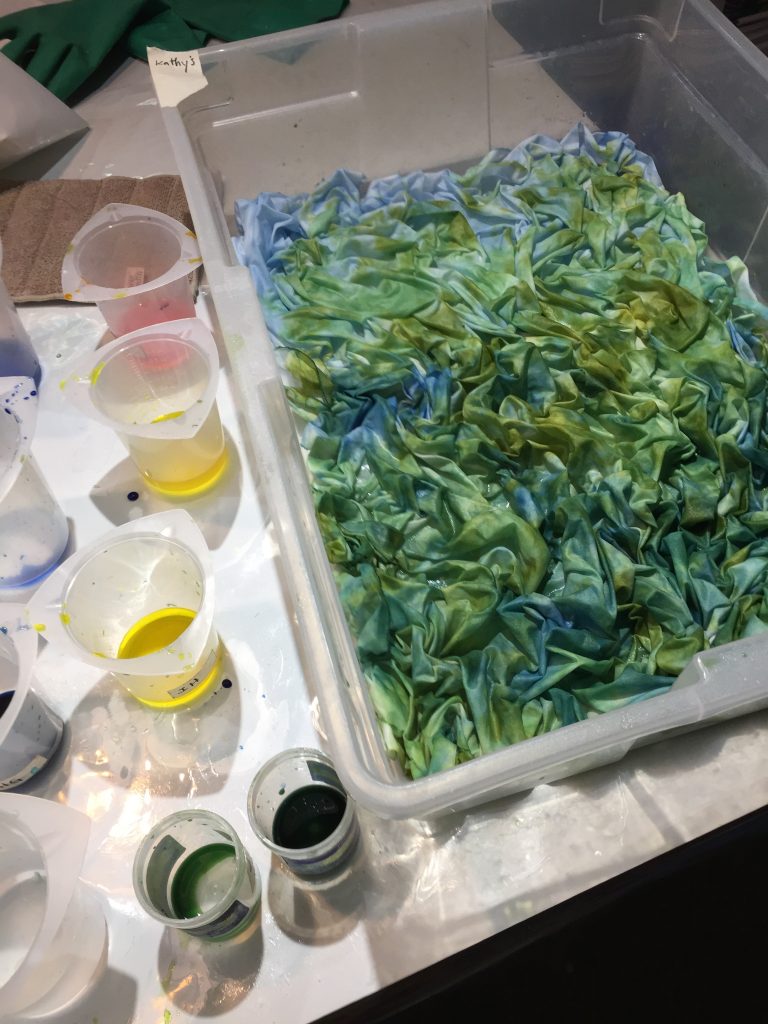
But before I can fuse, I need the right COLORS to fuse.   Some years ago I made some cloth that I gave to my friend Kathy, who used it is a fabulous portrait of her granddaughter.   I thankfully kept notes of which dyes I used, and I call this combination “Kathy’s fabric.”  This time, I decided to make it not as dark—summer meadow greens instead of piney woods greens.

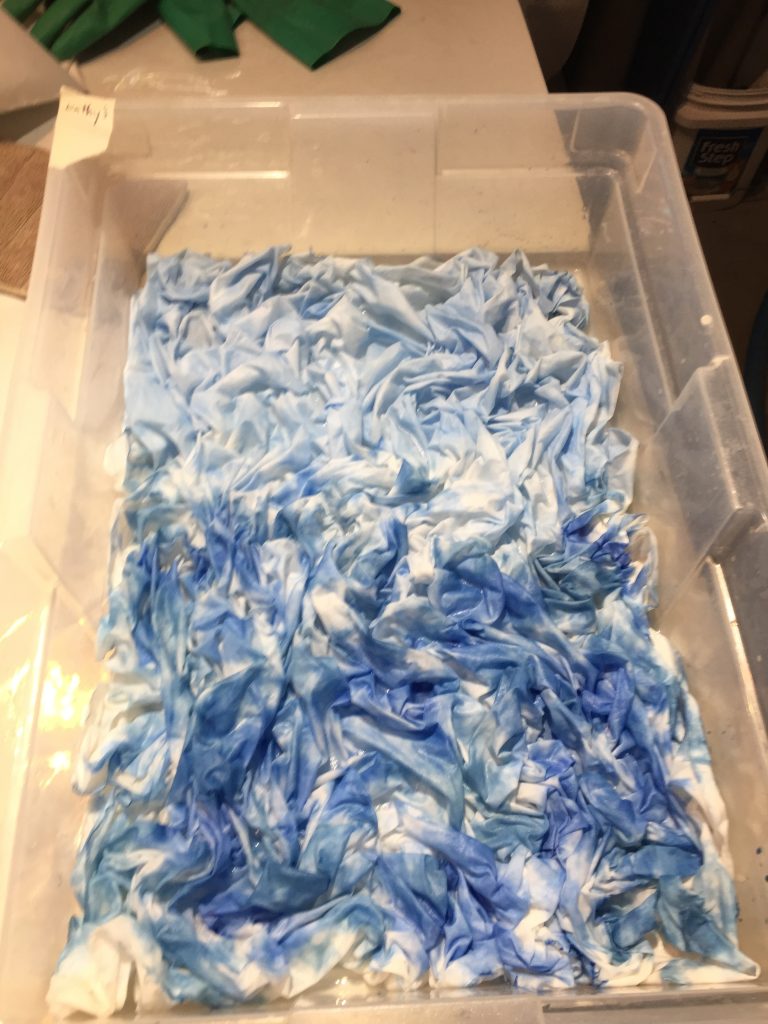
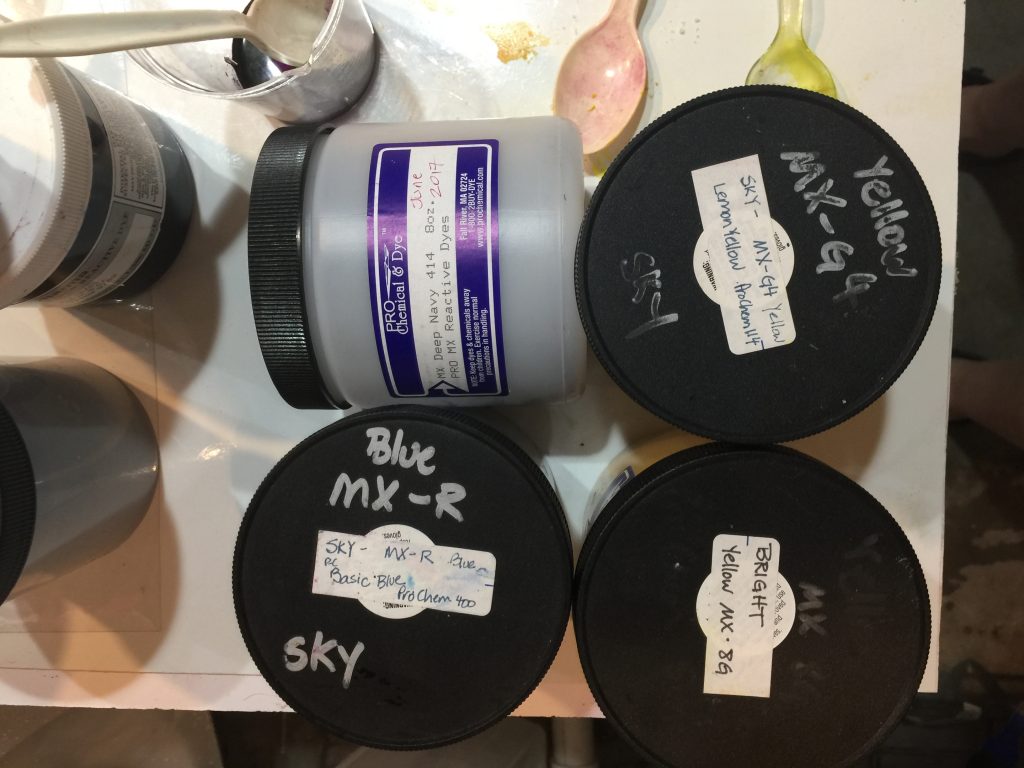
I start by dotting dye on, both navy and basic blue. I literally stick my latex-gloved fingers into the dye and daub it on. MANY classes with Carol Soderlund and many MANY yards of fabric and miles later, I can begin to predict what I will get because I tend to refer to my notes and books from the workshops, then go improv.

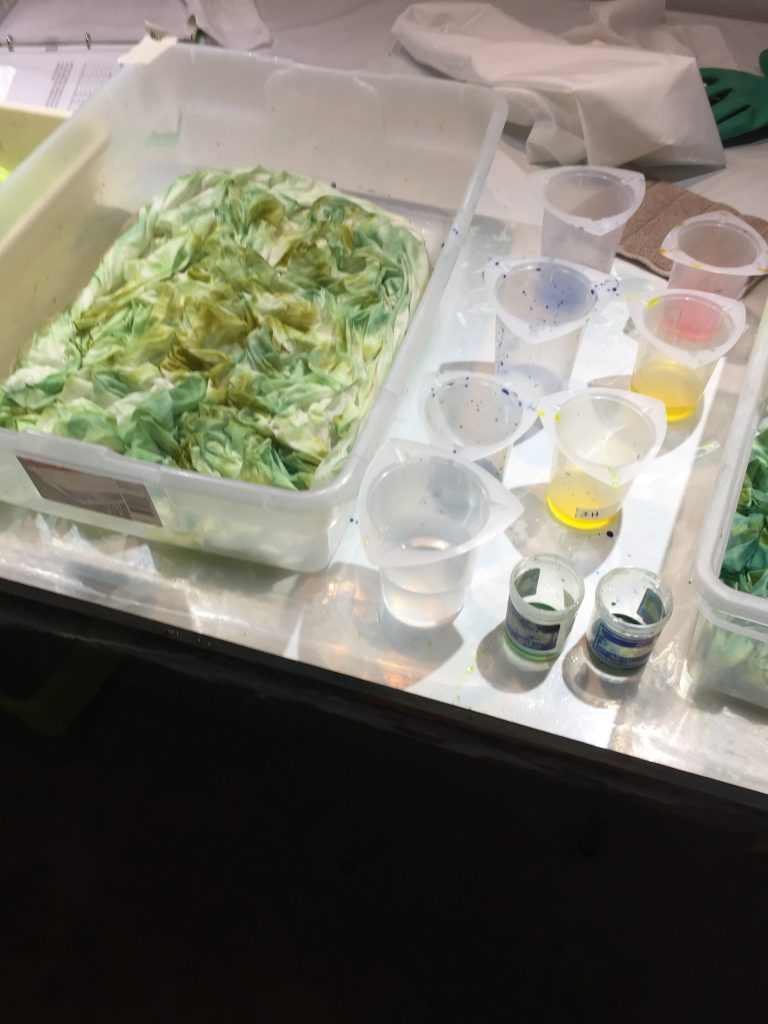
Then I add two or three yellows, because not just one will quite do what I want. Sometimes, I do a second cloth, as here, where I have actually mixed some greens instead of just doing yellow on blue.

For dye geeks, most of the time I prefer to paint dye onto cloth, then paint soda-ash/fixer solution on top, but this time I soda-soaked first, then daubed on the color.  When I want significant patterning, it’s soda-soak first.

The photo at the top of this post is the one which began with blue dots, then yellow, then greens.

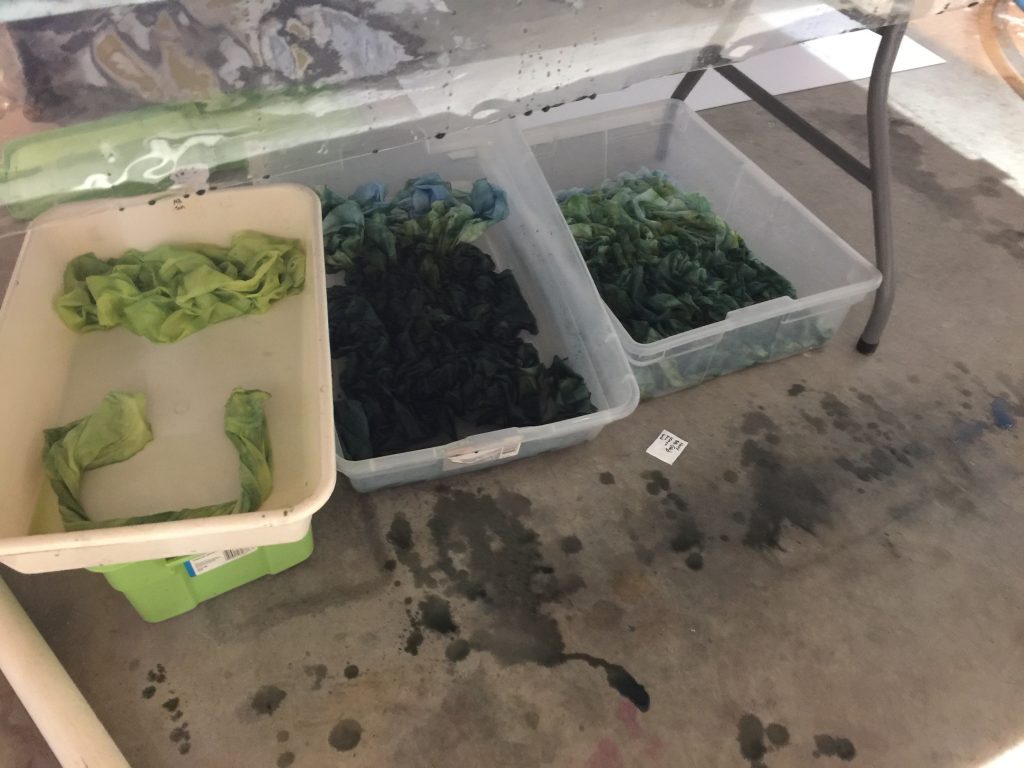
Once I’ve gotten the color on, the fabric needs to batch so it moves under the table for several hours before washout, sometimes (as this time) overnight. Had to make some of my bright spring greens, too.

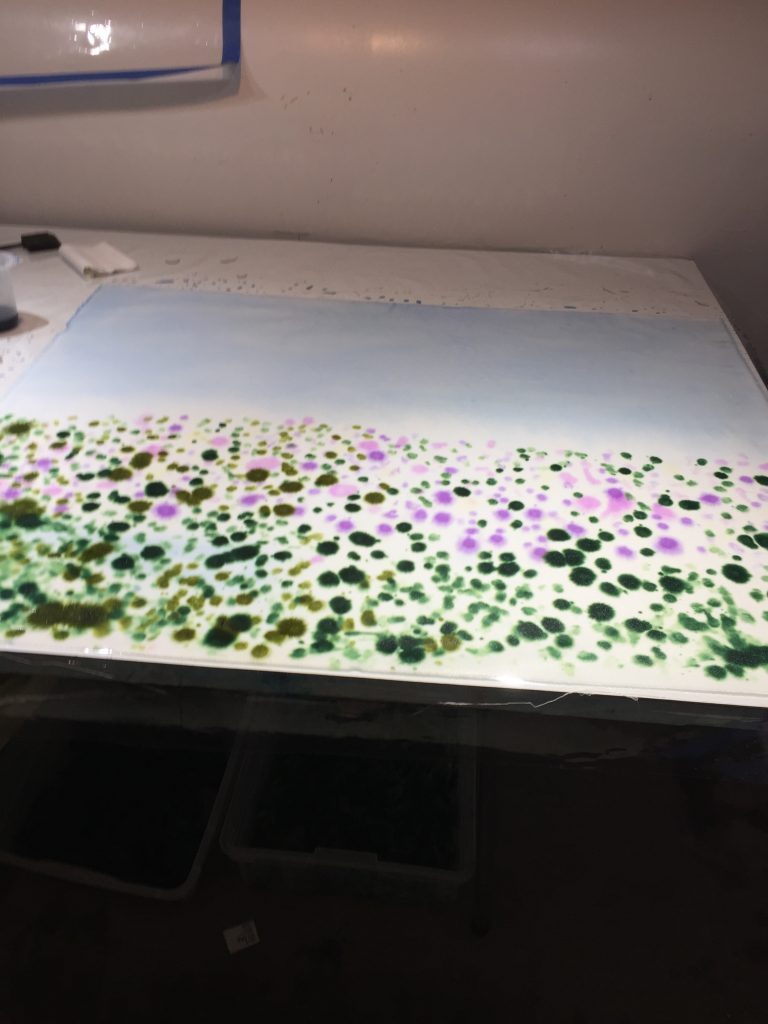
Then I decided to try to make a field with lupines in it, but blurry, to use as background at the top of the quilt.  I may have messed this one up…..

Sky at the top–good until I put some plastic over the top to batch it overnight. Apparently SOB there were stray dots of dye that didn’t get washed off properly last dyeing session. SOB.

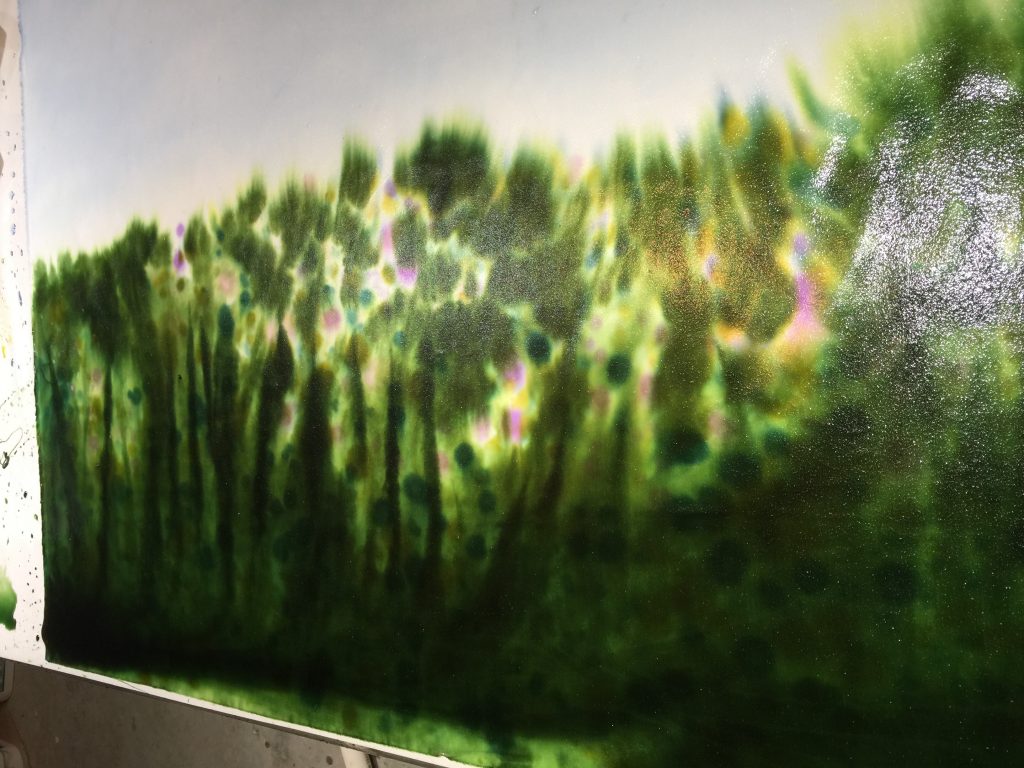
This is what it looked like about six hours later. I like the way the dye is seeping up into the sky. This is when I covered it. SOB.  And most of those dots got covered up. 

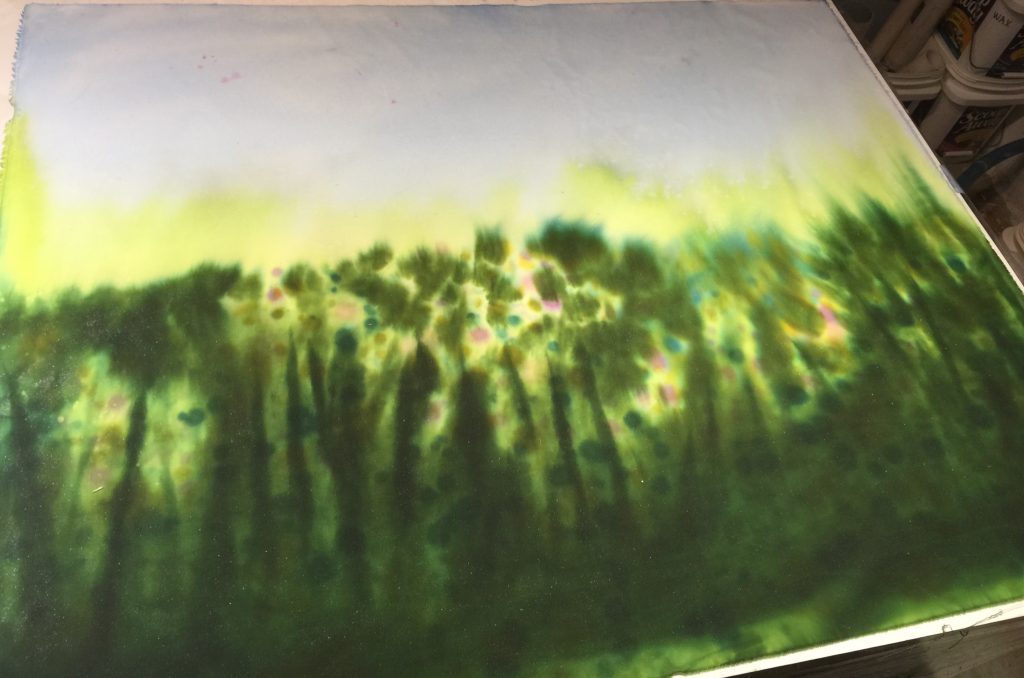
This morning when uncovered. SOB. Random specks of pink in the sky. SOB. Will have to see after washout what remains.  Cover it up with tall lupines perhaps.  SOB.

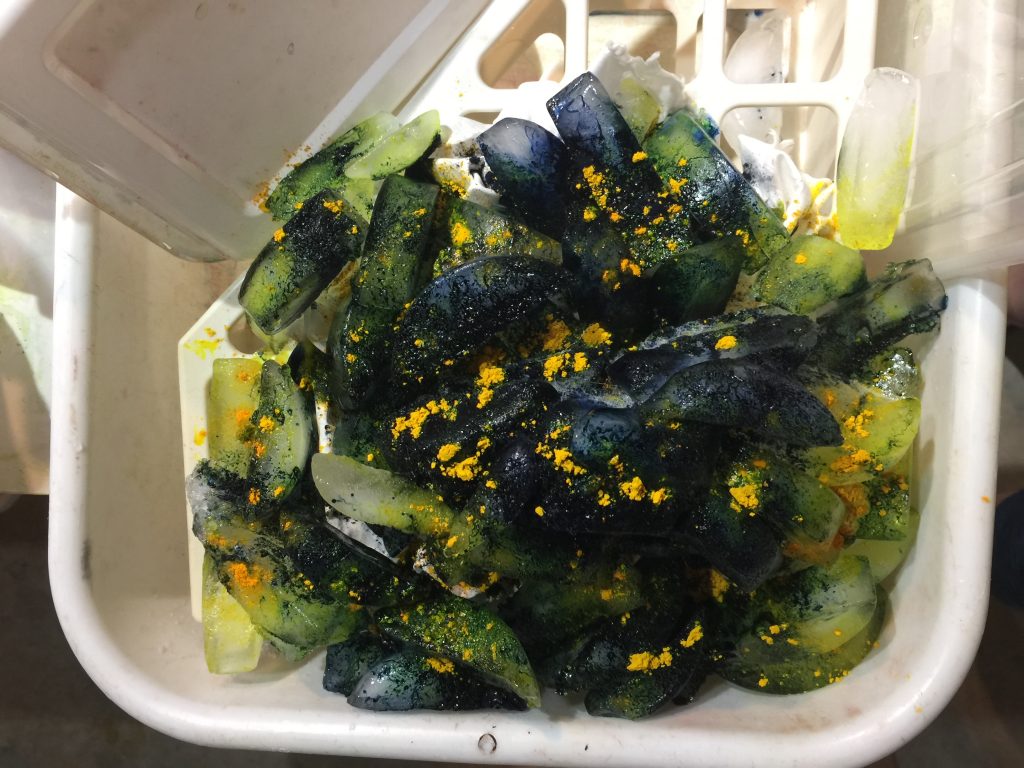
I also decided to try ice dyeing for the first time, inspired by my friend Jim Vander Noot. I used a magazine holder because it was available to keep the fabric up out of the pooling, dripping dye (instead of a screen). Put another piece of cloth in the bottom of the tub to soak up the drips. I use pure dyes, not mixes which is more typical for ice dyeing, so I kinda winged it on this one. I sprinkled the dyes in the picture below on, then dribbled some yellow dye solution I had already mixed up as well.

Dyes sprinkled on.

Today I washed out….stuff in the washer now.  OH MY I am SOOOOOOO gonna do more ice dyeing…totally hooked!   Hope they look as spectacular washed and dried as they did rinsed out!

Stay tuned for an update.

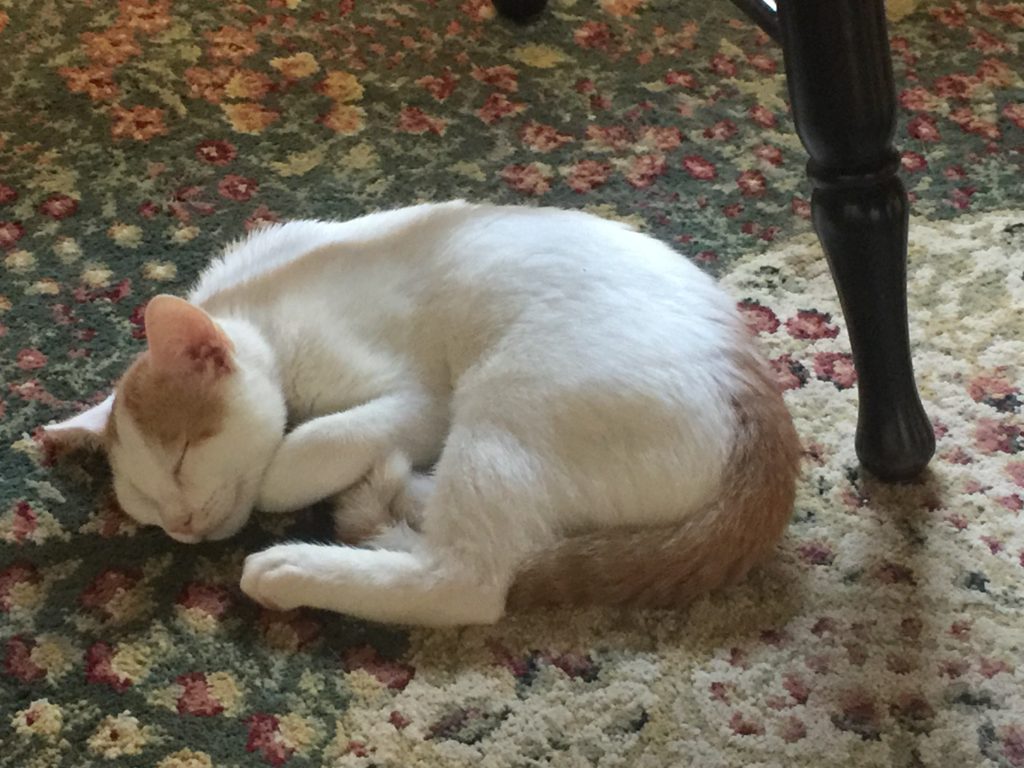
And…gratuitous cat pic of the new kitten, Zabu (named after the Leapin’ lemur on Zoboomafu which the boys watched when they were little)

Sweetness, to be followed when awake by zooming and cavorting and wreaking kitty havoc.

#saqa, #fabriccollage, #artquilt,#artistsoninstagram, #fusedfabric

#saqaexplorations, #neqmexplorations, #saqa, #neqm, #saqamari

SaveSave